“Meaning what we Say” Colchester Federated Church, October 1, 2023, (Matthew 21:23-32) World Communion Sunday
It’s good to be back with you on this World Communion Sunday. This is a day where we pray for Christian unity—for the sacrament of Communion to unite us as followers of Christ throughout the world. We give thanks to God for Christians all over our world who represent a beautiful diversity of races, ethnicities, languages, and cultures. We give thanks for Christians who may be different than us in some ways, yet Christians who are also our siblings in Christ. We may not agree on every belief and practice. Our prayers may sound different from one another and our worship services will have varied styles. Though on World Communion Sunday, we focus on an essential shared part of our faith—Communion—and the unity the Sacrament represents.
In this important act, Christians gather at Christ’s table from north and south, east and west. We break bread and we pour the cup, and we remember. We remember that the table is set for everyone who wishes to know the presence of Jesus Christ.
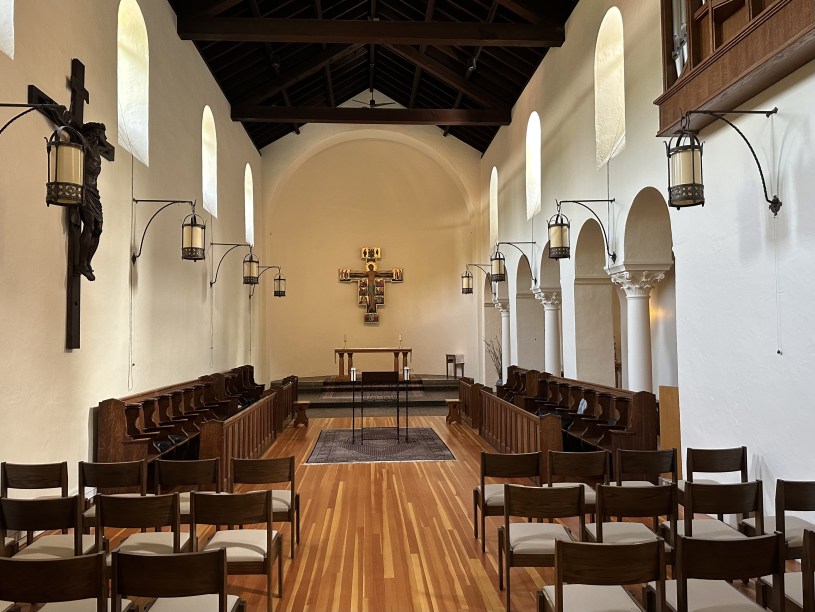
On my Sabbatical I worshiped with the monks at Holy Cross Monastery in West Park, New York and took Communion every day at the noon worship service. Now before arriving at Holy Cross for a silent retreat, I received a welcome packet with all sorts of helpful information. The materials let folks know that all baptized Christians were welcome to participate in the Holy Eucharist. Great! Though I knew that Communion with Anglican Benedictine monks would be different (as opposed to our practices and me being a lifelong member of the United Church of Christ). It wouldn’t be grape juice poured out and instead would be red wine. It wouldn’t be bread broken and shared and instead would be Communion wafers. Though I was so excited to receive the elements and focus on participating in this aspect of worship, not leading worship. I knew enough to know that Communion would be more individualistic in a way because usually a line is formed and the elements are given one by one, person by person. So, the first-time taking Communion at Holy Cross, I positioned myself strategically when the monks called us forward and we formed a circle of monks and retreatants around the altar—thinking that I would end up at the back of the line and could covertly study other people and how this would all go and not look like a complete novice.
Now one of the things that I love about Benedictine monks and nuns is the focus on hospitality. St. Benedict taught in The Rule of St. Benedict (written in the 1500s and still followed in monasteries today) that “All guests who present themselves are to be welcomed as Christ, for he himself will say, ‘I was a stranger and you welcomed me.’” This quote was literally calligraphed on a sign in the front entrance of the monastery. One of the monks greeted every guest—me included—and showed me to my room and helped with my bags and took me on a tour to make sure that I knew where everything was located since it was a silent retreat and the silence began after he wished me well.
“All guests who present themselves are to be welcomed as Christ, for he himself will say, ‘I was a stranger and you welcomed me.’”
The monks are all about hospitality. And at this particular monastery, the monks receive the Holy Eucharist last not first. Guests go first! So I had inadvertently positioned myself near the front of the line, not the back. I quickly observed how the very few people in front of me positioned their hands, but didn’t have time to consider whether I would drink the wine from the common cup or not. One of the monks offered me the blood of Christ and I drank from that common cup like everyone else in that sanctuary. Now I mean no disrespect, but I’m not sure about how sanitary this practice is given the effectiveness of wiping the brim of the cup with just a cloth napkin (and the same cloth napkin for everyone). I admit that I had a moment of, “Well, Sabbatical is going to begin with getting Covid!” That didn’t happen, thank you Jesus! However, feeling like a fish out of water in worship (as a member of the clergy) was humbling.
This experience made me go deeper about why we do what we do here at Colchester Federated Church. It made me consider how someone would feel when taking Communion with our congregation for the first time in this sanctuary. It matters that our church has an open Communion Table. Anyone can receive the Sacrament of Communion. For our congregation, this is in line with Jesus’ constant arguments with those in religious power. Jesus turned no one away, why should we? After all, at the end of his parable of the two sons that we heard in the Gospel according to Matthew Jesus says, “I assure you that tax collectors and prostitutes are entering God’s kingdom ahead of you. For John came to you on the righteous road, and you didn’t believe him. But tax collectors and prostitutes believed him. Yet even after you saw this, you didn’t change your hearts and lives and you didn’t believe him.”[1] Actions speak louder than words. We have to mean what we say.
If we say—no matter who you are or where you are on life’s journey, you are welcome here—well, we better be welcoming, right? No matter who you are. No matter where you are on life’s journey. Otherwise we’re like the son who said, “Yes, sir” when his father asked him to work in the vineyard and yet he didn’t go. He ended up being all talk and no action. We must mean what we say.
In our Christian tradition (the way we practice the tradition here at Colchester Federated Church as part of two denominations—the American Baptist Church and the United Church of Christ), we have two sacraments: Baptism and Communion. That’s it. One could argue that the way churches administer these sacraments says a whole lot about who we are and what we believe. Though this is not to say that everyone else does it wrong who doesn’t do it our way.
In fact, Bishop Michael Curry (the Presiding Bishop of The Episcopal Church) relates in his book Love is the Way: Holding on to Hope in Troubling Times that it was Episcopalians using the common cup that compelled his father to become a part of that denomination. Bishop Curry’s father went to worship at an Episcopal Church with the woman who became his wife (and Bishop Curry’s mother). His father observed that white parishioners and black parishioners drank the blood of Christ out of the same cup at a time in our country when there were separate (and unequal) facilities. Bishop Curry shares that this experience had a profound effect on his father, relating, “He would always say, ‘Any church in which Blacks and Whites drink out of the same cup knows something about the Gospel that I want to be a part of.’ And so my mother led my father down a path that he probably would never have taken for himself—love in action.”[2]
Alright, this is not to say—hey y’all I’m back from Sabbatical—let’s do Communion like the Episcopalians! Though it is to say that there is meaning behind what we do. It makes me happy that we take Communion as the united Body of Christ in this particular place in this old meeting house in Colchester, Connecticut by eating the bread and drinking the juice at the same time. When explaining our practice to children and youth, I have sometimes compared waiting for everyone to be served like we would wait for everyone to be served at a restaurant before we eat our meals. That is about having good manners and focusing on the Christian practice of hospitality. This is the Lord’s Supper. We are remembering a meal that Jesus once shared with his friends. In some mysterious way, we are also participating in that meal with Jesus. Our Deacons take the time to serve every single person and we wait until every single person is served before we eat the bread and drink the grape juice. It would go a lot faster if we served Communion differently, but would the meaning be what we are hoping to convey?
No matter who you are, no matter where you are on life’s journey—you are welcome here. Everyone is welcome at this open table. Jesus turned no one away, and neither will we. Thanks be to God. Amen.
[1] Matthew 21:31-32, CEB.
[2] Michael B. Curry, Love is the Way: Holding on to Hope in Troubling Times.
Photo by Rev. Lauren Ostrout of Holy Cross Monastery in West Park, New York.
 Lauren Ostrout ~ on being made well