“Chosen” Colchester Federated Church, October 15, 2023, (Matthew 22:1-14) Twentieth Sunday after Pentecost
Ah, weddings. People have lots of opinions about weddings. As soon as a couple announces their engagement, the questions start coming (questions from loved ones and questions you start asking yourselves as a couple planning your nuptials). Questions like—when should the wedding be held? Where should the wedding occur: in a house of worship or a venue or outside in nature? How many people should we invite? Is this an elopement, micro wedding, minimony, small wedding, medium wedding, or large wedding? Should the wedding be simple or extravagant, close to home or a destination wedding? What is the theme of the wedding and the colors and the flowers and the menu and the cake flavor and the wedding dress style? There’s a lot to figure out when it comes to weddings.
There are wedding traditions that are culturally significant. Many Indian weddings famously last from three to five days. And because of the cultural significance of weddings, it’s no surprise that weddings show up a few times in the Gospels. Perhaps the most famous example is Jesus turning water into wine at a wedding in Cana. Jesus and his mother are attending a wedding. Soon there’s trouble—the wine runs out. Mary turns to Jesus and says, “They don’t have any wine.” Jesus responds, “Woman, what does that have to do with me? My time hasn’t come yet.” Jesus probably just wanted to be a wedding guest. Though Mary looks right past her son to the servants and says, “Do whatever he tells you.”[1] Mary issues a challenge, and Jesus turns a whole lot of water into a whole lot of wine in his first of seven signs in the Gospel according to John.
This wedding story is a story of abundance. If we do the math (and others have done the math, so I’m just reporting back)—Jesus turns 6 large stone water jars that were used for the Jewish cleansing ritual into around 1,000 bottles of good wine. John is telling us something about Jesus’ life and teachings when he shares this sign—something about the abundance of love and grace that Jesus shared with those he loved. Later in the Gospel Jesus says, “I came that they may have life, and have it abundantly.”[2]
Hospitality and honor were culturally important in Jesus’ day. Preaching Professor Karoline Lewis reminds us that weddings lasted for around a week and an abundance of wine was expected until the end of the celebration. When the family in Cana ran out of wine at the wedding, it reflected poorly on them. Their resources were on display for all to see and clearly their resources didn’t go far enough to be gracious hosts. Wine was a staple of the Middle Eastern diet, so running out of wine at a wedding was deeply embarrassing. This family would have felt like terrible hosts which led to shame in their cultural context.[3] Jesus’ miracle at the wedding in Cana can be seen as a miracle of abundance and a miracle of compassion to help this family be hosts with the most!
With this context in mind, Jesus tells a parable about a wedding party in the Gospel according to Matthew. Just like last Sunday—we are still in the Temple on the Tuesday of Holy Week. Jesus is still teaching the crowds who think he is a prophet and the chief priests and scribes who would like to arrest him for challenging their authority. Jesus goes from teaching the parable of two sons to the parable of the tenant farmers to this parable of the wedding party. It’s hard to not admire Jesus’ courage to keep teaching about the kingdom of heaven considering the overt hostility he’s facing.
Jesus says that the kingdom of heaven is like a king who prepared a wedding party for his son. The king sends out his servants to gather the wedding guests, only they don’t want to come. The king sends out more servants to say to those invited (on his behalf), “Look, the meal is all prepared. I’ve butchered the oxen and the fattened cattle. Now everything’s ready. Come to the wedding party!”[4] But the guests pay the servants no attention. Some go back to their fields. Some go back to their businesses. Apparently, some folks grab the servants, abuse them, and kill them (just like what happened in the parable of the tenant farmers). It’s an extreme reaction to not wanting to go to a wedding. A simple RSVP “no thank you” would suffice! The king obviously gets upsets, so much so that the king sends soldiers to destroy the murderers and set their city on fire.
After that’s handled, the king tells more of his servants, “Go to the roads on the edge of town and invite everyone you find to the wedding party.”[5] The invitation to the wedding of the king’s son is being extended far and wide. Thinking about the cultural expectations of hospitality at a week-long wedding, the king is being a generous host on a whole different level here. Think of all the food and wine the king will need to provide for everyone who attends the wedding party to be able to eat, drink, and be merry for a week! If the servants were on the roads on the edge of town, there would be all sorts of people there. Jesus explains in the parable, “Then those servants went to the roads and gathered everyone they found, both evil and good.”[6] Everyone is included. The wedding party becomes full of guests. This is a large wedding celebration! It would be great to just stop there because this is the perfect image of the kingdom of God where everyone is invited, everyone is included. If you don’t want to respond to the invitation, that’s fine. But we’re going to keep extending the invitation—and we’re even going to go to the roads on the edge of town (the margins) and invite people who may not often receive invitations to fancy weddings.
But then the king kicks out one of the guests who wasn’t wearing wedding clothes. This seems unfair because it’s not as if the person was prepared to go to a wedding. Can we blame them for not dressing appropriately after receiving this last-minute invitation? Though “wedding clothes” may represent a fruitful life that is devoted to the will of God, obeying what God has intended for us. Just like hospitality was big in the ancient world and could result in shaming someone who wasn’t a gracious host, clothing was also significant in the ancient world. Sometimes clothing (for better or worse) was perceived to reflect a person’s character. In Paul’s Letter to the Romans we read, “Dress yourself with the Lord Jesus Christ” or in Galatians we read, “All of you who were baptized into Christ have clothed yourselves with Christ.”[7] The king is upset because the guest is perceived as being disrespectful. Jesus ends the parable with the king saying, “Many people are invited, but few people are chosen.”[8]
The idea being that the invitation must be accepted. People must be faithful to the will of God. Context matters whenever we read the Bible. Historical context as well as the literary context of whatever story we happen to be contemplating. Remember that Jesus is speaking to the crowds (people who may have come from the roads on the edge of town) and the religious leaders (who probably would have received an invitation in the first place and just didn’t want to come). This parable is comparing God’s kingdom (where Jesus taught that the first would be last and the last would be first) to a wedding party where literally the guests show up from the edge of town.
To me this is a story about the power of an open invitation, an invitation from one’s heart. That invitation can come from our families or friends. That invitation can come from God. Invitations can be mundane or life-changing. From, “Would you like to go to dinner with me?” to “Will you marry me?” From, “Follow me” to “Come to the wedding party!” Invitations accepted out of resentful obligation or fear, or wondering what people will think will often not turn out great in the end. “Many people are invited, but few are chosen.” We choose how we respond to the invitation, to God’s call in our lives. Fear only gets us so far. Love is what lasts. Thanks be to God. Amen.
[1] John 2:1-5, CEB.
[2] John 10:10, NRSV.
[3] Karoline Lewis, John: Fortress Biblical Preaching Commentaries, 36.
[4] Matthew 22:4, CEB.
[5] Matthew 22:9, CEB.
[6] Matthew 22:10, CEB.
[7] Romans 13:14 and Galatians 3:27, CEB.
[8] Matthew 22:14, CEB.
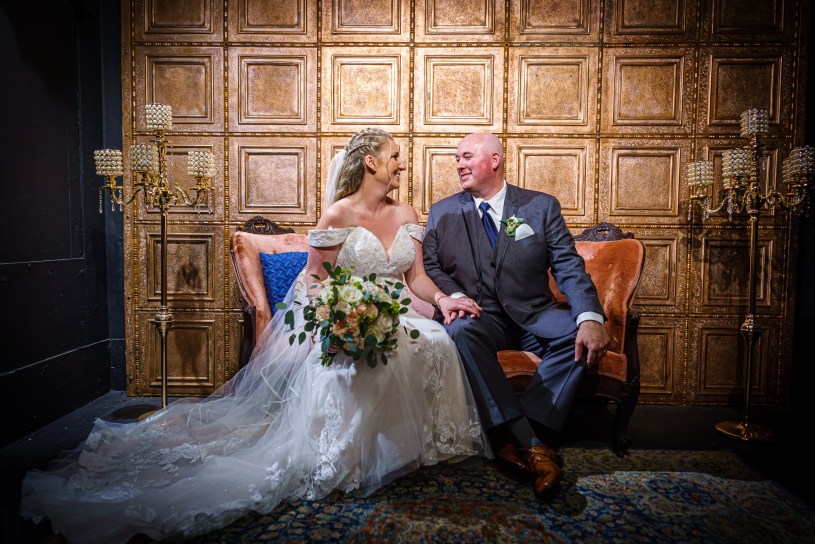
Wedding Photo of Rev. Lauren & Neill Ostrout by David Butler.
 Lauren Ostrout ~ on being made well