“Keeping the Commandments” Colchester Federated Church, October 29, 2023, (Matthew 22:34-46) Reformation Sunday
Today is Reformation Sunday. In Protestant churches we often celebrate the Protestant Reformation on the last Sunday of October. It’s a day where we remember that the Christian Church is at our best when we are open to the dynamic movements of God. As we like to say in the United Church of Christ, God is still speaking. It’s up to God’s people in each generation to discern where the Holy Spirit might be leading us. We are called to be a reformed and reforming church.
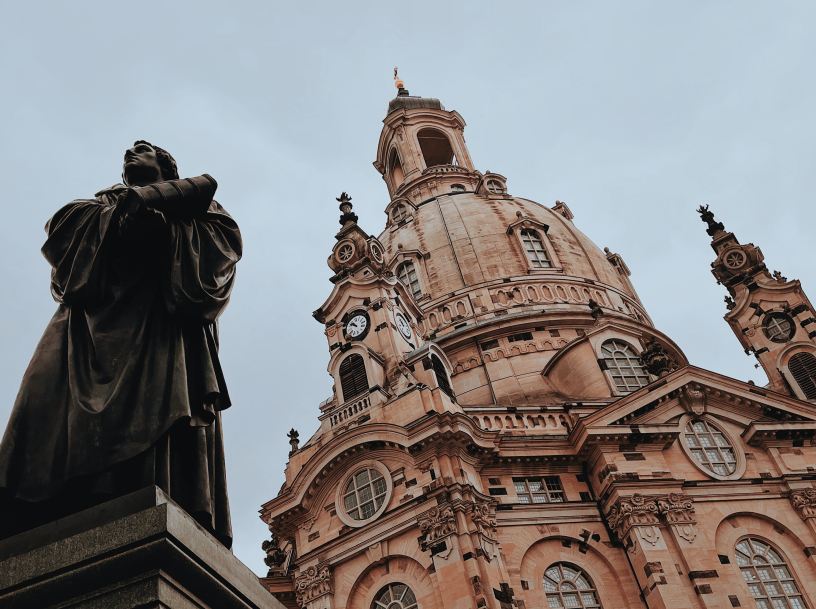
When Martin Luther nailed his 95 Theses to the door of the Wittenberg Castle Church on October 31st in 1517, he didn’t know that this would lead to a split within Christianity and the formation of hundreds of Protestant denominations. Martin Luther was a Roman Catholic priest and professor of theology at Wittenberg University. Therefore, we can think of his critique as a critique from within the ranks. Luther was opposed to the Catholic Church selling papal indulgences for the forgiveness of sins. People would literally give what little money they had to the Church so that their sins would be forgiven and they would supposedly be guaranteed a place in heaven. A quote was going around in Medieval Europe (credited to the papal agent Johannes Tetzel), “When the coin in the coffer rings/the soul from purgatory springs.”[1] St. Peter’s Basilica was being constructed at this time in Rome, and that glorious basilica was funded in part from the sale of indulgences.
So the poor kept getting poorer, and the Church and its leaders kept getting richer. Martin Luther saw this corruption for what it was and felt that the leaders of the Church were becoming further removed from their own flock. He wanted to do something about this. Luther posted the 95 Theses as an invitation to have a scholarly debate on selling indulgences. Remember that he was a professor of theology and the theses were written in Latin! But people in power don’t always react well when motivations are questioned. That is as true today as it was in 1517.
Martin Luther’s convictions led to five Latin phrases being used during the Protestant Reformation that codified the beliefs of the Reformers. The first was Sola Fide: by faith alone. The idea that salvation came through faith not works or the sale of indulgences. Sola Scriptura: by Scripture alone. Protestants argued that the Bible is the sole source of authority for Christians, not tradition or the Pope. Solus Christus: through Christ alone. Jesus is the one who offers access to God, not priests or any other clergy for that matter. This idea would develop into the priesthood of all believers. Sola Gratia, by grace alone. Salvation comes from what God has done, there’s nothing we can do to earn God’s grace. And finally, Soli Deo Gloria: glory to God alone. Our goal as Christians is not to please church leaders, keep a list of rules, or look after our own interests. We live as Christians to glorify God alone.
Now why should we contemplate the Protestant Reformation that happened almost five hundred years ago (besides your history-loving pastor thinking you must be as interested in this subject matter as I am)? Well, because we aren’t done reforming. The Christian Church remains in need of reformations over and again. After all, the simple meaning of the word “reform” is to make changes in something in order to improve it. Usually it’s something social, political, or economic. In our country we talk about education reform or prison reform, legal reform or justice reform. Do we think that the Protestant Reformation happened 506 years ago so we’re all good in the Christian Church and nothing more needs to be done? No changes need to be made in order to improve what we’re doing? Of course not!
It’s worth remembering the continual need for reformation in the Church by thinking about the impact of Martin Luther. Luther suffered because of his beliefs. He was declared a heretic and excommunicated, he was outlawed in the whole Holy Roman Empire. Luther had to stand trial and would not retract the beliefs he had shared in his writings. Luther famously declared, “Here I stand, I can do no other.”[2] The irony is that in time the Roman Catholic Church had a Counter-Reformation and wrestled with some of these same practices that Luther called into question. One could argue that the Christian Church (let alone individual local churches) do well to intentionally consider who we are and what’s our purpose from time to time. Reformations are necessary.
One of the books that I read during my Sabbatical was Bob Smietana’s Reorganized Religion: The Reshaping of the American Church and Why It Matters. Smietana is a veteran religion reporter and has done in-depth reporting for various news outlets. He writes about how in the past organized religion was powerful and well-respected in our society. Christianity had a place of honor. Things have changed. Our county is multi-ethnic, pluralistic, more egalitarian, and the fastest growing religious group in the country are those who claim no religious affiliation at all. Though he writes from a place of hope and shares that there are congregations that persist despite the enormous challenges and uncertain futures. Smietana relates, “They persist in part because congregations offer two key benefits: a sense of community and belonging for those who are part of the church, offering reassurance that they are not alone, no matter what they face, and a sense of mission to rally around, which is devoted to helping their neighbors in their hour of need.”[3] Even though we are in the midst of unprecedented societal changes, congregations are persisting. Let’s take heart that it’s not all doom and gloom in the American religious landscape of 2023. Congregations are unique in that we can provide a sense of community and belonging and a sense of mission, truly helping our neighbors.
It’s wonderful that the Lectionary Gospel text for today from the Gospel according to Matthew is Jesus sharing the greatest commandment in the Law. When a legal expert questioned him about this, Jesus responded, “You must love the Lord your God with all your heart, with all your being, and with all your mind. This is the first and greatest commandment. And the second is like it: You must love your neighbor as you love yourself.”[4] Jesus combined the commandment to love God from Deuteronomy and the commandment to love your neighbor from Leviticus. Jesus was asked to identify what the greatest commandment was and instead Jesus places these two commandments side by side—love of God and love of neighbor. For Jesus you need both to understand what God has in mind for humanity. It is next to impossible to practice the Christian faith in complete isolation. Because we are called to love God with everything we are and everything we’ve got and to love our neighbors as ourselves. Loving our neighbors helps us love God. Loving God helps us love our neighbors. May we always be a re-forming faith community that prioritizes community and belonging and love. Thanks be to God. Amen.
[1] David B. Morris, “Martin Luther as Priest, Heretic, and Outlaw: The Reformation at 500,” The Library of Congress European Reading Room, https://www.loc.gov/rr/european/luther.html
[2] Morris, “Martin Luther as Priest, Heretic, and Outlaw: The Reformation at 500,” The Library of Congress European Reading Room, https://www.loc.gov/rr/european/luther.html
[3] Bob Smietana, Reorganized Religion: The Reshaping of the American Church and Why It Matters, pg. 9.
[4] Matthew 22:37-39, CEB.
 Lauren Ostrout ~ on being made well