On December 17th, the Third Sunday of Advent, I preached the following:
Recently, I was delighted to find a beautiful (and unique) Advent Candle Lighting liturgy that was written by Susan Lukey of the United Church of Canada. The liturgy is called “The Dance of Dark and Light.” The refrain that we have been hearing as a congregation throughout Advent is, “Light and dark, friends and companions. One cannot exist without the other.” I just love that. She writes about the beautiful dance that takes place between dark and light.
Today members of our Discipleship Class read from this Advent liturgy, “Imagine the northern lights, greens and blues, oranges and reds, leaping and swirling across the dark northern sky. Northern lights dancing as night falls and cold embraces the earth. Darkness makes possible the wonder of northern lights. Colourful displays held in the beauty of darkness.”*
If there’s one natural phenomenon that I have always wanted to witness in person, it’s the northern lights. The northern lights (or aurora borealis) are a colorful display of light that can be seen in the night sky where we live in the northern hemisphere. The auroras that occur in the southern hemisphere are the southern lights (or aurora australis). Both the northern lights and southern lights are polar lights since they occur near the magnetic poles of the earth. There was a good article about auroras from the Canadian Space Agency, and since the Advent Candle Lighting Liturgy came from the United Church of Canada it seemed on point to stick with the Canadians for sermon research and writing this week!
Anyway, our Canadian friends explain, “Auroras occur when charged particles (electrons and protons) collide with gases in Earth’s upper atmosphere. Those collisions produce tiny flashes that fill the sky with colourful light. As billions of flashes occur in sequence, the auroras appear to move or ‘dance’ in the sky. Earth’s magnetic field steers the charged particles towards the poles. The shape of Earth’s magnetic field creates two auroral ovals above the North and South Magnetic Poles. That is why auroras occur almost every night in the northern sky, from August to May.”** Maybe you knew all that. Though knowing that what we are witnessing is collisions of electrons and protons with gases in the upper atmosphere of our earth and these collisions produce flashes that fill the night sky with colorful lights, isn’t that amazing?
Here’s the thing, it is the darkness of the night sky that makes it possible for you and I to witness the wonder of the northern lights (even if only in photos for now). Light and dark, friends and companions, one cannot exist without the other.
——————————————————
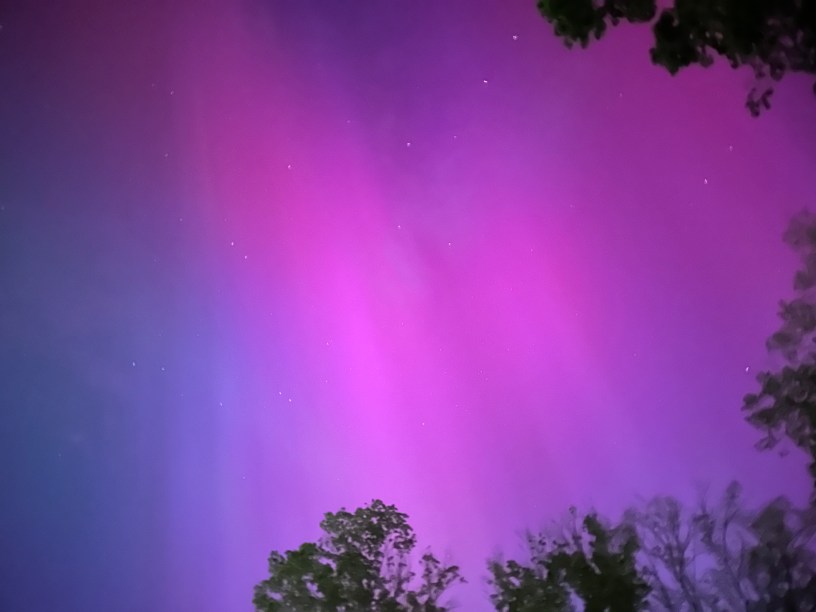
It was incredible to witness auroras dancing across the night sky right in our own backyard.
A dream come true.
We live in a beautiful world!
Love,
Pastor Lauren
*“The Dance of Dark and Light” written by Susan Lukey. Used with permission. The United Church of Canada.
**“What are the northern lights?” The Canadian Space Agency, https://www.asc-csa.gc.ca/eng/astronomy/northern-lights/what-are-northern-lights.asp
Photos by Rev. Lauren Ostrout, The Northern Lights in Connecticut on 5/10/24
Thursday Thoughts 5/16/24

 Lauren Ostrout ~ on being made well