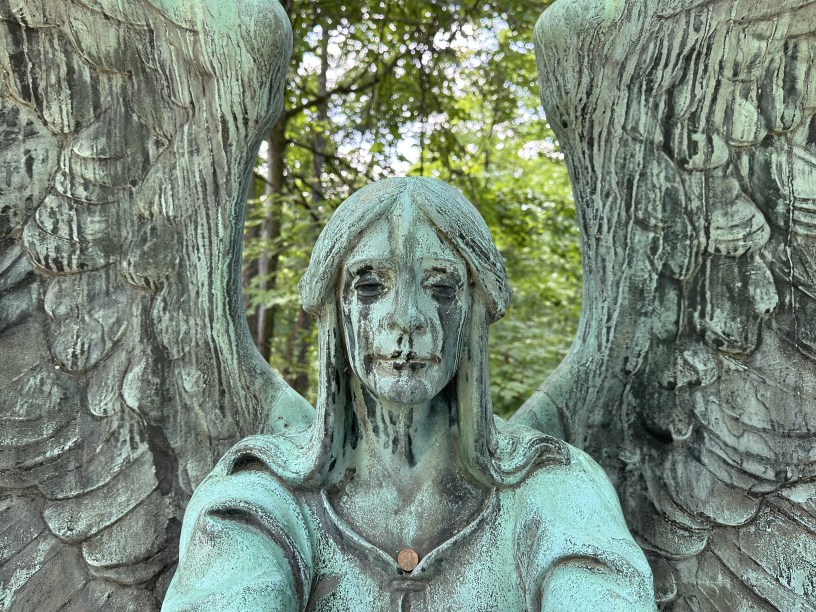
“Praising God” Colchester Federated Church, November 3, 2024, All Saints Sunday (Psalm 146)
This morning, we hear the sweeping words of the Psalmist as God is praised. The Psalmist tells us that their whole being praises God. God is praised with our lives and we can sing praises to God for as long as we live. Psalm 146 (this is the Lectionary Psalm) takes a turn when the Psalmist tells us to not trust leaders and human beings for our salvation. Because the day will come when “their breath leaves them, then they go back to the ground. On that very same day, their plans die too.”[1] Human rulers come and go. We make plans and God laughs. Though God is our Creator, Sustainer, and Redeemer with a more expansive view of history and time than we can even begin to comprehend.
Thus, we are invited to praise God with our whole being and our whole life, which suggests deep and abiding trust. That level of trust can be placed in God alone. Because God is God and we are not. The Psalmist proclaims, “The person whose help is the God of Jacob—the person whose hope rests on the Lord their God—is truly happy! God: the maker of heaven and earth, the sea, and all that is in them, God: who is faithful forever, who gives justice to people who are oppressed, who gives bread to people who are starving! The Lord: who frees prisoners. The Lord: who makes the blind see. The Lord: who straightens up those who are bent low. The Lord: who loves the righteous. The Lord: who protects immigrants, who helps orphans and widows, but who makes the way of the wicked twist and turn! The Lord will rule forever!”[2] Praise God!
These are hopeful words from the Psalmist. The words are true and a good reminder that we cannot place our trust fully in any leader. We know that human beings are finite beings with a limited number of days on this Earth (including us). Though it is also true that there are people who give us hope, people who inspire us. There are people who teach us how to love one another and who help those who are bent low. This is part of what we acknowledge and celebrate on All Saints Sunday.
We remember that this special day in the Christian liturgical calendar is typically celebrated on the first Sunday in November. All Saints developed because there were so many saints and martyrs remembered in the Roman Catholic Church that the Church ran out of days in the calendar. The solution was to designate November 1 as the day to commemorate all the saints who couldn’t have their own individual dates and the saints whose names may have been forgotten in some corners of the Church over the years. Traditions developed so that all canonized saints are commemorated on November 1 and all the departed faithful are commemorated on November 2—All Souls Day.[3]
Perhaps we are also familiar with the Day of the Dead (Dia de los Muertos) which is traditionally celebrated on November 1 and 2. It’s a holiday that takes place over multiple days and is widely observed by people of Mexican heritage. Family and friends gather to pay their respects and remember loved ones who have died. Sometimes the celebrations can be light-hearted as people lift up events and memories that are amusing. Home altars get built and marigold flowers abound and favorite foods and drinks of the dearly departed are offered. The Day of the Dead is a celebration of loved ones who have come and gone, yet whose memories are kept alive by telling stories. All Saints. All Souls. Dia de los Muertos. There are unique traditions associated with remembering and honoring those who have gone home to God before us at this time of year in particular.
For Protestants like us, All Saints Sunday is not just about remembering the famous figures of the Church. We don’t just remember saints who have already been set aside and designated as holy in the Christian tradition if you will. Instead, we tend to focus on those people we have personally known and loved and lost. We read the names and acknowledge those on our hearts. We praise God for the holy in the ordinary, for the lives of believers in our time. We often focus on our families and friends—naming and honoring those souls we have commended to God.
All Saints Sunday sometimes revolves around giving thanks for any person who has been influential in our spiritual formation and growth. This week I was reflecting that one of the first people to teach me about prayer was one of my childhood Sunday School teachers at Trinity UCC in Wadsworth, Ohio—Mrs. Baxley. I recall that we were talking about prayer and I was struggling with how to pray correctly. Do we have to close our eyes? Do we have to fold our hands and sit quietly? Does God really hear everyone’s prayers let alone answer all our prayers? How exactly does prayer work? Yes, I was sometimes that child in Sunday School. Mrs. Baxley let me voice all my questions and concerns and said, “You know, Lauren, sometimes I think of prayer as just talking to Jesus.” Would it shock you to know that despite all those theology classes and earning my Master of Divinity degree and mountains of books read and years of ministry, that it still one of my favorite definitions of prayer? “Prayer is just talking to Jesus.”
We are surrounded by a great cloud of witnesses in our individual lives and in the Christian tradition as a whole—families, friends, neighbors, church family—praise God! As Lutheran Minister Nadia Bolz-Weber explains in Accidental Saints: Finding God in all the Wrong People, “But in the church, we do the very odd thing of proclaiming that the dead are still a part of us, a part of our lives, and are even an animating presence in the church. Saint Paul describes the saints as ‘a great cloud of witnesses,’ so when they have passed, we still hold them up, hoping perhaps that their virtues—their ability to have faith in God in the face of an oppressive empire or failing crop or the blight of cancer—might become our own virtue, our own strength.”[4] We remember that everyone can have a positive impact on another person’s life. And Sunday School teachers are saints of almost every church as far as I am concerned!
At the end of the day, we have more power to be the light for others than we sometimes may realize. Perhaps today we can think of those saints who have gone home to God and those saints who are still with us, giving us strength to persevere in the face of whatever we may encounter. All Saints Sunday helps us remember and praise God for the ways that we can help one another and for the ways that people helped us on our respective faith journeys. Because we truly are surrounded by a great cloud of witnesses. Thanks be to God. Amen.
[1] Psalm 146:4, CEB.
[2] Psalm 146:5-10.
[3] Laurence Hull Stookey, Calendar: Christ’s Time for the Church, 147-148.
[4] Nadia Bolz-Weber, Accidental Saints: Finding God in all the Wrong People, pg. 5.
Photo by Rev. Lauren Ostrout.
 Lauren Ostrout ~ on being made well