“Stones and Buildings” Colchester Federated Church, November 17, 2024, Twenty-Sixth Sunday after Pentecost (Mark 13:1-8)
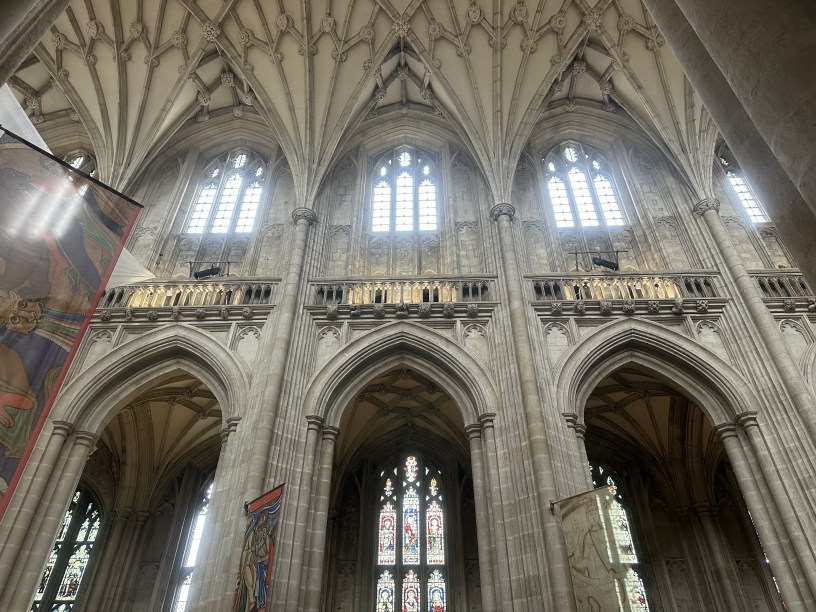
This past summer, when I visited England with my best friend Emilia, we explored Winchester Cathedral. Now Winchester Cathedral is perhaps not as famous as Westminster Abbey in London or Canterbury Cathedral—the cathedral of the Archbishop of Canterbury. Though Winchester Cathedral is one of the finest buildings in England (the cathedral guide book told us so)! It truly was magnificent! As the Cathedral articulates their vision: “Winchester Cathedral is called to renew, inspire and unite people in faith, hope and love. These are the values we live by: Openness so that all may be renewed. Excellence so that all may know God’s love. Kindness so that all may find a place.”[1]
There was a nominal entry fee to visit the cathedral. The fee could be waived for various reasons, including attending a service or needing a place to pray. Before we possibly get judgmental, the entrance fee helps cover the expense of running Winchester Cathedral—to the tune of £14,000 pounds a day![2] Yes, it costs nearly $18,000 U.S. dollars every single day to operate Winchester Cathedral. And we thought Pledge Campaign Season in many of our American churches was challenging! Good Lord!
This church began being built in 1079—it’s been around for more than 900 years. Ancient kings and warriors are buried there; so is Jane Austen. At one point in its history, the east end of the cathedral nearly collapsed because it was built on soft, wet ground. The foundations flooded. An experienced deep-sea diver named William Walker spent six years going on almost daily dives carrying sacks of concrete to lay at the bottom of trenches to shore up the foundation. Groundwater eventually got pumped out and bricklayers came in to fill the voids. By 1911 a team of 150 workmen rebuilt the foundations of the cathedral. William Walker has gone done in history as saving Winchester Cathedral with his own two hands. I wanted to visit Winchester Cathedral to see such a historic church and visit the grave of Jane Austen. It was amazing to learn the story of William Walker and what he had done to save this great church for people like us to experience.[3]
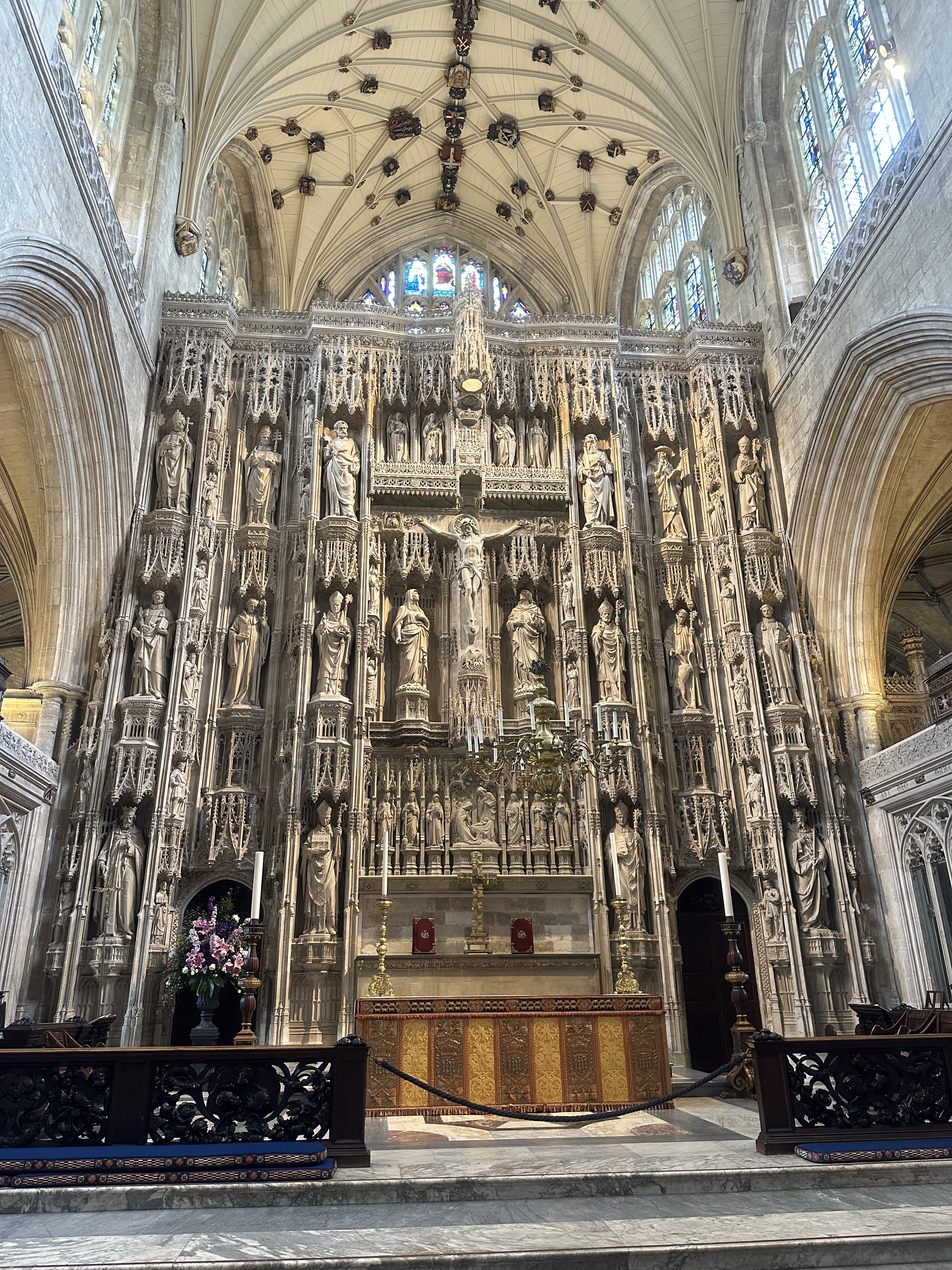
Now we may have mixed feelings about grand cathedrals. It is good to ponder the astronomical costs associated with running them. What else could the Church of England be doing with all that money? What else can any denomination or individual church be doing with the money it takes to maintain historic buildings made with human hands? It can be a real conundrum—these costly buildings that help us glorify God. Though it matters how church buildings are used and if they are open to the wider community. If we treat churches like museums where people are allowed to look and not touch anything, is it any wonder that churches fade away?
For what it’s worth, this topic appears to have come up for Jesus and the disciples. As we heard in our Gospel story from the Gospel according to Mark, Jesus and his disciples were leaving the Temple in Jerusalem when the disciples said, “Teacher, look! What awesome stones and buildings.” The disciples weren’t from around those parts and the glorious grandeur of the Temple standing tall and proud atop a hill in the holy city must have been amazing to behold. At the time, this magnificent building was at the center of their Jewish faith. It was believed that the Temple housed the very presence of God in the Holy of Holies (the inner sanctum)—the meeting place of heaven and earth. The only person who could enter the Holy of Holies was the High Priest and entry only happened one day every year, on Yom Kippur (the Day of Atonement).
The disciples are understandably moved when looking at this sacred place, this thin place. In this moment of awe, Jesus tells his followers, “Do you see these enormous buildings? Not even one stone will be left upon another. All will be demolished.”[4]
What a statement! The destruction of the Temple must have seemed like an impossibility. The Temple that housed the presence of God in the Holy of Holies demolished? Not one stone left upon another? How could that possibly happen?
Now we know that the destruction of the Temple in Jerusalem came to pass, but the disciples must have been confused. Because the scene shifts to Jesus sitting on the Mount of Olives across from the Temple. Peter, James, John, and Andrew (Jesus’ inner-circle) ask him privately about this. What sign should they be on the lookout for that will show all these things are about to come to an end?
Jesus tells them to beware that nobody deceives them: “When you hear of wars and reports of war, don’t be alarmed. These things must happen, but this isn’t the end yet. Nations and kingdoms will fight against each other, and there will be earthquakes and famines in all sorts of places. These things are just the beginning of the sufferings associated with the end.”[5]
The 13th Chapter of Mark’s Gospel concerns the destruction of the Temple and Jerusalem itself. It deals with the end of the world as we know it. This chapter is known as the “little apocalypse” and has the tone of a farewell discourse. We can read about a “venerated figure sharing the fate and fortunes of his followers in the shadow of his own departure.”[6] Though if we kept on reading, Jesus goes on to say, “But nobody knows when that day or hour will come, not the angels in heaven and not the Son.”[7] Jesus says that God is the only one who knows the future.
The little apocalypse doesn’t seem exactly hopeful on the surface since we are considering deception and wars and rumors of wars and the destruction of the Temple and nations and kingdoms fighting against each other and earthquakes and famines and suffering. Yet perhaps the hope comes when we realize and let it sink into our hearts that the future is in God’s hands, not ours. Sometimes we look around and everything seems awful. How can our faith sustain us in those moments? It can be of great comfort that even Jesus did not know exactly how everything would come to pass. The truth is that we do not know what the future holds, but we know who holds the future. That is where our comfort can be found. Because the future is ultimately in the hands of our loving God. Thanks be to God. Amen.
[1] David Souden, A Guide to Winchester Cathedral, pg. 48.
[2] “Book your visit,” Winchester Cathedral, https://www.winchester-cathedral.org.uk/welcome/book-your-visit/
[3] David Souden, A Guide to Winchester Cathedral, pg. 31.
[4] Mark 13:1-2, CEB.
[5] Mark 13:7-8.
[6] Footnote on Mark 13:1-37 in The Westminster Study Bible with the Deuterocanonical/Apocryphal Books, NRSVUE, pg. 1791.
[7] Mark 13:32.
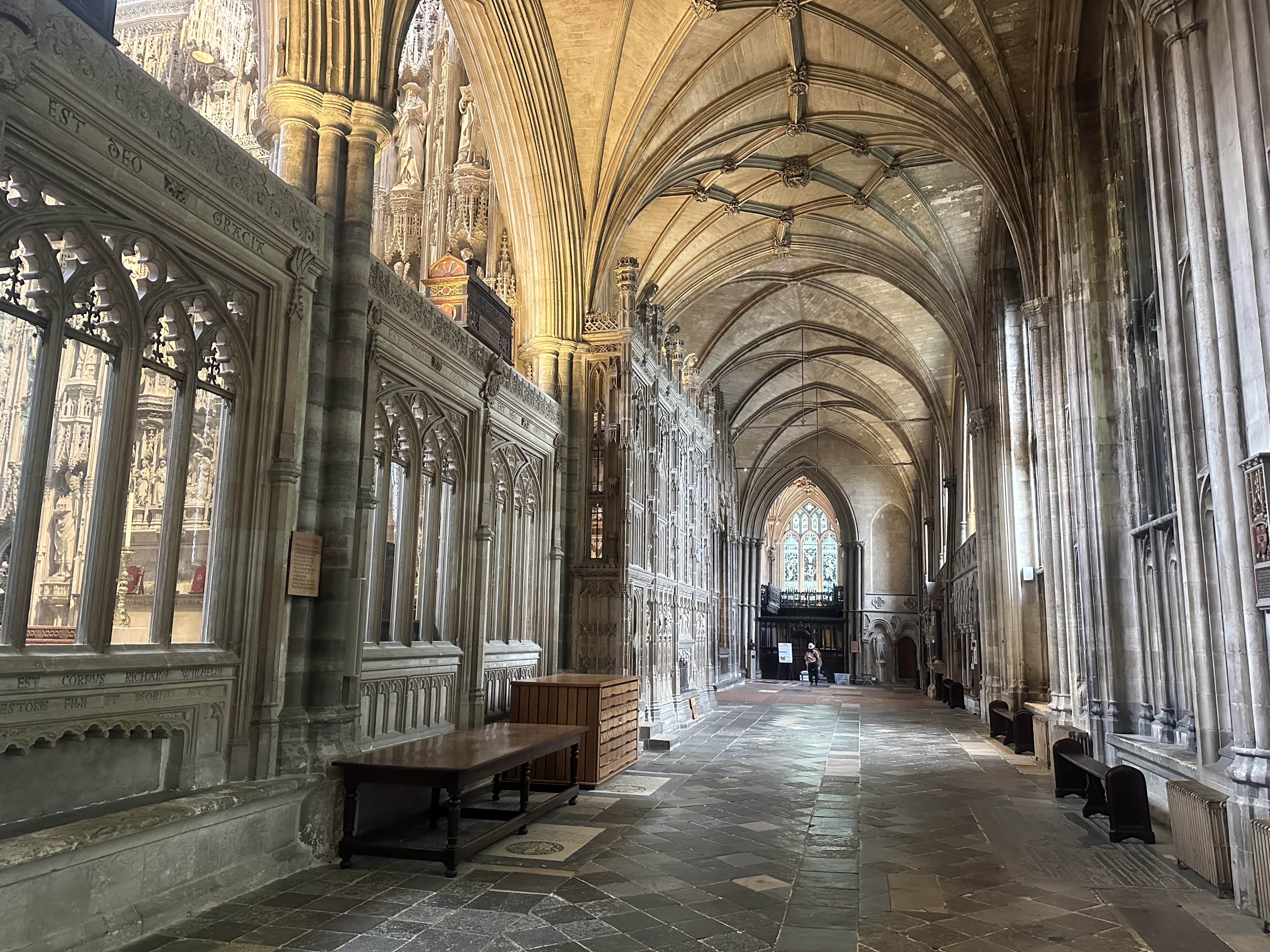
Photos by Rev. Lauren Ostrout of Winchester Cathedral, Winchester, England.
 Lauren Ostrout ~ on being made well