“What is Possible?” Colchester Federated Church, January 5, 2025, Epiphany Sunday (Matthew 2:1-12)
On Epiphany Sunday here at Colchester Federated Church we receive Star Words. This is a tradition I introduced to our congregation, though it did not originate with me out of all the people in the universe. For those who might be new to the practice, here’s how A Sanctified Art describes Star Words: “The use of star words, also called ‘star gifts,’ is a prayer practice connected to Epiphany and the new year that has been growing in popularity in Protestant churches for nearly a decade now. The idea is that a list of intention words, or guiding words, are written or printed on paper stars. These paper stars are then arranged, most commonly face down, on the Communion Table or in a large basket. At some point during your Epiphany service, individuals are invited to draw a word from the basket or off the Table, and to use that word as a guiding word throughout the year . . . Individuals are often encouraged to place their star word somewhere they will see it regularly throughout the year to allow consistent reflection on how God has moved through, around, or in connection to that word.”[1]
Here at CFC, Nicole cuts out the stars and I write a word on each throughout December. These words come from several Epiphany Star Words Lists. My hope is that the Star Word will be a gift for your individual journey of faith as we enter this new year. Now it might be clear right away what the word means for you and how God is still speaking through that word in your life. Or your Star Word may be a conundrum, even after you’ve looked up the meaning in the Dictionary and sat with that particular word for a while. Put the star on your refrigerator, dresser, or desk—somewhere where you can see it regularly and ponder its meaning. The hope is that your Star Word will guide you on your way in 2025 just like the magi of old followed the light of the Christmas Star to find Jesus.
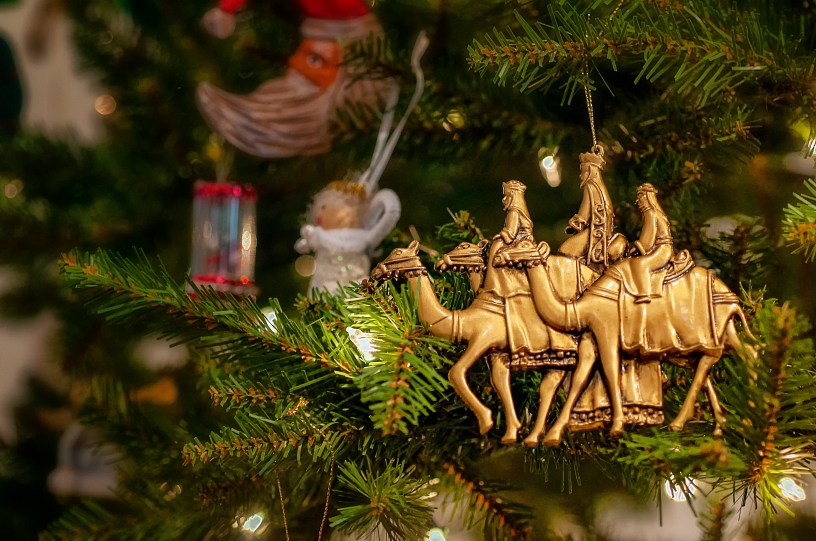
Epiphany Sunday is one of those days in the liturgical cycle that is full of possibilities. The Feast of Epiphany is tomorrow, January 6th, and marks the conclusion of the 12 Days of Christmas. Epiphany is when we celebrate the revelation of Jesus Christ to all nations, represented by the magi who come from the east to worship the Christ child. By the willingness of these wise people following the light of a star in the night sky, the story of Jesus’ birth becomes more expansive and inclusive. After all, this is the story of Gentiles who come to visit this Jewish child whom we Christians believe to be the Messiah. It’s a remarkable story. The holy day of Epiphany is about celebrating Jesus the Christ as the light of the whole world.
Epiphany is a story found only in Matthew’s Gospel centered on the magi and their journey to find Jesus. The magi were most likely astrologers who folks at the time believed could foretell the future. Professor Elisabeth Johnson relates that the magi might have even been Zoroastrian priests who came to Bethlehem from Persia (modern-day Iran). We know for certain that they were Gentiles, and that they didn’t seem to know Jewish Scriptures. Johnson writes, “But they do know how to read the stars. God reaches out to them and leads them through what they already know. In the ancient world, stars and other signs in the heavens were thought to signal important events. In this case, a bright star rising leads them to discern that a royal birth has occurred in Judea. So they come bringing gifts fit for royalty – gold and frankincense and myrrh.”[2]
The story of the magi illuminates the practice of pilgrimage. If we read the Epiphany story of the magi coming from the east as a pilgrimage story, we can see universal patterns of pilgrimage play out—the call, separation, journey, contemplation, encounter, and the completion and return.[3] The magi make that journey by the light of a star to encounter and honor the newborn king. As Matthew explains, “When they saw that the star had stopped, they were overwhelmed with joy. On entering the house, they saw the child with Mary his mother, and they knelt down and paid him homage. Then, opening their treasure chests, they offered him gifts of gold, frankincense, and myrrh. And having been warned in a dream not to return to Herod, they left for their own country by another road.”[4]
The magi felt called to go and discover the identity of this child. In order to do this, they had to leave their homeland and imagine possibilities before them. These wise ones journeyed across a great distance following that star. There was some contemplation about how to go about finding Jesus, hence the consultation with Herod. Though they saw right through his political maneuverings and desire for power. The magi eventually see the star alighting over the place where Jesus was staying. This sign fills them with joy. These wise ones meet Jesus with Mary his mother, and falling on their knees they honor him and give gifts out of gratitude. The magi experience a sacred encounter, and the pilgrimage changes them. The magi eventually return home from their pilgrimage, albeit by another road.
Just like the story of Jesus’ birth we hear on Christmas Eve, this Epiphany story is one we know well. In truth, Epiphany sermons tend to be an amalgamation of sermons I have already preached about this sacred story for fourteen years by now. There are only so many ways to tell the familiar story and contemplate the meanings.
Though what changes year to year is us. Wherever we might be at this particular moment on our individual faith journeys can illuminate the meaning of the story. Sometimes we ourselves are searching and seeking. Sometimes we need to just stop and rest in the embrace of God. Sometimes we feel courageous, and other times we need compelled to get going on a journey of discovery.
There are many aspects of Epiphany that are compelling to hear no matter how many times we’ve heard it before (or will hear it again). Because this is a story about laying out a longer table and opening up the doors wide as the magi (Gentile astrologers) come to Bethlehem to encounter the infant Jesus. This is a story about the power of following one’s own intuition as the magi saw right through what Herod was up to and trusted their own understandings. This is a story about imagining what may be possible and having the courage to set out on a journey into the unknown. Journeys like this begin with just a single step, and who knows what may await us! We may just follow our own stars and discover that the impossible will become possible. Happy New Year, and thanks be to God. Amen.
[1] “How does a weary world rejoice? Star Words Liturgy,” A Sanctified Art, June 27, 2023,
https://sanctifiedart.org/blog/how-does-a-weary-world-rejoice-liturgy-for-epiphany-sunday
[2] Elisabeth Johnson, Commentary on Matthew 2:1-12, Working Preacher, January 6, 2022, https://www.workingpreacher.org/commentaries/revised-common-lectionary/epiphany-of-our-lord/commentary-on-matthew-21-12-11
[3] Sacred Journeys with Bruce Feiler, PBS, https://www.pbs.org/wgbh/sacredjourneys/content/pilgrimage/
[4] Matthew 2:10-12, NRSVUE.
Photo by Robert Thiemann on Unsplash
 Lauren Ostrout ~ on being made well