“In the Wilderness” Colchester Federated Church, March 9, 2025, First Sunday in Lent (Luke 4:1-13)
Lent has begun. As the great professor Walter Brueggemann reflected, “We are on the road again! As followers of Jesus, we are on the road again in Lent, walking the way of obedience to Jerusalem for the big showdown with the authorities of church and state. It turns out, every time, to be a hazardous journey, full of toils and snares, potholes and adversaries, ending in a rigged trial. But women and men of faith are always on the road again, departing safe places, running risks, and hoping for well-being on the journey.”[1]
On the First Sunday in Lent, we encounter Jesus soon after his baptism. Still basking in the glow of God’s acceptance, still shaking the waters of the Jordan River from his body—led by the Holy Spirit into the wilderness to be tempted by the devil for forty days. Lent begins with a physically weak Jesus and a gloating, deceitful Satan facing each other. However we conceive of the devil (whether we think of a literal being or a metaphor or something else entirely), evil still exists in our world. Temptations can trip us up as our journeys can be full of potholes and adversaries. Our Gospel story is open to interpretation, though it presents scenarios that continue to play out in our world and in our lives. We hear about temptations that revolve around identity and power, temptations that revolve around who we are and who we are striving to be.
In the First Temptation, the devil goes right for the jugular. The tempter says, “Since you are God’s Son, command this stone to become a loaf of bread.”[2] We know that Jesus has been fasting and is physically starving. There is that aspect of this temptation about the physicality of Jesus’ hunger. Though we also remember that Jesus just heard that he is God’s Son in the waters of Baptism. The tempter calls that holy moment of divine identity into question: “Since you are God’s Son.” We know that God has named and claimed Jesus as his own, but the tempter calls Jesus’ belovedness into question. Jesus responds in this moment of vulnerability by quoting scripture: “People won’t live only by bread.”[3] Jesus passed his first test by not doubting his identity and value as God’s own beloved child. Neither should we—no matter what voices out there would tell us.
In the Second Temptation the devil leads Jesus up to a high place and shows him all the kingdoms of the world. The devil makes a power play, “I will give you this whole domain and the glory of all these kingdoms. It’s been entrusted to me and I can give it to anyone I want. Therefore, if you will worship me, it will all be yours.”[4] If Jesus ruled the kingdoms of the world right then, he would have ruled justly. Jesus would have shown mercy and set things right. But where would his power have come from? Even though Jesus was good to his core, could he have ruled justly if he had to bow down to evil in order to gain power? Jesus declines by telling the devil that God alone should be worshipped and served.
In the Third Temptation the devil brings Jesus to Jerusalem. More specifically Jesus is brought to the highest point of the temple. The tempter again calls Jesus’ identity into question, “Since you are God’s Son” and tells Jesus to throw himself down. For it is written in scripture (Psalm 91): God “will command his angels concerning you, to protect you and they will take you up in their hands so that you won’t hit your foot on a stone.”[5] This is a test of heroism and what kind of Messiah Jesus will be. Is he going to be the warrior king, the super hero who can leap from buildings in a single bound and be saved at the last instant? Or is he going to be the kind of Messiah folks never imagined possible, the Suffering Servant? Jesus overcomes this final temptation by telling the tempter that he will not test the Lord his God. Jesus saw right through this temptation about pride and ego, and the devil leaves him be, for now.
Lent begins with temptation, with toils and snares. Lent begins in the wilderness. This is not always an easy season in our liturgical calendar—from the more stoic music to the prayers of confession to the emotionally heavy special services. It is a season of spiritual discipline and devotion. Though perhaps we can appreciate Lent as a season of honesty. Because sometimes we are also in the wilderness.
Though here’s the thing, sometimes wilderness wanderings can be surprising. Sometimes time in the wilderness can even be transformative. Here’s one example.
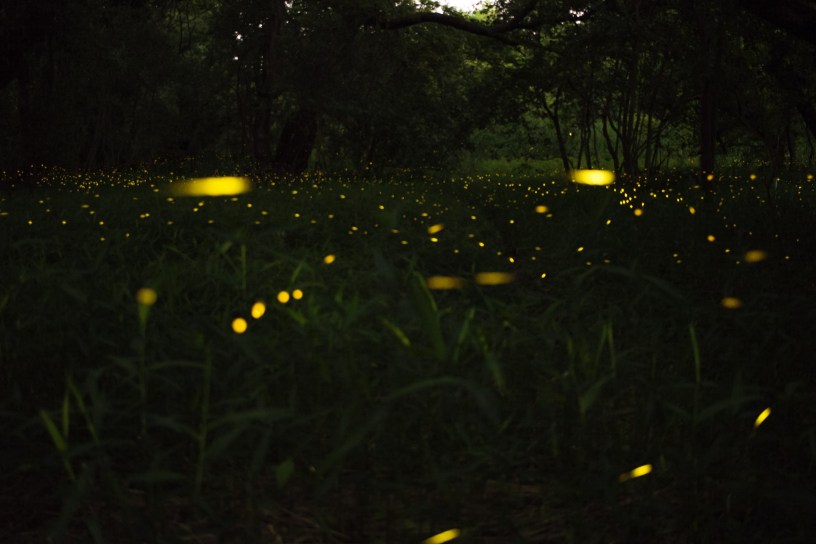
We always have a lot of fun at Vacation Bible School here at CFC, and last year we had a camping theme. Lumen the Firefly and Counselor Sam (AKA Aaron and me) shared all sorts of information about the wonders of the natural world and fireflies in particular at our opening and closing assemblies at Camp Firelight. On the final day of VBS, Counselor Sam and Lu talked about glowing lights that could be seen down by the archery field at camp. Counselor Sam wondered if those lights were a campfire, Christmas lights, or someone playing flashlight tag. Lu shared, “It was bioluminescent lights from me and my friends. We were putting on a synchronous light display.”[6] Lu explained that this is when all the fireflies blink their lights at the same time and that his friends from the Great Smoky Mountains do it each summer.
This is all true. We were not lying to the children. In fact, the firefly event that can be viewed in the Great Smoky Mountains National Park draws visitors from all over. Author Leigh Ann Henion writes about the experience in her book Night Magic: Adventures Among Glowworms, Moon Gardens, and Other Marvels of the Dark. Some years ago, the National Park Service began to have a lottery for folks to secure passes to see the synchronous light displays from fireflies in the Smoky Mountains because of the growing popularity raising concerns about conservation. God bless our National Parks!
Anyway, Henion describes the experience in the Great Smoky Mountains National Park by sharing, “The insects are responding to each other’s light, working with their neighbors to find their role in the whole. From a distance, the activity appears as a shimmering current of light running through the forest from right to left: Whoosh. Then darkness. Then again, a whoosh of light.”[7] Scientists believe that the fireflies’ synchronous light display is related to mating. Because the flashy fireflies all happen to be males possibly showing off for females. Are we shocked by that?
Sometimes when darkness falls that is our signal to go safely inside and turn on the lights. Though there are some amazing sights to behold in the darkness of night. Stars are in the sky above us right now, but we only see them when the sun is not shining so brightly. Henion mused after her experience with the fireflies that “while it’s true that only light can drive out darkness, there are some forms of light that only darkness can reveal.”[8]
As Lent has begun and we are in the wilderness with Jesus I wonder about the possibility of embracing the unknown, the darkness, the wilderness. I wonder about embracing our departure from the safe (and well-known) places. Because perhaps out there in the wilderness there are lessons to be learned and phenomena yet to be discovered. Perhaps there are transformations that could not occur without the adversaries and potholes we may encounter on the road. God is always with us. Thanks be to God. Amen.
[1] Walter Brueggemann, A Way Other Than Our Own: Devotions for Lent, pg. 4.
[2] Luke 4:3, CEB.
[3] Luke 4:4.
[4] Luke 4:6-7.
[5] Luke 4:10-11.
[6] Camp Firelight Opening Assembly, Session 5, Cokesbury.
[7] Leigh Ann Henion, Night Magic: Adventures Among Glowworms, Moon Gardens, and Other Marvels of the Dark, pg. 6.
[8] Leigh Ann Henion, Night Magic: Adventures Among Glowworms, Moon Gardens, and Other Marvels of the Dark, pg. 14.
 Lauren Ostrout ~ on being made well