“Under Her Wings” Colchester Federated Church, March 16, 2025, Second Sunday in Lent (Luke 13:31-35)
On this Second Sunday in Lent, we find ourselves in Jerusalem with Jesus expressing profound sorrow in the holy city. Some Pharisees (who appear to be friendly toward Jesus) approach him with a warning, “Go! Get away from here, because Herod wants to kill you.”[1] Jesus responds to their warning with defiance. Jesus tells the friendly Pharisees to tell that fox that he’s throwing out demons and healing people today and tomorrow, and he will complete his work on the third day. Perhaps foreshadowing Jesus’ death and resurrection to come, including that Jesus will be killed in Jerusalem like some of the prophets who came before him.
Jesus laments over the holy city, “Jerusalem, Jerusalem, you who kill the prophets and stone those who were sent to you! How often I have wanted to gather your people just as a hen gathers her chicks under her wings. But you didn’t want that.”[2] Though some people accepted Jesus with open arms and glad hearts, Jesus also experienced profound rejection. In the Gospel according to Luke, Jesus encounters these Pharisees who inform him that Herod wants to kill him. That must have been alarming to hear. Jesus must have known that his ministry was threatening because he spoke truth to power and called people to be in right relationship with one another. Like the prophets who came before him, Jesus realized that he would likely share a similar fate. Yet Jesus kept on throwing out demons, he kept on preaching, teaching, healing, and embodying the compassion of God anyway.
In line with the prophetic tradition, Jesus laments over Jerusalem. He could have just steered clear of the lion’s den. Jesus had some support in Galilee and would have been safer ministering to people in that region. Yet he traveled back to Jerusalem time and again. Jesus kept showing God’s love knowing that he would be persecuted. We see this over and again with our Lenten Gospel texts, this foreshadowing of what would come to pass and Jesus’ determination to keep going. What courage this took. Theologian Dorothee Soelle wrote that Jesus “left [God’s] house of his own free will. It was his own decision to leave Galilee, where he undoubtedly had stronger support. In the end he went freely towards his own catastrophe, which we call the cross.”[3]
Jesus actively chose the cross, his own catastrophe. We sometimes wonder about the humanity and divinity of Jesus. We wonder about what he knew and didn’t know. Though emphasizing Jesus’ free will and his decision to leave Galilee, going freely toward his own catastrophe makes this all the more moving. It’s remarkable that despite his difficult journey toward the cross, he continued to spread the Good News of the Kingdom of God until the very end. Even if people rejected him, Jesus kept going. Today we hear Jesus defiantly tell the Pharisees (who may well have been looking out for him) to relay to Herod, “I’m throwing out demons and healing people today and tomorrow, and on the third day I will complete my work.”[4]
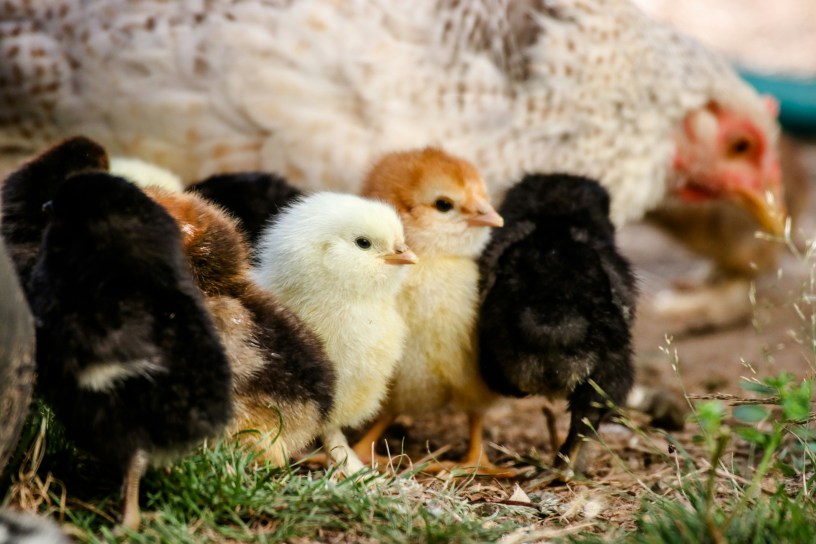
The image Jesus uses to describe what he wants to do with the people of Jerusalem is also remarkable. Jesus compares himself to a Mother Hen gathering her chicks under her wings. Make no mistake, this is a feminine image. This is a tender image. Sometimes we use the term “mother hen” to describe someone who sees to the needs of others, but does so in a fussy, overprotective, or interfering way. Sometimes “mother hen” evokes this image of someone overstepping boundaries. It is not necessarily a compliment.
Though isn’t it really something that Jesus uses the image of the Mother Hen to talk about himself? “How often have I wanted to gather your people just as a hen gathers her chicks under her wings. But you didn’t want that.”[5]
Rev. Nadia Bolz-Weber wrote a wonderful reflection about the Mother Hen God. She mused, “Maybe that beautiful image of God could mean something important for us: and by us I mean we fragile, vulnerable human beings who face very real danger. I can’t bear to say that this scripture is a description of what behaviors and attitudes you could imitate if you want to be a good, not-afraid person. But neither can I tell you that the Mother Hen thing means that God will protect you from Herod or that God is going to keep bad things from happening to you. Because honestly, nothing actually keeps danger from being dangerous.”[6]
This image Jesus uses of the Mother Hen gathering her chicks under her wings is still powerful. For instance, Colchester, Connecticut is a Right-to-Farm Community. I looked up what this actually means in Colchester’s Town Charter this week and found: “Pursuant to Connecticut General Statutes, no present or future agricultural operations conducted or maintained in a manner consistent with accepted customs and standards of the agricultural industry on a recognized farm which is engaged in the act of farming shall become or be considered a nuisance due to the identified impacts below solely because such activity resulted or results in any changed condition of the use of adjacent land, provided that best management practices for all activities are observed.”[7] The identified impacts include incidental noise from livestock or farm equipment, odor from livestock, manure, fertilizer or feed, dust and fumes, the usage of agricultural chemicals, pesticides, and fertilizers, and water pollution from livestock or crop production activities (except polluting pubic or private drinking water supplies). The agricultural past and present of Colchester are clear to see, including folks who raise chickens. All of this to say that when Jesus compares himself to a Mother Hen that image still resonates 2,000 years after he shared it. Maybe it resonates especially in a town like Colchester that is a Right-to-Farm Community including having provisions in our Town Charter and everything!
So, what if we thought of this Mother Hen image Jesus is talking about here less as an image of protection (because God cannot prevent every bad thing from happening) and more as an image of God’s unconditional love? What if we embraced that the Mother Hen cannot keep the foxes from being dangerous and going after the chicks? We know this from real life farming. Though the Mother Hen does her best to shelter those chicks under her wings. Rev. Bolz-Weber again relates, “A Mother Hen of a God doesn’t keep foxes from being dangerous . . . a Mother Hen of a God keeps foxes from being what determines how we experience the unbelievably beautiful gift of being alive. God the Mother Hen gathers all of her downy feathered, vulnerable little ones under God’s protective wings so that we know where we belong, because it is there that we find warmth and shelter.”[8]
This is what Jesus was offering as he lamented over Jerusalem. Jesus was offering a sense of belonging and a sense of purpose. When churches live into who God is calling us to be, this is what we can do—offer a sense of belonging and a sense of purpose. On this Second Sunday in Lent, we remember that God the Mother Hen gathers all of her vulnerable chicks under her wings so that we know where we belong. We belong to God, and we belong to one another in Christian community. Thanks be to God. Amen.
[1] Luke 13:31, CEB.
[2] Luke 13:34.
[3] Dorothee Soelle, Choosing Life, 54.
[4] Luke 13:32.
[5] Luke 13:34.
[6] Nadia Bolz-Weber, “A Mother Hen God,” Center for Action and Contemplation, March 28, 2022, https://cac.org/daily-meditations/a-mother-hen-god-2022-03-28/
[7] Town of Colchester, CT Charter, Chapter 55 “Right to Farm,” https://ecode360.com/14351886#14351892
[8] Nadia Bolz-Weber, “A Mother Hen God,” Center for Action and Contemplation.
Photo by Michael Anfang on Unsplash
 Lauren Ostrout ~ on being made well