“Give it Time” Colchester Federated Church, March 23, 2025, Third Sunday in Lent (Luke 13:1-9)
On this Third Sunday in Lent, we hear Jesus teaching a parable. New Testament Professor Arland Hultgren wrote this great book called The Parables of Jesus: A Commentary. As an aside, I usually consult this book when a parable comes up in the Lectionary. Though I once accidentally spilled some tea on this book when preparing a sermon. The pages are all crinkly and warped, so it just adds to the experience of finding gems to share.
Anyway, Professor Hultgren notes that the two things we know about Jesus beyond any historical doubt is that Jesus was crucified in the First Century and that Jesus taught in parables. So, what’s a parable? A helpful definition is: “a parable is a figure of speech in which a comparison is made between God’s kingdom, actions, or expectations and something in this world, real or imagined.”[1] We hear Jesus teach, “The kingdom of God is like . . .” a seed growing secretly, a mustard seed, leaven, treasure hidden in a field, an expensive pearl, a great banquet. Jesus is comparing the idea of the Kingdom of God to everyday ordinary things—something in this world, real or imagined.
On the surface, this parable from Luke’s Gospel is just a story about a barren fig tree. Though we see that there’s more to the story. Because this is also a parable about demanding genuine change and repentance. Jesus tells this story about a fig tree in a vineyard. For three long years this fig tree doesn’t bear any fruit. The vineyard owner tells the gardener, “Cut it down! Why should it continue depleting the soil’s nutrients?”[2] This proposed action could represent an economic loss—fig trees didn’t exactly come cheap. But at least this seemingly worthless fig tree would be out of sight and mind. At least this fig tree would make room for a better tree to bear fruit in the vineyard. Though the gardener intervenes, “Lord, give it one more year, and I will dig around it and give it fertilizer. Maybe it will produce fruit next year; if not, then you can cut it down.”[3] The gardener asks the vineyard owner for another chance for this tree, to give it time.
Professor Hultgren points out that applying fertilizer to a fig tree would have been highly unusual in Jesus’ day. This would have been “a sign of extraordinary care for the tree.”[4] That’s exactly what the gardener advocates. Let me go the extra mile. Let me see if my extra attention, love, and more time will make a difference for this tree. The two figures in this parable (the vineyard owner and gardener) could represent two sides of God: judgment and mercy. Perhaps our story shows how God must sometimes wrestle with barren fig trees that aren’t living into their potential. Maybe God wrestles with cutting them down or loving them that much more so that they will bear fruit in the end.
Note that the story ends with mercy. The gardener intervenes and even though the vineyard owner doesn’t for sure consent to this request, giving the tree more time is implied. This may be what Jesus was teaching his followers in this parable—mercy wins the day. Because God’s amazing grace is greater than anything we can imagine or deserve. Our God is a God of second chances who sees potential in us that we may not yet see in ourselves, especially because Luke will go on to share more parables with these themes (including the parable of the lost sheep and the prodigal son).
Perhaps we hear that this parable is about mercy and repentance and the repentance aspect makes us feel uncomfortable. That word “repent” can make us think of hellfire and brimstone preachers who scream their messages of judgment. However, repentance can be a theologically rich concept for us as people of faith. It comes up in these stories in the season of Lent, and it’s not all negative. Repentance means “to turn back” in Hebrew or “to change one’s mind” in Greek.
A helpful way to think about repentance could be that sometimes we are not in right relationship with God, with one another, or even with ourselves. Something is off. Something is broken. We are invited to turn back, to change our thinking, and to return home to God’s mercy. We are not going to get it right every time. Sometimes we are going to need more time to bear fruit. Sometimes we need mercy.
To show mercy is not a sign of weakness, it’s a sign of strength. In our present times when we may hear people say that empathy is toxic or weak, we need to remember the words of Jesus: “blessed are the merciful, for they will receive mercy.”[5] There are times when we are in a position to help other people, and there are times when we need to receive help. Blessed are the merciful.
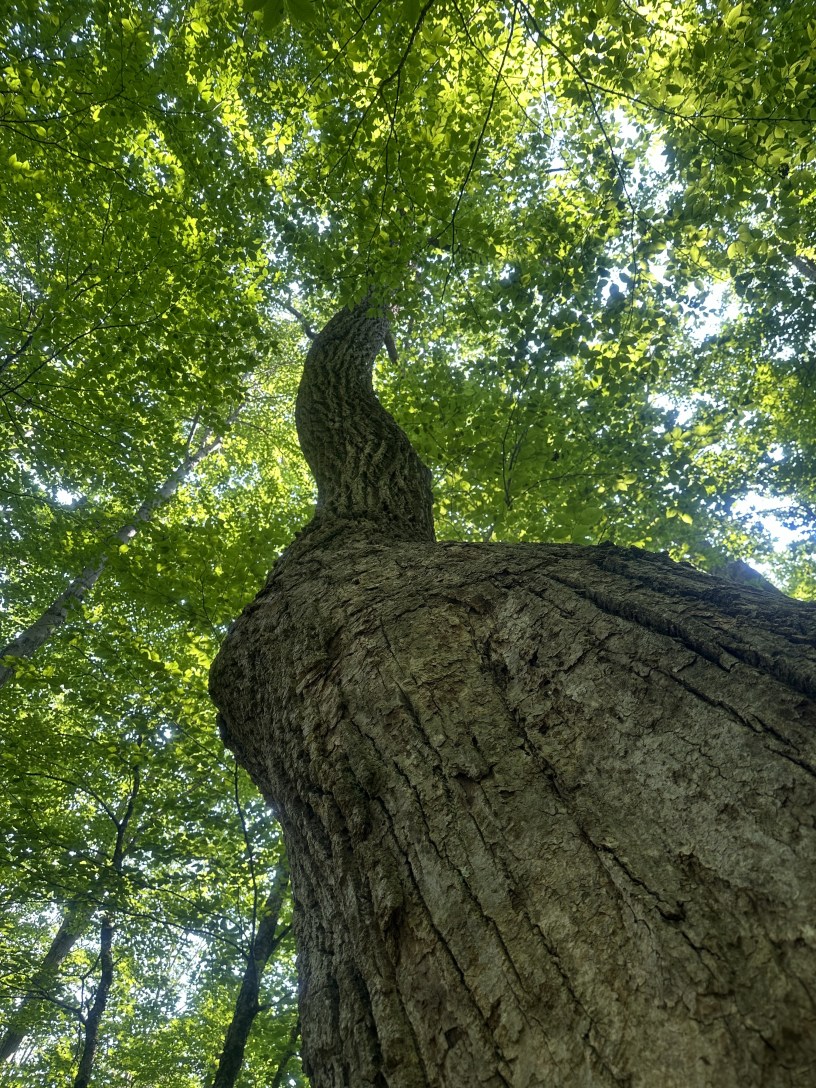
And you know what? Maybe that fig tree would remain barren, but who’s to say God can’t use that barren fig tree anyway? As part of the process to become a certified Forest Therapy Guide I went on a Soul Walk—spending at minimum four hours wandering somewhere in nature alone at my leisure and submitting a project afterwards. The day that worked with my schedule happened to be during a heatwave in July. No matter, off I went to the Ruby and Elizabeth Cohen Woodlands to wander among the trees alone for hours on a summer’s day. I walked on the trail and stopped frequently to observe the forest. It was so hot and the mosquitoes were awful. Though as I opened up my senses, there was magic everywhere. Here’s one of the poems I wrote:
Meandering on the Red Trail—
mossy rocks and mud and mosquitoes,
a Downy Woodpecker hammering away,
lost in my thoughts
allowing myself to wander
because not all who wander are lost
after all.An old, glorious tree makes me stop
in my tracks
on the trail.The trunk of the old tree is bent
at an irregular angle:
like a shoulder awkwardly out of joint
from an old sports injury still visible
that makes for a good story,
“Oh this?
Let me tell you about the time . . .”The scars and misshapen
parts of us—
all of us—
that somehow help tell our stories.Stories of persistence
and perseverance.
Stories of hope
and perfect imperfection.We are here now.
You are here now.This old tree
odd and bent
and still gloriously reaching for
the light—
what beauty to behold.
What struck me on that Soul Walk is that old, bent, misshapen trees (even seemingly dead trees) still help the forest ecosystem. Those trees provide shelter and food for all sorts of beings in the more than human world. Dead trees decompose and release nutrients back into the soil. The nutrient rich soil helps new life grow. Death and rebirth. Hope and new life. Sometimes we just need to give it time. Thanks be to God. Amen.
[1] Arland J. Hultgren, The Parables of Jesus: A Commentary, 3.
[2] Luke 13:7, CEB.
[3] Luke 13:8.
[4] Arland J. Hultgren, The Parables of Jesus, 244.
[5] Matthew 5:7, NRSVUE.
Photo by Rev. Lauren Ostrout.
 Lauren Ostrout ~ on being made well