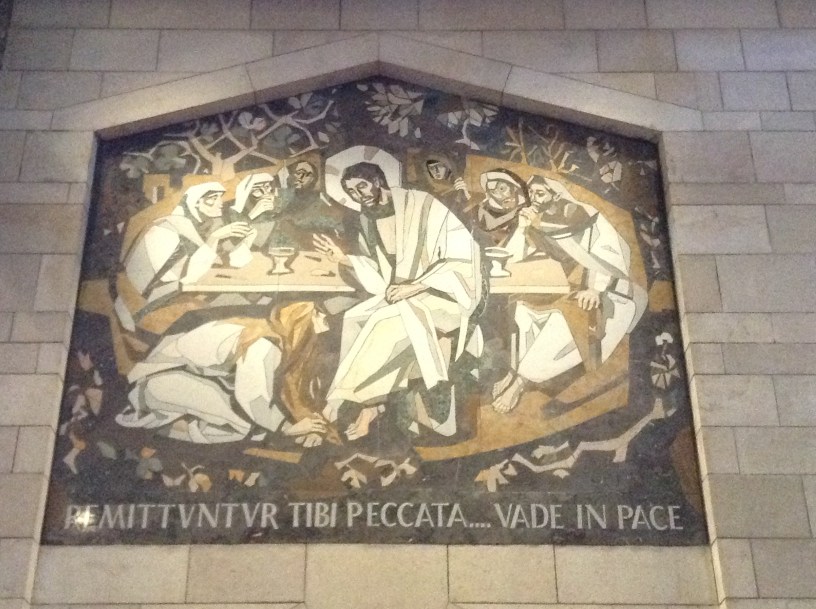
“Costly Perfume” Colchester Federated Church, April 6, 2025, Fifth Sunday in Lent (John 12:1-8)
On this Fifth Sunday in Lent, we find ourselves at the home of Lazarus, Martha, and Mary in Bethany. It is just six days before Passover. John tells us that Jesus has joined his close friends at their home for dinner. This all takes place after Jesus raised Lazarus from the dead. Our attention turns to Mary because she is about to perform an extraordinary act. Mary takes what John categorizes as an extraordinary amount of perfume made with pure nard and anoints Jesus’ feet with this ointment, wiping his feet dry with her hair. “The house was filled with the aroma of the perfume.”[1]
There is scholarly debate about who anoints Jesus because the story is presented differently in the Gospels.[2] In Mark and Matthew, Jesus is anointed by an unnamed woman while at the house of Simon the leper. (Because these were great ways to refer to people. The woman is not named at all and Simon is Simon “the leper”). In Luke, Jesus is anointed by a “woman of the city, who was a sinner” at the home of a Pharisee. In that version, the Pharisees have a strong reaction to the woman even touching Jesus. In John, Jesus is anointed by Mary of Bethany, the sister of Martha and Lazarus. Though new evidence has come to light in the academic world by New Testament scholar Elizabeth Schrader Polczer studying ancient versions of the Gospel of John (namely in Papyrus 66) that Mary and Martha of Bethany could actually be Mary Magdalene. Stay tuned! All of this to say, this story of a woman anointing Jesus with costly perfume is a significant story that can be found in all four Gospels. Throughout this sermon, I will refer to this woman as Mary knowing that this could be Mary of Bethany or Mary Magdalene.
So when Judas complains about Mary anointing Jesus (because of the expense of the perfume), Jesus comes to Mary’s defense immediately. Jesus says to Judas, “Leave her alone. This perfume was to be used in preparation for my burial, and this is how she has used it. You will always have the poor among you, but you won’t always have me.”[3]
Judas objecting to the costly perfume seems rude, right? Though to be fair, the cost was significant. As Preaching Professor Karoline Lewis relates, “The anointing of Jesus should be experienced as an act of abundance. Every detail in the verse points to an expression of profuse love. A pound of ointment, costly perfume, pure nard, the fragrance filling the entire house, which exceeds any and all expectations, like the wedding at Cana.”[4]
Moreover, three hundred denarii—the cost of this perfume—is rather absurd when we consider that a day’s wage was one denarius. Mary anoints Jesus with almost a pound of perfume made out of pure nard. This perfume made of pure nard (aromatic oil from the spikenard plant that grows in the Himalayas) would have cost Mary almost a year’s salary. This is such an over-the-top display of affection and love for Jesus—using a great deal of this costly perfume, using so much that the entire house has the perfume’s fragrance in the air, wiping Jesus’ feet dry with her own hair. It’s a lot, and that’s the whole point! This was an over-the-top act of loving devotion using that costly perfume that Mary performed for Jesus days before he would die.
Have we ever experienced an almost over-the-top act of loving devotion?
I have had the privilege of visiting India twice with my mentor Pash. One of the visits was during monsoon season when the roads were rather challenging to navigate with the rain and the mud and the manure from the cows who roam freely in the villages. One day we arrived at a community center for a ceremony, and it is good manners to take off one’s shoes before going inside a building. I took off my sandals and looked down in dismay at my feet covered in mud (and covered in who knows what else). As I contemplated what to do about this situation Sr. Stella (one of the Roman Catholic sisters at the convent where we were staying), sprang into action. Sr. Stella found a basin of water and began to wash my feet without a second thought. I had a reaction and tried to stop her because it was especially embarrassing given the state of my feet! But Sr. Stella was a nurse and treated villagers every day at the convent who came for help with all sorts of medical issues. She merely shushed me, washed my feet, and ushered me inside for the ceremony seemingly without a second thought.
Now why did I think of Sr. Stella washing my feet that one time in India this week? Because the story of Mary using this costly perfume to anoint Jesus’ feet and drying his feet with her hair connects to the story of Jesus washing his disciples’ feet. That is the story that we contemplate together on Maundy Thursday. Here at our church, the story of Jesus washing the feet of his disciples as found in John 13 is read aloud dividing up the parts between a narrator, Jesus, and Peter. On years when we have a Communion Class, Nicole and I wash the hands of the children after we hear this Gospel story to share a version of Jesus’ radical act of love with our congregation. Because as Jesus said, “If I, your Lord and teacher have washed your feet, you too must wash each other’s feet. I have given you an example: Just as I have done, you also must do.”[5]
This description of what Mary does in anointing Jesus’ feet with that costly perfume foreshadows the foot washing that will take place only a chapter later in John’s Gospel. Again, Professor Karoline Lewis shares, “Mary believes in Jesus, and to believe in Jesus means to be in a relationship with Jesus. With the anointing, Mary demonstrates her love and how much her relationship with Jesus means . . . Mary’s act of love must be directed to him because he will soon depart, but also because it is what Jesus will act out in the foot washing.”[6] The stories of the anointing and foot washing are linked.
In the end, it is not an exaggeration to say that Mary’s act of love could have influenced or inspired Jesus to perform his own act of love for his disciples when he washed their feet. Because this is all about devotion, it’s about real relationships and mutuality. “Just as I have done, you also must do.” Give and take. Help and be helped. Jesus taught, “Love each other. Just as I have loved you, so you also must love each other.”[7] Mary ministers to Jesus in that moment of anointing. Just a few days later, Jesus ministers to his disciples with an action that is so similar to what he experienced with his friend Mary who comforted him before all that was to come. In this sometimes-difficult life, it is a blessing to be a blessing for one another. Thanks be to God. Amen.
[1] John 12:3, CEB.
[2] The Anointing in Bethany as told in Matthew 26:6-13, Mark 14:3-9, Luke 7:36-50, & John 12:1-8.
[3] John 12:7-8, CEB.
[4] Karoline M. Lewis, John, Fortress Biblical Preaching Commentaries, pg. 165.
[5] John 13:14-15, CEB.
[6] Karoline M. Lewis, John, Fortress Biblical Preaching Commentaries, pg. 167.
[7] John 13:34, CEB.
Photo by Rev. Lauren Ostrout, depiction of Mary Anointing Jesus at the Basilica of the Annunciation in Nazareth
 Lauren Ostrout ~ on being made well