“Restoring our Souls” Colchester Federated Church, May 11, 2025, Fourth Sunday of Easter (John 10:22-30)
Today is the Fourth Sunday of Easter—Good Shepherd Sunday. We consider the image of Jesus as the Good Shepherd of God’s people. We contemplate the ways that the voice of Jesus calls out to us even now, calling each of us by name to follow where the Spirit might lead. We ponder Jesus’ words that the sheep listen to his voice and that Jesus knows them and the sheep follow him.
As we prayed together from the 23rd Psalm (during the Call to Worship): “The Lord is my shepherd; I shall not want. He makes me lie down in green pastures; he leads me beside still waters; he restores my soul. He leads me in right paths for his name’s sake.”[1] This is all about the relationship between sheep and shepherd giving us insight into the very nature of God. A sheep resting in grassy meadows, being led to restful waters, and guided on right paths is all about the shepherd taking care of their sheep. This is about having food and water, avoiding danger, and then attaining good shelter. The best translation may be that God keeps me alive. The sheep doesn’t lack anything because the shepherd is providing the basic necessities for life—food, drink, and shelter. What we have is someone saying that their life depends solely on God.
Before we go further with this metaphor that can be found in both the 23rd Psalm and the 10th Chapter of John’s Gospel, let’s be clear that Jesus is the Good Shepherd. Not us. In this metaphor, we are the sheep. In Psalm 23, we are in the position of the Psalmist praising the Good Shepherd for guiding us to right paths and not fearing evil while walking in the darkest valley because Jesus is with us. The Good Shepherd’s rod and staff comfort us. The Good Shepherd protects us. In John 10 Jesus says, “My sheep listen to my voice. I know them and they follow me.”[2] We are invited to be the sheep with Jesus leading us. We are invited to listen to Jesus’ voice because he knows us. We are invited to follow.
Now thinking of Jesus as our Good Shepherd may or may not be appealing at the outset because sheep are known for not being intelligent. When we think of intelligent animals we might think of dolphins or chimpanzees or crows. Dolphins have larger brains than humans and sophisticated communication systems. Chimps share 98.7% of their DNA with humans and have complex social hierarchies. Crows (and ravens) use tools and even teach their young to remember human faces as either our friends or our enemies who are mean to us.[3]
Though sheep? Well, sheep have a herd mentality, tend to wander off, and often get into trouble. We may have an image of sheep as being part of a mindless flock. Who wants to be called a sheep? That is often hurled as an insult with statements like, “You’re all just a bunch of sheep!” As in, you have a herd mentality and don’t think for yourself, you will just follow along with the crowd (whether the crowd is right or wrong).
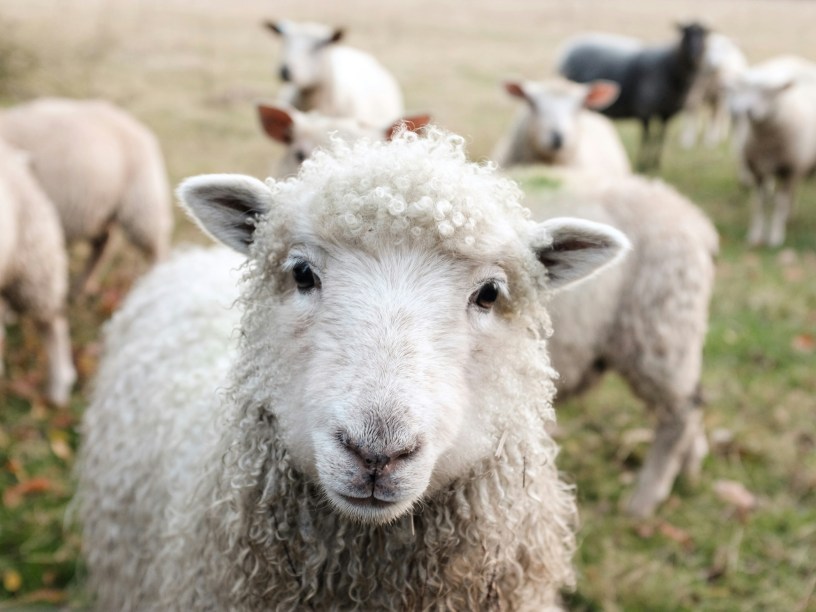
Perhaps it’s helpful to consider the traits of sheep to contemplate Jesus as our Good Shepherd. There are some redeeming qualities about this whole sheep/shepherd metaphor (which I have shared before, but it’s worth revisiting). In fact, every time these passages come up on Good Shepherd Sunday in Eastertide, I feel this deep need to redeem the reputation of sheep. Because it ends up that sheep are not that dumb. For instance, researchers in the U.K. discovered that sheep do in fact have a good sense of individuality. Sheep can recognize the faces of at least 10 people and 50 other sheep for at least two years! That’s probably better than some of us can do, let’s be honest.
Further, sheep react to facial expressions. Like humans, they prefer a smile to a frown. Sheep even mourn individuals—they know when part of the flock is missing and are sad about it. These findings from scientists challenge the stereotype of dumb animals that have no sense of self.[4] Because sheep rank just below pigs and on par with cattle in intelligence among farm animals.
To give them some credit, sheep have instincts that have developed over centuries. Sheep are grazers and instinctively run away from what scares them. Their only means of survival is to band together in large numbers to protect the flock. Border Collies and other herding dogs are good at their jobs because sheep see the dogs as predators. The sheep come together for protection and move away from danger. If a shepherd can control the dog, the shepherd controls the whole flock. Sheep follow each other. If you get one to move, they should all come along eventually. Their instinct is to move toward other sheep or even people that they perceive as friends. But it’s not just about a mindless herding mentality. Sheep band together for protection. It’s a survival instinct because there can be strength in numbers. Though sheep also maintain a sense of individuality and prefer some distance or safe zone when it comes to their personal space. It’s not as if sheep are one big clump all the time. All of this to say, there are good, redeeming qualities about sheep.
Perhaps we could even consider that sheep traits and this whole idea of Jesus as our Good Shepherd challenges the mentality of American individualism. It has been well documented of late that America faces what some call a loneliness epidemic. Social isolation has been soaring. Dr. Vivek Murthy who served as our country’s 19th and 21st Surgeon General issued a report in 2023 on “Our Epidemic of Loneliness and Isolation” in the United States. The findings were startling, including that lacking social connection is as dangerous as smoking up to 15 cigarettes a day.[5] Seriously.
The report stated, “Our relationships and interactions with family, friends, colleagues, and neighbors are just some of what create social connection. Our connection with others and our community is also informed by our neighborhoods, digital environments, schools, and workplaces. Social connection— the structure, function, and quality of our relationships with others—is a critical and underappreciated contributor to individual and population health, community safety, resilience, and prosperity.”[6] One of the suggestions to help address this issue is to cultivate a culture of connection. Folks making connections across all sorts of human differences is something that churches can excel at doing. There are, of course, those who say that they are spiritual but not religious. Though it is next to impossible to practice one’s spirituality or faith in isolation. The truth is that organized religion does not have to be about being part of a mindless herd of sheep (because we now know that sheep do have a sense of individuality anyway). But also, churches provide the important service of social connection which is quite literally good for our bodies, minds, and souls. Being part of a faith community can help restore our souls.
In the end, the whole idea of the rugged individual in this country who pulls himself up by his bootstraps and goes it alone like John Wayne out in the wilderness may not be all that healthy at the end of the day. It tends to be an image of isolation which ultimately leads to human suffering. Humans are social creatures (just like sheep). Maybe we need each other in order to not just survive, but thrive. Let us always heed the voice of our Good Shepherd who truly knows us. Thanks be to God. Amen.
[1] Psalm 23:1-3, NRSVUE.
[2] John 10:27, CEB.
[3] Patrick Pester, “Top 10 Smartest Animals in the World,” BBC Science Focus, July 13, 2023, https://www.sciencefocus.com/nature/smartest-animals
[4] Mark Townsend, “Sheep might be dumb. . . but they’re not stupid,” The Guardian, 6 March, 2015, http://www.theguardian.com/uk/2005/mar/06/science.animalwelfare
[5] Our Epidemic of Loneliness and Isolation 2023, The U.S. Surgeon General’s Advisory on the Healing Effects of Social Connection and Community, pg. 25.
[6] Our Epidemic of Loneliness and Isolation 2023, pg. 8.
Photo by Sam Carter on Unsplash
 Lauren Ostrout ~ on being made well