“The Spirit’s Power” Colchester Federated Church, June 8, 2025, Pentecost Sunday (Acts 2:1-21)
This morning’s text begins rather dramatically: “When Pentecost Day arrived, they were all together in one place. Suddenly a sound from heaven like the howling of a fierce wind filled the entire house where they were sitting. They saw what seemed to be individual flames of fire alighting on each one of them. They were all filled with the Holy Spirit and began to speak in other languages as the Spirit enabled them to speak.”[1]
The Holy Spirit does arrive in dramatic fashion on Pentecost—with a fierce wind, individual flames of fire, and gifts of speaking in diverse languages. Pentecost marks the birth of the Christian Church. It’s an action-packed story full of the unexpected. We can look no further than Peter (the same Peter who denied three times that he even knew Jesus) facing the crowd that momentous day and declaring the Good News of the Gospel for everyone to hear! At first the crowd can’t even believe what is happening, turning to one another and asking what it all means. Some folks even thought that the disciples were drunk (which leads to that funny response from Peter), “These people aren’t drunk, as you suspect; after all, it’s only nine o-clock in the morning!”[2]
Pentecost unveils this new revelation of God’s presence that ushers in the Church. It’s a story full of deeper meanings and lasting symbolism. Fire accompanies the divine presence. To this day, we light candles to symbolize the start of worship in praise of God. Each time we do so, we can remember that the birth of the Christian Church began with the fire of the Holy Spirit. The liturgical color for Pentecost is red to help us imagine the fiery appearance of the Holy Spirit. Clergy typically wear red stoles for Ordinations and Installations of fellow clergy to remember the calling of the Holy Spirit to go out and serve God’s people. Wind is how we can feel the Spirit sweeping over the earth. Seeing the wind blow through the trees in the midst of worship (or in our case, seeing the flock of birds that will sometimes appear) can be a reminder of the presence of the Spirit all around us. Speaking in diverse languages shows that Christians are called to witness to God’s love to the ends of the earth. We are called to teach the Christian faith in a way that people can connect with and understand.
After all, the Church is not some private country club where we focus only on meeting our individual needs or even the needs of our congregation. We can operate that way, but one has to question if that is actually the point of Jesus’ teachings. It would seem that Christians are called to go forth and meet people where they are—to witness to God’s love for all people. To go and do likewise. We are invited to love our neighbors and to be of service to one another. We are called to make the faith our own in each succeeding generation of the Church, passing on the faith to the generations who will come after us—for God is still speaking.
Pentecost is a bold story of this small band of Jesus’ followers having a message so important to share that they would put their lives on the line to do it. Those earliest followers of Jesus faced persecution and hard to imagine hardships to spread Jesus’ message of radical love. Pentecost is a story that can be especially life giving in the Christian Church today. Yes, in this time period where less people in our society identify as traditionally “religious.” One of the invitations is to understand Pentecost as not just a one-off miracle, but as the beginning of something so much more that we are part of today. To this end, our closing hymn will be “Every Time I Feel the Spirit.” The chorus goes, “Every time I feel the Spirit moving in my heart I will pray. Yes, every time I feel the Spirit moving in my heart I will pray.”[3] The Spirit didn’t just move the disciples to witness to all that they had seen and heard, and that is where the story ends. The Spirit continues to empower and move in our hearts, moving us to prayer and faithful action.
Because we see that the power of the Holy Spirit is a power that can unite us across our differences. The Spirit gives the disciples the ability to speak in the other languages of all these diverse people who were gathered in Jerusalem for the festival of Pentecost. People had traveled to Jerusalem to mark 50 days after Passover and to thank God for the grain harvest. Pentecost (or the Feast of Weeks) was also a way to remember God giving the Law to God’s people. This festival was joyful and a way for people to gather together to thank God for harvest and abundance, for the Law that guided how people lived and treated one another.
This is why sometimes this day (as depicted in the Book of Acts) is called the first Christian Pentecost. Because this particular celebration changed the trajectory for the followers of Jesus. It is important to remember that this miracle was not “speaking in tongues” that has to be interpreted by someone in order to understand. This is speaking in the native languages of those present. Luke (who wrote both the Gospel of Luke and the book of Acts) related that the Holy Spirit enabled the disciples to speak in these other languages. People began to hear this sound and a crowd gathered. People were mystified because they were hearing the disciples speaking in a way that they could personally understand even though they were from Egypt and Libya and Crete and all sorts of far-flung places. The disciples would have spoken in Aramaic to each other since that was the common language of Judea. So, it is no wonder that this event attracted a crowd. Because the power of the Holy Spirit enabled the disciples to talk to people in a way that they could understand and to share their belief in Jesus as the Messiah.
Remember how I said that Pentecost is a story full of the unexpected? Who would have thought that all these folks from all these places who came to Jerusalem to celebrate Pentecost would end up hearing about Jesus’ life and death and resurrection in their own native languages from the very people who had abandoned Jesus when he got arrested? If this story is not a wake-up call that our God is a God of the unexpected who can use flawed people like you and me to show forth the love of Jesus to others, then I don’t know what is. Remember that this was not just a one-off miracle, the Spirit’s power is still moving in our hearts and moving in our world.
In the end, wisdom can still come from unexpected places. It reminds me of a beautiful passage from Robin Wall Kimmerer’s book Braiding Sweetgrass. Kimmerer reflects, “I have heard our elders give advice like ‘You should go among the standing people’ or ‘Go spend some time with those Beaver people.’ They remind us of the capacity of others as our teachers, as holders of knowledge, as guides. Imagine walking through a richly inhabited world of Birch people, Bear people, Rock people, beings we think of and therefore speak of as persons worthy of our respect, of inclusion in a peopled world. We Americans are reluctant to learn a foreign language of our own species, let alone another species. But imagine the possibilities. Imagine the access we would have to different perspectives, the things we might see through other eyes, the wisdom that surrounds us. We don’t have to figure out everything by ourselves: there are intelligences other than our own, teachers all around us. Imagine how much less lonely the world would be.”[4]
The truth is that we are surrounded by a great deal of wisdom. We do not have to figure out everything by ourselves. We exist in a web of relationships with one another with many beings in our world and with God. Pentecost helps us remember those threads of connection as the disciples reached out to people who were different than them in love. The power of the Holy Spirit continues to inspire the Church. The power of the Spirit can move in our hearts. Thanks be to God. Amen.
[1] Acts 2:2-4, Common English Bible.
[2] Acts 2:15.
[3] “Every Time I Feel the Spirit,” Worship & Rejoice, #481.
[4] Robin Wall Kimmerer, Braiding Sweetgrass: Indigenous Wisdom, Scientific Knowledge and the Teachings of Plants.
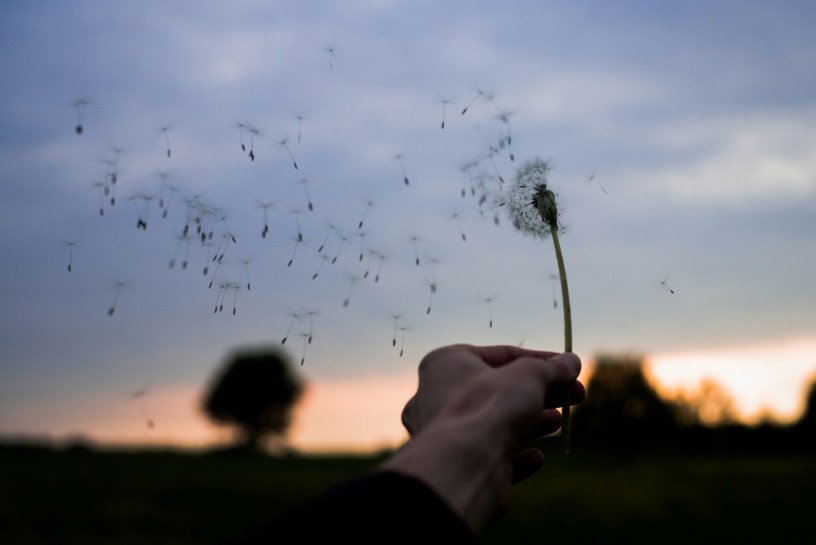
Photo by Oliver Hihn on Unsplash
 Lauren Ostrout ~ on being made well