
“Welcoming Sinners” Colchester Federated Church, September 14, 2025, (Luke 15:1-10) Fourteenth Sunday after Pentecost
I once was lost, but now am found, was blind but now I see. Today we are contemplating God’s amazing grace. Because Jesus once told his followers some relatable parables in the Gospel according to Luke about being lost and being found.
Jesus first told folks about a lost sheep. Just imagine that someone among us has one hundred sheep, but loses one. Wouldn’t that person leave the other ninety-nine in the pasture and search for the lost one until they find it? And when that lost sheep is found, wouldn’t that person be thrilled and place the sheep up on their shoulders? Wouldn’t they arrive home and call together their friends and neighbors, saying, “Celebrate with me because I’ve found my lost sheep.”[1]
Or Jesus tells us to imagine a woman who has ten silver coins. One of those silver coins is lost. Wouldn’t she light a lamp and sweep the house searching carefully until she finds that one lost silver coin? And when she finds it, maybe she would call her friends and neighbors together, saying, “Celebrate with me because I’ve found my lost coin.”[2]
Because that’s sometimes what we do. We find something that was lost and we can’t help but shout it from the rooftops! We rejoice when something lost has been found—whether it’s a ring or a watch or a jacket or a book or our favorite umbrella or a lost dog comes back home. We are good friends to one another when we take the time to celebrate someone else’s success. Life is hard enough. It’s important to celebrate the wins!
Though what makes these parables especially powerful is that we can easily imagine other scenarios. We can imagine that the shepherd does not go looking for that 1 lost sheep because the shepherd has 99 to look after. Perhaps it does not seem wise to leave so many behind to just focus on the one sheep. There is a saying (from Star Trek I think) that the needs of the many outweigh the needs of the few, or the one. Sometimes sacrifices are made to protect the vast majority of people (or sheep in this case).
Or we can imagine that the woman doesn’t worry herself too much with finding that one lost silver coin. Of course it matters, but at least she can comfort herself that the nine silver coins are still safe and sound in her possession. Why tear apart the whole house when it’s bound to turn up sometime soon anyway?
Though what once was lost is now found. The shepherd and the woman go through a great deal of effort to go searching for what was lost. There is a single-mindedness and intentionality here to find what was lost. The needs of the one end up mattering a great deal when it comes to the lost coin and the lost sheep. Jesus tells us that so it goes with God. Jesus once taught, “Aren’t two sparrows sold for a small coin? But not one of them will fall to the ground without [God] knowing about it already. Even the hairs of your head are all counted. Don’t be afraid. You are worth more than many sparrows.”[3]
Jesus tells us that rejoicing is the reaction in heaven when one person changes their heart and life and comes back to God. Because Jesus told these stories about the sheep and the coin being lost and found after he was criticized by the Pharisees and the legal experts. The criticism came about because of who Jesus associated with as he was going about his ministry. Jesus is welcoming and eating with tax collectors and sinners. This is what the Pharisees and the legal experts are grumbling about. Perhaps rightly so!
Because in those days tax collectors were nearly universally despised. In the First Century, tax collectors were often untrustworthy. In their line of work, they collected tolls, market duties, and all kinds of local taxes (sales tax, income tax, property tax, and inheritance tax.) Though tax collectors made a better living by overcharging people. Some of their fellow Jews saw them as Roman collaborators.
Though Jesus saw the situation differently. He responds to this criticism by these “righteous” religious folks by telling these parables—about the one sheep that went missing and the one coin that went missing. About how much the shepherd and the woman rejoiced when they found what had been lost. Jesus ends these stories by saying to those who criticize his welcoming ways, “In the same way, I tell you, joy breaks out in the presence of God’s angels over one sinner who changes both heart and life.”[4]
It ends up that God isn’t looking for our perfection, but our sincerity. God is after authenticity and not putting on a show to act as though we are blameless and without any flaws. God knows that we are not perfect. As the joke goes—the Church is full of hypocrites, and there’s always room for one more. God knows that sometimes we end up lost like that coin and that sheep. We sin—we end up separated from God, from one another, and from being the person that God is calling us to be.
Through many dangers, toils, and snares I have already come. The point is to remember that we can be found. Separation can be overcome. There’s rejoicing (not judgment) when we come back home to God no matter where we’ve been or what we’ve done or left undone in our lives. For these are images of true welcome, shared after Jesus has been criticized for welcoming those “tax collectors and sinners” in the first place. This is an image of God seeking out to save the lost and the lonely.
It reminds me of something that happened when my best friend Emilia and I were visiting England. We had stayed in a cottage on a working farm in Middleton Stoney near Oxford. Our Airbnb hosts invited us to walk around the farm if we wanted and included a map of paths on the property. Em and I went walking one day on the farm, securing the fence behind us. We moved from observing the chickens to the cows to some of the sheep when all of a sudden we came upon a single sheep on the path right in front of us.
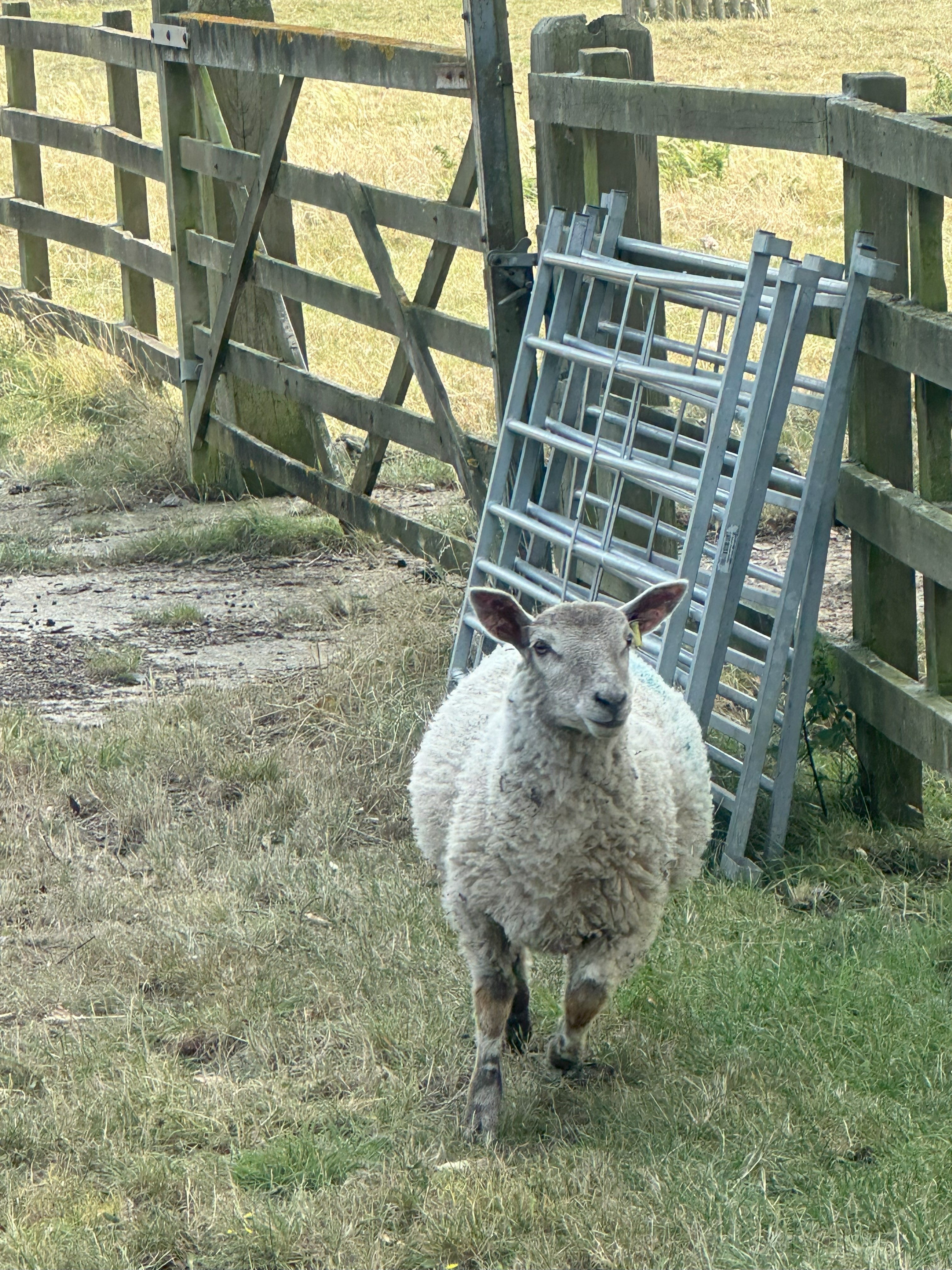
We looked at the sheep and the sheep looked at us. The sheep was quite vocal and skittish as he darted away. We wondered aloud to each other, “What do we do?” All the other animals are in various pastures—the cows and the chickens and the sheep and even a few bulls in their own pastures secured by various gates and fences. Yet here was this one seemingly lost sheep. We wondered, can the sheep somehow get through the fence we just came through and eventually onto the road and get run over? Is the sheep hurt or somehow in distress?
We decided that it was our responsibility to alert someone on the farm about this lost sheep because we are good, responsible guests. So we hustled and found one of the farmers. We literally flagged her down while she was on a tractor by frantically waving our arms. Out of breath, we explained that one of your sheep is out of the pasture. We just saw that lost sheep on the path.
The farmer thanked us and chuckled and explained (in her fabulous British accent), “Oh I know the one. Don’t worry. He can’t go far. He’s just nosy and likes to slip out to visit the sheep in the other pasture. But he always makes his way back where he belongs.” The farmer’s reaction was comforting. That lost sheep will make his way back where he belongs. And eventually, he did.
Somehow, some way God keeps calling us home.
‘Tis grace that brought me safe thus far, and grace will lead me home.
Thanks be to God. Amen.
[1] Luke 15:6, CEB.
[2] Luke 15:9.
[3] Matthew 10:29-31.
[4] Luke 15:10.
Photos by Rev. Lauren Ostrout.
 Lauren Ostrout ~ on being made well