“Unexpected Joy” Colchester Federated Church, December 14, 2025, Third Sunday of Advent (Luke 1:39-55)
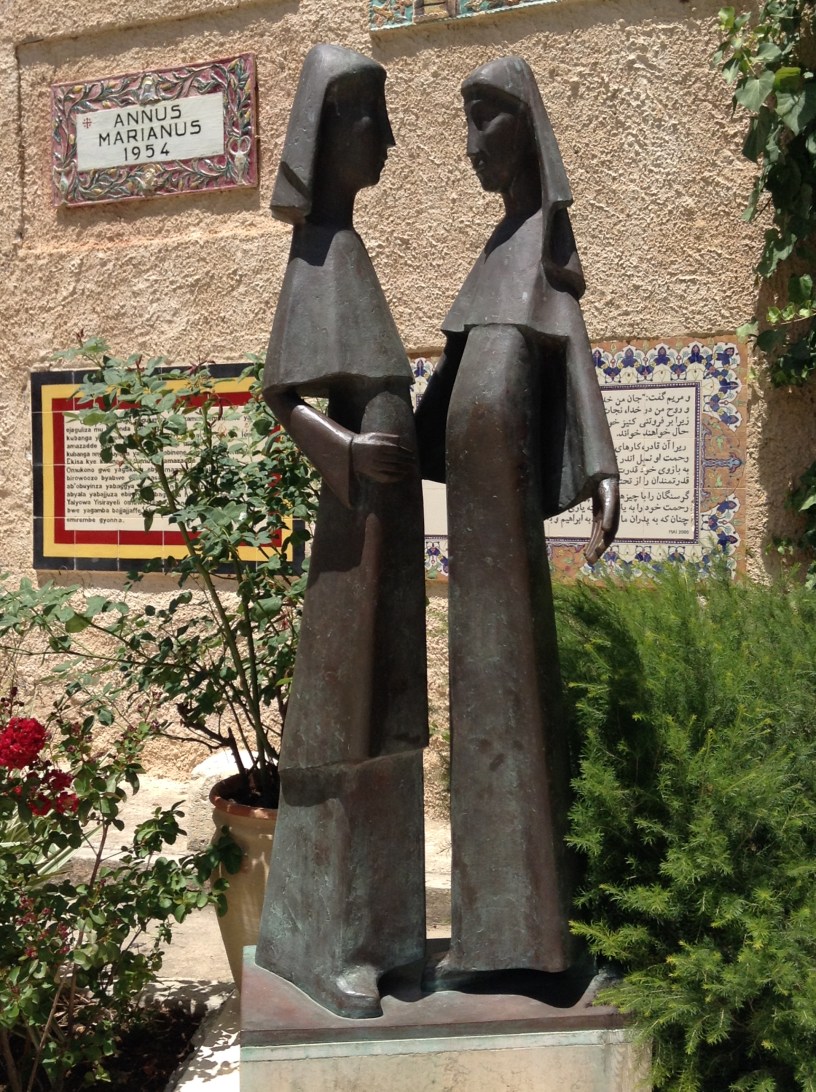
On the Third Sunday of Advent—Joy Sunday—we are spending time with Elizabeth and Mary in the Judean highlands. Luke tells us that Mary travels to see her relative Elizabeth as both women are pregnant. This all takes places after the miraculous visitation from the angel Gabriel when Gabriel told Mary, “Look! You will conceive and give birth to a son, and you will name him Jesus . . . Look, even in her old age, your relative Elizabeth has conceived a son. This woman who was labeled ‘unable to conceive’ is now six months pregnant. Nothing is impossible for God.”[1] Of course Mary has to go and see the good news for herself. When Mary arrives, Elizabeth affirms Mary’s calling: “happy is she who believed that the Lord would fulfill the promises [God] made to her.”[2]
We remember that Mary had previously encountered the angel Gabriel and responded to the notion that her child will be great, called the Son of the Most High, and will reign over the house of Jacob forever with, “Here am I, the servant of the Lord; let it be with me according to your word.”[3] In the Annunciation, Mary is confused, but not necessarily afraid. She asks questions. She wonders what kind of greeting this is. She questions Gabriel further and comes to an understanding of what will come to pass. And after that remarkable encounter with an angel and after hearing words of affirmation from Elizabeth, she can’t help but break into this song of pure joy. This remarkable song that we call “The Magnificat” because it begins with “my soul magnifies the Lord.”
Homiletics Professor Charles Campbell reflected on Mary’s story by writing, “The church prepares this week for Jesus’ birth, not through serious theological reflection, but through subversive laughter, singing, and astonishment . . . The story is not only odd and joyful, it is fleshy, embodied, earthy, appropriate as a forerunner to the incarnation . . . in the women’s actions, the world is indeed turned upside down. Hierarchies are subverted. The mighty are brought down. Two marginalized, pregnant women carry the future and proclaim the Messiah.”[4] This is fantastic and joyful beyond measure. Mary can’t help but proclaim the goodness of God in the midst of all these unexpected blessings.
These women are proclaiming joy, not joy as an avoidance of pain but as the response of people who know that God dwells with them. In line with the reversal theme throughout Luke’s Gospel, Mary says that God has “pulled the powerful down from their thrones and lifted up the lowly. [God] has filled the hungry with good things and sent the rich away empty-handed.”[5] In this revolutionary song Mary reveals that there are systems in place that exploit the poor. Though Mary is imagining a different reality where God is scattering the proud, filling the hungry, and lifting up the lowly. We still have a long way to go to make Mary’s words come to fruition. Though this is the invitation—to understand joy as not just a feeling, but joy as rooted in justice for all God’s children. Because real joy is not about stuff, it’s not about material possessions that we accumulate. Joy is about the kingdom of God breaking through when we stand beside each other in solidarity.[6]
It was theologian Albert Schweitzer who once said, “I have always held firmly to the thought that each one of us can do a little to bring some portion of misery to an end.” Sometimes the bravest thing we can do is say yes to a new opportunity even though it can be scary. Because each one of us can do something to bring a small portion of misery to an end. On the hard days it’s worth remembering that we have some power to help make our world a better place. Perhaps Elizabeth and Mary’s stories help us take this to heart as these women disrupt the narrative about what makes someone significant in the first place. Because Elizabeth remained childless well into her old age (at a time when many people regarded childlessness as shameful). And Mary is unexpectedly pregnant in circumstances that some considered scandalous. Yet both women trusted that God was with them since God dwells with ordinary people just like them and just like us.
On Joy Sunday, we can celebrate Mary in particular as an inspiring figure. And although Mary is more revered among Catholic and Orthodox Christians than Protestant Christians, it is good to contemplate Mary’s story every Advent because she is remarkable and prophetic. The truth is that Mary’s legacy has become quite something to behold. There are some things we know about Mary historically that makes her all the more remarkable. For instance, we know that Mary was Jewish, she was poor, and she was young when Jesus was born. It’s always worth remembering that Mary and Joseph were Jewish and Jesus was Jewish and all the earliest disciples were Jewish. The community was living under the occupation of the Roman Empire, so life was not easy. The Gospel of Luke shares that Mary lived in Nazareth where Jesus would eventually grow up. Nazareth was a hill-town in the middle of nowhere, a town not even mentioned in the Hebrew Scriptures! There were anywhere from 400-2,000 people who lived in that town and they were mostly day laborers and farmers. Jesus was probably part of the laboring class with his family. So yes, Mary was Jewish living under Roman occupation and came from humble roots in Nazareth. Her sons and daughters (she had more children after Jesus was born) grew up in this historical and cultural context.
Mary and Joseph were betrothed when Mary gets pregnant, and the age of betrothal was 12.5 years old. Matthew tells us about Mary’s pregnancy by sharing, “When his mother Mary had been engaged to Joseph, but before they lived together, she was found to be pregnant from the Holy Spirit.”[7] The Greek word we translate into English as “virgin” (parthenos) can also mean young woman or maiden, as in someone of child-bearing age who wasn’t married. The point being that Mary was young when she gives birth to her oldest child—Jesus. From a historical context, it is impossible to verify the miracle of the Virgin Birth. That’s why we can say that Mary was Jewish, poor, and young but it becomes a matter of faith as to how we understand the spiritual circumstances that led to the birth of Jesus. Though Mary responds with a resounding yes to the calls of God in her life.
Perhaps the point is that life doesn’t need to be perfect in order to find joy. Soon we will hear the story yet again about how Mary and Joseph had to travel from Nazareth in Galilee to Bethlehem to be enrolled on the Roman tax lists. Mary was close to giving birth and must have been uncomfortable. Joseph must have been worried sick. Mary and Joseph were simple, law-abiding people. They were poor and not powerful, as were the shepherds who came to share their company and the miracle of Jesus’ birth. Once Joseph and Mary arrived in Bethlehem, there wasn’t even anywhere for them to stay.
The events we will celebrate on Christmas Eve soon to come aren’t perfect. But they are holy and beautiful and full of joy perhaps because God somehow breaks forth in the midst of an imperfect world. Because joy can be an oasis in the desert. Joy can set us on the path of love even in the wilderness. Joy can be unexpected. Thanks be to God. Amen.
[1] Luke 1:31 and 36-37, CEB.
[2] Luke 1:45, CEB.
[3] Luke 1:38, NRSVUE.
[4] Charles L. Campbell, Homiletical Perspective of Luke 1:39-45 (46-55) in Feasting on the Word, David Bartlett and Barbara Brown Taylor, Eds., Year C, Volume 1, 93 and 95.
[5] Luke 1:52-53, CEB.
[6] Character Spotlight of Elizabeth in The Will to Dream Commentary & Preaching Guide from Illustrated Ministry, © 2025 Illustrated Ministry, LLC.
[7] Matthew 1:18, NRSVUE.
Photo by Rev. Lauren Ostrout at Church of the Visitation in Ain Karem, Jerusalem.
 Lauren Ostrout ~ on being made well