
“Who is Blessed?” Colchester Federated Church, February 1, 2026, Fourth Sunday after the Epiphany (Matthew 5:1-12)
Soon we will tune into the Super Bowl and enjoy the big game between the Seattle Seahawks and the New England Patriots. While scanning the crowd, it will not be surprising to see someone holding up a John 3:16 sign— “For God so loved the world that [God] gave [God’s] only Son, so that everyone who believes in him may not perish but may have eternal life.”[1] Though I am longing/begging/pleading for the day when someone in some stadium somewhere holds up a sign that directs people to Matthew 5:1-12—the Beatitudes. “Blessed are the poor in spirit. Blessed are those who mourn. Blessed are the meek. Blessed are those who hunger and thirst for righteousness. Blessed are the merciful. Blessed are the pure in heart. Blessed are the peacemakers. Blessed are those who are persecuted for the sake of righteousness. Blessed are you when people revile you and persecute you and utter all kinds of evil against you falsely on my account.”
The Beatitudes are among the most important teachings Jesus shared with his followers as Jesus began teaching what became known as the Sermon on the Mount. This section of the Gospel according to Matthew marks Jesus’ first major speech beginning in chapter 5 and extending all the way through chapter 7 when Jesus finishes saying these words and the crowds are astounded at his teaching. The Sermon on the Mount is the most famous sermon Jesus ever preached. If you recall, our congregation here at CFC deeply engaged with the Beatitudes during the pandemic. Coloring pages from Illustrated Ministry were made available to members and friends of our congregation and we all individually colored images inspired by these teachings. Then we mailed or dropped off those finished masterpieces back to church and Nicole assembled the individual coloring sheets to become larger posters that visually represented these blesseds.
There’s a reason why Illustrated Ministry created a whole curriculum based on these twelve verses of the Bible. Because the Sermon the Mount is so famous and because the Beatitudes in particular are full of wisdom for people of all ages and stages of life. Through them we begin to glimpse Jesus’ vision of God’s inclusive kingdom. We can understand how Jesus turned traditional views about who is blessed upside down. The poor in spirit are blessed. Those who mourn are blessed. The meek are blessed. The peacemakers are blessed. The persecuted are blessed. The reviled are blessed.
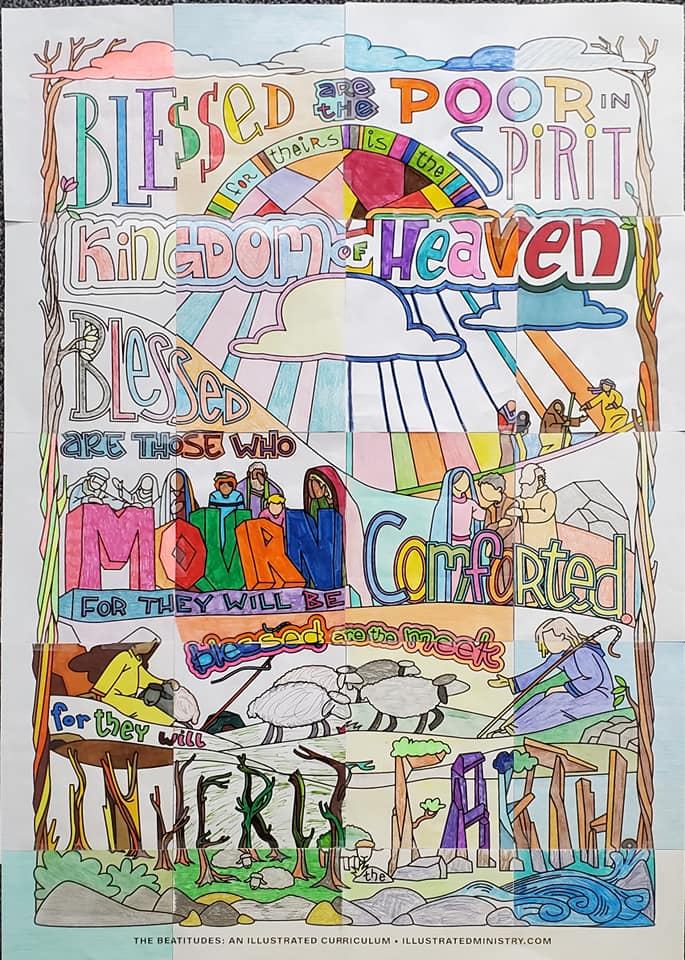
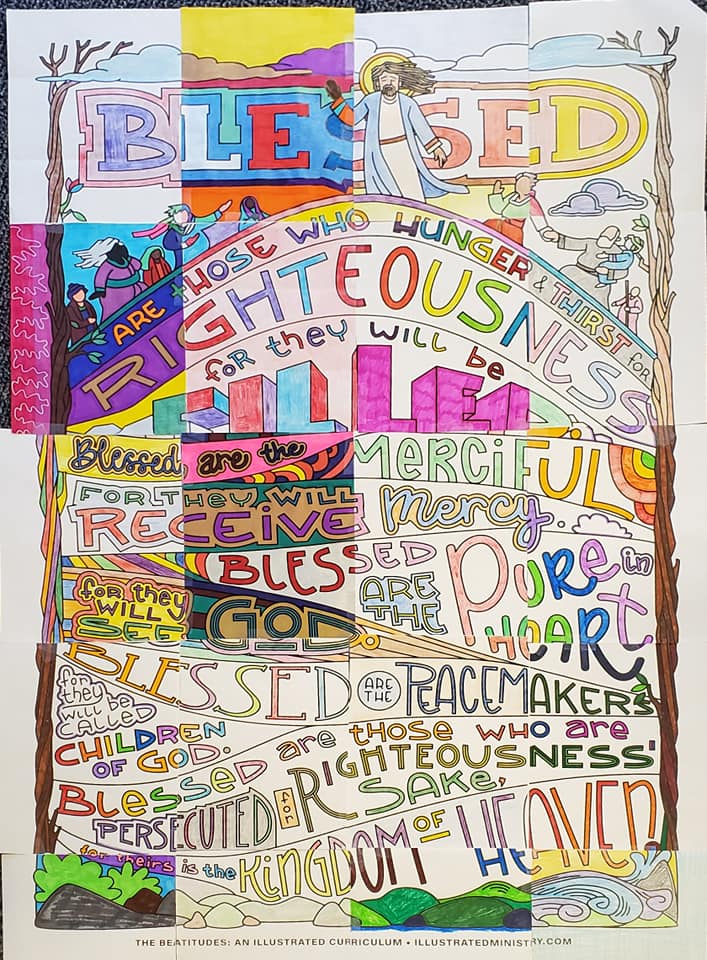

I appreciate how Jesus’ teachings are translated in the First Nations Version: An Indigenous Translation of the New Testament: “Creator’s blessing rests on the poor, the ones with broken spirits. The good road from above is theirs to walk. Creator’s blessing rests on the ones who walk a trail of tears, for he will wipe the tears from their eyes and comfort them. Creator’s blessing rests on the ones who walk softly in a humble manner. The earth, land, and sky will welcome them and always be their home . . . Creator’s blessing rests on the ones who are merciful and kind to others. Their kindness will find its way back to them—full circle.”[2] Those are just a few verses. Though the way these verses are translated emphasizes that the blessing of God our Creator is bestowed upon people who may not look all that strong and put together on the outside. Creator’s blessing is bestowed upon those with broken spirits, those who walk a trail of tears, those who walk softly, and those who are merciful and kind to others. We can be at peace knowing that we are living our lives in service to God when we are being the hands and feet of Christ to one another.
In some ways, followers of Jesus have been debating what to do with these teachings and how to understand them ever since Jesus shared them! New Testament Professor Warren Carter asks some great questions we all may wonder when we read the Beatitudes, “How does the sermon function, and for whom? Does it set out entry standards for encountering God’s empire, or does it set out practices for committed Jesus-followers? Does it establish impossible standards that force people to cry out for divine mercy, or does it provide an interim ethic ahead of Jesus’ return but which, with the passing of time, is no longer relevant? In other words, what is the interaction between grace and works, the indicative and the imperative? Does the sermon reveal God’s will, persuade compliance, construct identity, train for discernment, empower followers?”[3]
Thinking about the Beatitudes this week reminded me of what happened to a pastor named Russell Moore, the editor of Christianity Today. Moore was once one of the top officials in the Southern Baptist Convention. Eventually he found himself in contention with some of the leaders of his denomination about various issues, specifically he was troubled by political endorsements, the response to abuse within the Southern Baptist denomination, and the rise of Christian Nationalism. Suddenly Russell Moore found himself on the outside looking in. In an interview with NPR back in 2023 on All Things Considered, Moore was asked why he thinks Christianity is in a crisis today. He responded, “Well, it was the result of having multiple pastors tell me essentially the same story about quoting the Sermon on the Mount parenthetically in their preaching – turn the other cheek – to have someone come up after and to say, where did you get those liberal talking points? And what was alarming to me is that in most of these scenarios, when the pastor would say, I’m literally quoting Jesus Christ, the response would not be, I apologize. The response would be, yes, but that doesn’t work anymore. That’s weak. And when we get to the point where the teachings of Jesus himself are seen as subversive to us, then we’re in a crisis.”[4]
Blessed are the merciful. Blessed are the peacemakers. Blessed are the meek. These are the words of Jesus Christ. Maybe these teachings seem “weak” on the surface. We certainly know that the crowds who first heard them up on that mountain with Jesus were astounded by these teachings in part because Jesus shared them with such authority. We know that Jesus’ teachings emphasize inclusion. The Beatitudes are astounding because this is not a depiction of Jesus as a heavenly warrior trampling on his enemies and encouraging his followers to go and do likewise. These kingdom ethics shared from Jesus’ heart are not meant for the faint of heart. These are challenging teachings that could help our world be more just and more compassionate if we were to actually put them into practice. Some folks are putting them into practice, look for the helpers—blessed are the peacemakers. Blessed are those who are persecuted. Blessed are the merciful. Blessed are the pure in heart. Thanks be to God. Amen.
[1] John 3:16, NRSVUE.
[2] Matthew 5:3-5 and 5:7, First Nations Version: An Indigenous Translation of the New Testament.
[3] Warren Carter, “Commentary on Matthew 5:1-12,” Working Preacher, February 1, 2026, https://www.workingpreacher.org/commentaries/revised-common-lectionary/fourth-sunday-after-epiphany/commentary-on-matthew-51-12-11
[4] “Russell Moore on ‘an altar call’ for Evangelical America,” NPR, August 5, 2023, https://www.npr.org/2023/08/05/1192374014/russell-moore-on-altar-call-for-evangelical-america
Cover Photo by Rev. Lauren Ostrout taken at The Church of the Beatitudes by the Sea of Galilee.
Gallery Photos of Colchester Federated Church’s Beatitudes posters colored during the Covid-19 pandemic.
 Lauren Ostrout ~ on being made well