“Up a High Mountain” Colchester Federated Church, February 15, 2026, Transfiguration Sunday (Matthew 17:1-9)
This Sunday is Transfiguration Sunday where we see the miracle of Jesus’ glory revealed to Peter, James, and John on top of a high mountain. In the Liturgical Calendar, the transfiguration is the story we consider on the Sunday right before Ash Wednesday. This is the story we hear in worship before the holy season of Lent begins. Preaching and Worship Professor Laurence Hull Stookey relates that the transfiguration acts as a bridge into Lent by identifying who Jesus is and by anticipating what will occur in Jerusalem. Stookey asks, “Who is this who is born in Bethlehem and now is steadfastly headed for Jerusalem? This is the One who by being crucified and raised will fulfill all that the scriptures have promised. Before the curtain goes up on the action of a dramatic opera, the orchestra plays an overture that hints at the musical themes to follow; so, just before the opening of Lent, the transfiguration presents subtle clues to the content of the Forty Days of Devotion and Discipline and the Great Fifty Days of rejoicing that follow.”[1]
It’s that important of a story, acting as a bridge into a whole new season. In the Gospel according to Matthew, Jesus was transformed in front of his disciples Peter, James, and John on top of that very high mountain. We hear that Jesus’ face shone like the sun and his clothes became as white as light. Moses and Elijah appeared on that mountain, talking to Jesus. A bright cloud overshadowed them—a symbol of God’s presence. A voice came from the cloud, saying, “This is my Son whom I dearly love. I am very pleased with him. Listen to him!”[2] The disciples fell on their faces because they were understandably filled with fear and awe. Peter even offers to build shrines in order to honor Moses, Elijah, and Jesus. Because what do you do with that kind of religious experience if you’re a humble fisherman from Galilee? Perhaps you offer to get to work, to build something to remember this holy moment forever.
Though Jesus touches his followers with compassion as they are on the ground overwhelmed by all they just experienced. Jesus tells them to get up and to not be afraid. As Jesus, Peter, James, and John come down the mountain Jesus has a strict instruction for them, “Don’t tell anybody about the vision until the Human One is raised from the dead.”[3] And as soon as they come down from that mountain there is a crowd already waiting for them. There is a man who meets Jesus and asks for his help, to show mercy on his son. There is seemingly no time to dwell on that holy moment because the needs of the world have not stopped during that time spent apart.
It’s worth wondering how the disciples reacted to that instruction from Jesus. Can you imagine being Peter, James, or John and witnessing this miracle? You meet Moses and Elijah—two of the most significant figures in your religious tradition. Moses represents the Law and Elijah represents the Prophets. You see Jesus transformed before your eyes with his face shining and his clothes becoming a brilliant white color. You hear the very voice of God. And on the way down the mountain, on the way back to reality and life as you know it, back to the world full of hardship and complications—Jesus tells you, “By the way, don’t tell anybody about this vision until I’m raised from the dead. Okay, thank you!”
The transfiguration is an incredible story. The story taking place on top of that high mountain (most likely Mount Tabor) matters. Has anyone here ever climbed a mountain? I know that some of you have! As a forest wanderer (happily not a mountain climber) it amazes me that there are folks who love to climb mountains. There are even mountaineers who make it a life goal to climb the Seven Summits—the highest mountains on each of the seven continents.
Mountains occupy that liminal space between heaven and earth. Mountains are home to more biodiversity than any other landscape. Mountains seem to loom large in our imaginations. In the book Speak with the Earth and It Will Teach You: A Field Guide to the Bible UCC Minister Daniel Cooperrider ponders, “As microcosms of the earth and its seasons, mountains also appear to be that part of the earth that is attempting to reach beyond the earth, which speaks to the human yearning for transcendence and the beyond.”[4]
Some New Testament scholars have pointed out that Matthew’s Gospel is actually shaped by mountains. There are seven mountain stories that Matthew uses throughout the Gospel to share pivotal moments of Jesus’ life and ministry with us.[5] We will soon hear about Jesus’ temptation in the wilderness as we move into Lent. We will consider how Jesus was tested for forty days and forty nights. At the end of that testing, Jesus is led to the top of a very high mountain. Then there was that mountaintop story we heard just a few Sundays ago—when a crowd gathered before Jesus on top of a mountain as he shared his most important teachings in the form of the Sermon on the Mount. “When Jesussaw the crowds, he went up the mountain, and after he sat down, his disciples came to him. And he began to speak and taught them, saying: ‘Blessed are the poor in spirit, for theirs is the kingdom of heaven. Blessed are those who mourn, for they will be comforted. Blessed are the meek, for they will inherit the earth.’”[6]
After preaching and healing, Jesus would sometimes withdraw from the demands of the world and hike up a mountain to pray by himself. On one of those occasions, a crowd once again gathers before him as Jesus feeds the multitudes with five loaves of bread and two fish. After the feeding of the five thousand, the next mountaintop story is what we are considering today—Jesus transfigured atop Mount Tabor. A few chapters later, Jesus will sit with his disciples on the Mount of Olives and reflect on events that will come to pass. Jesus will be led away to be crucified at Golgotha—the mountain of crucifixion. Finally, Matthew explicitly ends his Gospel with the Great Commission, “Now the eleven disciples went to Galilee, to the mountain to which Jesus had directed them . . . And Jesus came and said to them, ‘Go therefore and make disciples of all nations, baptizing them in the name of the Father and of the Son and of the Holy Spirit and teaching them to obey everything that I have commanded you. And remember, I am with you always, to the end of the age.’”[7]
Isn’t this amazing when we consider all these pivotal events of Jesus’ life and the role that mountains play in shaping his story? We could try to pass this off as coincidental, but the truth is that Jesus seems to have a fondness for mountains in the Gospel of Matthew in particular. Perhaps just like Moses and Elijah who came before him who also had some marvelous mountaintop moments themselves. These remarkable stories in Jesus’ life all taking place up a high mountain can still inspire, especially for those who may also love mountains. Because maybe there is something magical about mountains! There’s something about mountains that speaks to our human need for connection and even transformation, to our human yearning for transcendence and the beyond.
Going back to Rev. Daniel Cooperrider’s book, he reflects on the story of the transfiguration through the lens of the theologian Irenaeus. Irenaeus famously said, “The glory of God is a human being fully alive.” So we can imagine the disciples hiking up this mountain with Jesus and that as the hike goes on the disciples would have become more in-step with the rhythms of the mountain. Perhaps by the time they reach the peak of the mountain they were fully attuned to the moment before them, present to one another and to Jesus. “And then, in something like the state of having their attention restored to maximum capacity, they finally see what’s right in front of them, and what’s been right in front of them the whole time . . . They see Jesus in a way that they never had before. They see Jesus for who he truly is, a human being fully alive, the glory of God.”[8]
The story of the transfiguration is one of those Gospel stories that can give us hope should we ever feel hopeless. It is more than okay to need moments apart from the needs of the world. Even Jesus had to hike up a mountain sometimes to take a break from the crowds! And sometimes we too will have mountaintop moments on our faith journeys, when our attention is at maximum capacity and we truly see what is right in front of us. Holy moments where we experience transcendence. We can rejoice when we experience those moments when time stands still and we are fully alive. And it’s true—the glory of God is a human being fully alive. Thanks be to God. Amen.
[1] Laurence Hull Stookey, Calendar: Christ’s Time for the Church, pg. 137.
[2] Matthew 17:5, CEB.
[3] Matthew 17:9, CEB.
[4] Daniel Cooperrider, Speak with the Earth and It Will Teach You: A Field Guide to the Bible, pg. 53.
[5] Matthew 4:8, 5:1, 15:29, 17:1, 24:3, 27:33, and 28:16.
[6] Matthew 5:1-5, NRSVUE.
[7] Matthew 28:16-20 (adapted), NRSVUE.
[8] Cooperrider, Speak with the Earth and It Will Teach You, pgs. 82-83.
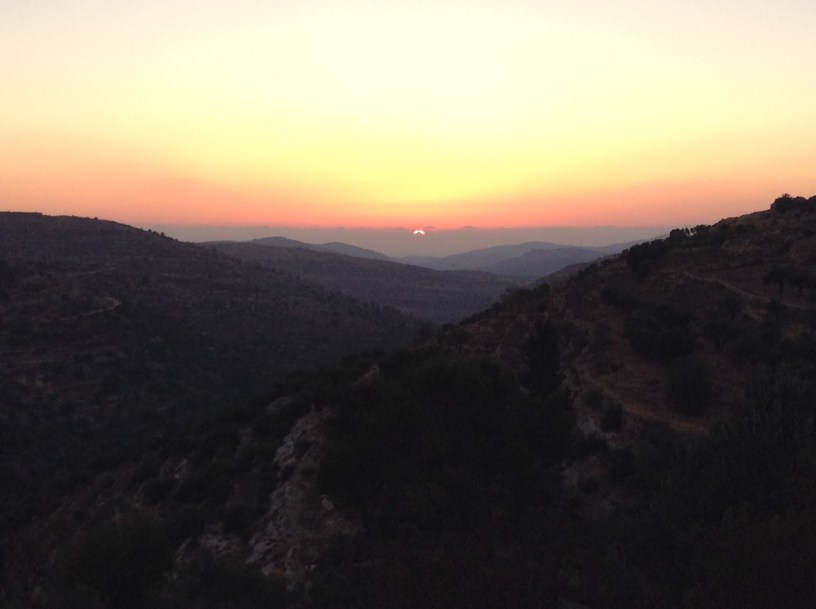
Photo by Rev. Lauren Ostrout.
 Lauren Ostrout ~ on being made well