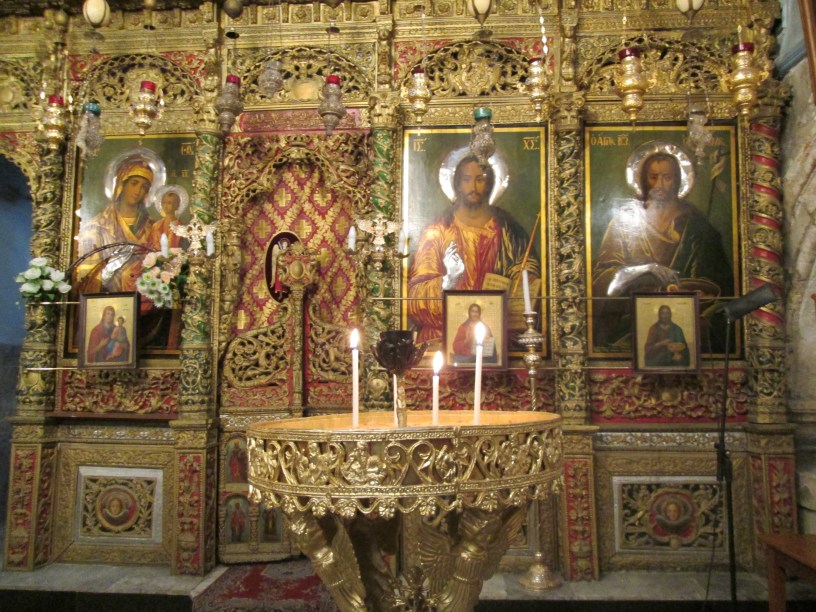
“The Stone is Rolled Away” Colchester Federated Church, April 5, 2026, Easter Sunday (John 20:1-18)
Mary Magdalene comes to the tomb early in the morning on the first day of the week while it is still dark outside. The events of the last few days must have been running through her mind and weighing heavily on her heart. The joyous parade in Jerusalem and the tender meal in the upper room. “This is my body, which is given for you. Do this in remembrance of me . . . This cup is the new covenant by my blood, which is poured out for you.”[1] Mary must have contemplated Jesus washing the feet of his disciples and commanding them to love one another as he had always loved them. “I give you a new commandment: Love each other. Just as I have loved you, so you also must love each other.”[2] And then she must have ruminated on when things took a turn—Jesus’ agony in the garden and arrest. Sham trials and his painful crucifixion. “Father, forgive them, for they don’t know what they’re doing.”[3] Mary Magdelene and some of the other women had stayed by Jesus’ side up until the end, weeping at the foot of his cross.
Today we see Mary making her way to Jesus’ tomb in the early hours of Easter morning. Some versions of the Easter story share that Mary and some of the other women go to the tomb and bring spices so they could anoint Jesus’ body. Everything had been so painful and chaotic. Though at least they could honor Jesus in death and prepare his body for a good and proper burial. Yet in the Gospel according to John, Jesus’ body is anointed by Joseph of Arimathea and Nicodemus after the crucifixion. Remember Nicodemus? His story is one we explored during Lent—a story of a powerful one-on-one encounter with Jesus. He was a Pharisee and a leader, the one who had come to Jesus at night asking about being born from above. In John’s Gospel, Nicodemus comes to honor Jesus in death, bringing with him a mixture of myrrh and aloe. Following Jewish burial customs Joseph and Nicodemus anoint Jesus’ body with the spices and wrap him in linen cloths. These faithful men lay Jesus in a new tomb.
In John’s Gospel there is no mention of Mary traveling with other women and bringing spices to anoint Jesus’ body. This loving act had already been performed by Joseph and Nicodemus. Instead Mary Magdelene travels to the tomb in the early hours of the morning before the sun had even risen for the day alone. Mary goes to the tomb seemingly to mourn her friend Jesus and to be present at the place where they laid Jesus. This is when she immediately sees that the stone covering the opening of that new tomb had in fact been rolled away.
Even after she runs back to find Peter and the beloved disciple we see Mary once again alone at the tomb after the other disciples depart. Mary stands outside the tomb crying. It is in part two of the morning’s Easter scene that Jesus appears and she mistakes him for the gardener. The theme of recognition and nonrecognition continually plays out in this chapter of the Gospel. Though we hear Jesus call her name— “Mary.” And Mary returns with conviction to find her fellow disciples. Mary announces, “I’ve seen the Lord.”[4] Mary Magdelene becomes the first person to experience the Resurrected Christ. Mary Magelene becomes the Apostle to the Apostles. Episcopal priest Cynthia Bourgeault reflects, “The story of Mary Magdelene really begins at the moment of Jesus’s physical death, and its epicenter is always in the profound transition point between dying to human love and awakening to a new reality.”[5]
Jesus tells Mary gently, “Don’t hold on to me, for I haven’t yet gone up to my Father. Go to my brothers and sisters and tell them, ‘I’m going up to my Father and your Father, to my God and your God.’”[6] In essence Jesus is telling Mary that the story is not over, and is just beginning in some ways. She cannot cling to him because there is so much more to do as followers of Jesus Christ. Death did not get the last word in God’s story. Christ is risen indeed! And that work begins right away when Mary goes and announces that she has seen the Lord to her fellow disciples.
Now while I have never bought into The Da Vinci Code theory that Mary Magdalene was Jesus’ wife I do believe that she was a far more significant leader of the Jesus movement then she is often credited with being. The first person to see the Resurrected Christ is Mary Magdelene after all. There was a podcast some months ago (We Can Do Hard Things) that highlighted Mary Magdelene’s significance in the Christian tradition. I know that some of you listened because several church members texted and chatted with me afterwards to say, “Did you know how big of a deal Mary Madelene is? Did you know that some people in the Church have downplayed how big of a deal Mary Magdaelene is?” To which I said, “Yes! Do you know how much I love Mary Magdelene?” Some years ago when we dressed up as our favorite Bible characters in worship I dressed up as Mary Magdelene—and no one knew who I was (not that I’m still salty about it)!
There is even the Gospel of Mary (that did not make it into the New Testament canon). The Gospel of Mary has its own version of the upper room appearances that we can read in the Gospels of Luke and John. Recent New Testament scholarship from Elizabeth Schrader calls into question some discrepancies in ancient versions of the Gospel of John that may have intentionally obscured Mary Magdelene’s significance. As historian Diana Buter Bass declares, “Mary is indeed the tower of faith. [Our] faith is the faith of that woman who would become the first person to announce the resurrection. Mary the Witness, Mary the Tower, Mary the Great, and she has been obscured from us. She has been hidden from us and she been taken away from us for nearly 2,000 years.”[7]
In more enlightened Christian churches, we can celebrate Mary Magdelene’s significance every Easter because she serves as such a wonderful example of Christian discipleship. Mary Magdelene stayed at the foot of Jesus’ cross and bore witness to his suffering. When we have loved ones experiencing pain and sorrow, we can do the same and show up with loving hearts. We can embody a ministry of presence. Mary went to the tomb while it was still dark to grieve the death of her friend Jesus. When we experience loss we can acknowledge our grief, with and for each other. Mary did not cling to the past, but moved forward to a hopeful future declaring for all to hear, “I’ve seen the Lord.” May we go forth and do likewise. Thanks be to God, and Happy Easter. Amen.
[1] Luke 22:19-20, CEB.
[2] John 13:34, CEB.
[3] Luke 23:34, CEB.
[4] John 20:18, CEB.
[5] Cynthia Borgeault, The Meaning of Mary Magdalene: Discovering the Woman at the Heart of Christianity, pg. 165.
[6] John 20:17, CEB.
[7] Diana Butler Bass, “Mary the Tower” https://dianabutlerbass.substack.com/p/mary-the-tower
Photo by Rev. Lauren Ostrout.
 Lauren Ostrout ~ on being made well