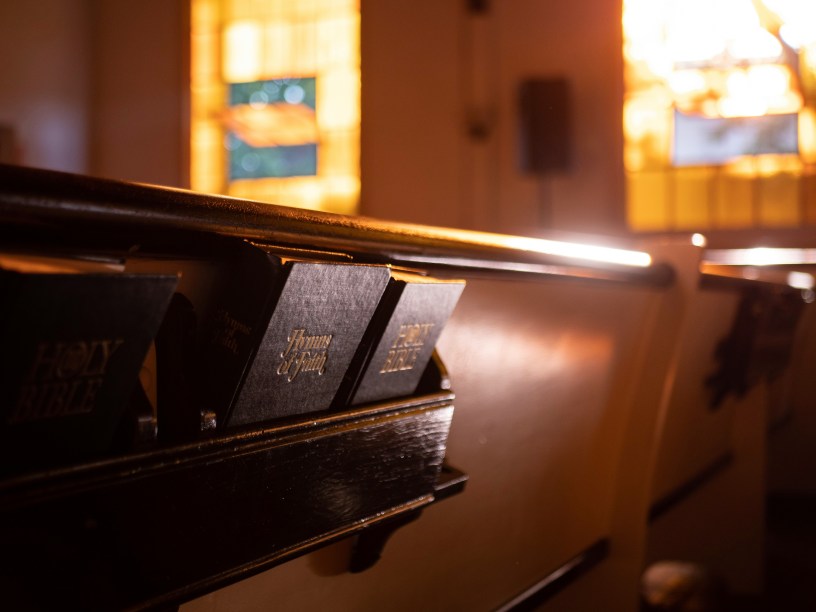
“Doubt, Belief, and New Life” Colchester Federated Church, April 12, 2026, Second Sunday of Easter (John 20:19-31)
On this Second Sunday of Easter we remember that Easter Sunday begins a whole new season in the liturgical calendar. We are now in Eastertide which lasts for 50 days and ends on Pentecost (May 24th this year). As historian Diana Butler Bass shares, “Like Christmas, Easter is more than a single day. It is a season of fifty days. As spring lengthens, as the earth awakens, the year invites us to explore the many meanings of resurrection. It raises questions, even as it inspires hope. Easter speaks to anyone longing for abundant life.”[1] Over the next several Sundays we will keep pondering resurrection and new life. We will contemplate Christ’s resurrection appearances and remember some incredible sacred stories together. We will see the Risen Christ appearing far beyond what Mary Magdelene experienced on the morning of Easter Sunday.
Today we are contemplating Thomas’ story of longing for abundant life. Thomas is known for being the disciple who misses out on an encounter with the Risen Christ on the evening of Easter Sunday. He just cannot believe that resurrection is possible without first seeing the Risen Christ with his own eyes. Let’s be honest, Thomas sometimes gets a bad rap in Christianity. The “Doubting Thomas” nickname stuck. Yet there’s something so authentic and vulnerable and endearing about Thomas. Because Thomas has the courage to voice his doubts. He owns them. He doesn’t take the word of others at face value without embarking on his own quest for truth. Thomas persistently searches for God by resisting easy answers to the hard questions of faith.
What Thomas ends up needing the most to affirm his faith is an experience of the Risen Christ. This is exactly what he gets. Jesus says to him, “Put your finger here and see my hands. Reach out your hand and put it in my side. Do not doubt but believe.”[2] What’s notable is that Jesus doesn’t express impatience with Thomas. He doesn’t tell Thomas that he shouldn’t be having to prove his resurrection because Thomas should have believed the words of his fellow disciples or Jesus’ own teachings. Jesus says that if you want more than a second-hand encounter with me—touch me, see me, believe in me. If nothing else, we can take away negative stigma that may be attached to “Doubting” Thomas. Jesus doesn’t condemn his doubts, so why would we do so?
Now we don’t know if Thomas did touch Jesus, the text actually never says. Jesus meeting Thomas where he was with this compassionate verbal response might have been more than enough to overcome those doubts. We see that Jesus offers this personal religious experience of the resurrection. This is a story about God coming to us, no matter where we are in our spiritual lives. This is a story about God meeting us where we are and offering new life and hope everlasting. And these lessons have major implications for all of us. We’re not left alone to fend for ourselves.
A Gospel story like this Thomas and Jesus’ resurrection story can give us hope when times are particularly hard. Or maybe when we find ourselves in a spiritual drought. Who’s to say that Jesus won’t come to meet us where we are too? If it happened to Thomas, who’s to say that it can’t happen to us?
There’s a lovely experience that Dr. Lauren Winner (Associate Professor of Christian Spirituality at Duke Divinity School) tells about her own spiritual drought in Still: Notes on a Mid-Faith Crisis. Dr. Winner was particularly lost and adrift spiritually right around Holy Week. During the Easter Vigil at her church, she became so restless that she left in the middle of the service to go help in the kitchen for their church’s Champagne Easter Vigil Feast. Gotta love those Episcopalians! After returning to the sanctuary and receiving Communion, she wondered if she should at least try to look like she was praying. As she faced her spiritual restlessness in the pew, she heard: “You can stay here now.” Dr. Winner writes, “Just five words, and I know that this voice is God and what God means is that there is ground beneath my feet again, that this is the beginning of sanity and steadiness, this is the beginning of a reshaped life.” God broke through and met her right where she was at that Easter Vigil service, in her moment of restlessness.[3]
God sometimes has a habit of showing up in unexpected places or at unexpected times. And our lives are never the same. What is amazing about Thomas’ religious experience is that Thomas responds to Jesus’ compassionate movement toward him with an affirmation of faith unlike anything else we hear in the Gospels. Thomas declares: “My Lord and my God!”—one of the strongest declarations of faith about Jesus Christ in the entire New Testament.[4]
This story ends on such a hopeful note for the rest of us. If “Doubting” Thomas can get to profound belief that God’s presence is abiding and that love is victorious over death itself, we can too. If Jesus comes to find Thomas in the midst of his doubt-filled crisis of faith, maybe Jesus can come find us too. That’s certainly what Dr. Winner describes during her personal crisis of faith. Sometimes the hardest thing we face on our spiritual journeys is holding out hope that God can reach us when we’ve reached that place of spiritual drought or debilitating doubt. Though God does seek us out. And stories like these help us to truly believe that when we fear that it’s just not true.
Most of us have moments on our faith journeys when we live in those valleys of shadows and doubts. It can be painful and feel like the dark night of our souls. It’s also perfectly normal that our faith journeys are not always smooth sailing. Even Jesus and the disciples did not stay on the mountain of transfiguration forever.
At the end of the day what’s so amazing about Thomas is that he matters deeply to people halfway across the world from us too. Legend has it that after this episode in the Gospel according to John, after Thomas admits his doubts and comes to make a profound declaration of faith about Jesus, Thomas arrived in India around 52 CE. Once there, he founded a Christian community who in time would call themselves St. Thomas Christians. Supposedly, Thomas helped establish churches and even built a palace for an Indian King while he was living and working among the people. Thomas is thus the Patron Saint for architects, carpenters, construction workers, and surveyors.[5]
And if folks make their way to Mylapore, India they will find San Thome Church. It’s the summit of Indian Christianity and a structure that would certainly make the Patron Saint of architects quite proud. This Roman Catholic Basilica was built over the tomb of Thomas who was martyred in 72 CE. Of course there is debate about Thomas’ remains. Some Christians claim that his remains were transferred to Syria and then onto Italy. But Indian Christians insist that Thomas is and has always been buried in Mylapore. “Doubting” Thomas is the Father of Indian Christianity and the Patron Saint of India.
What a guy, right?! And what broad appeal. Maybe this is because there’s a little bit of Thomas inside all of us. Because it is good and holy to identify with Thomas’ yearning for faith, his doubts, his persistent search for God, his wanting a personal religious experience with the Risen Christ. Thomas can be an inspiration for our faith journeys.
In the end, Thomas’ story can give us hope in our moments of spiritual doubts and droughts. God can come to us, wherever we are in our lives. God can meet us right where we are, whether we are full of faith or emptied by doubt. When we face those profound and desperate questions in our lives or experience suffering or loss unlike anything we’ve known before—we can rest assured that God is present in the midst of our hardest moments. We won’t always have our eyes opened right then. We won’t always hear the still small voice of God in our hearts. We won’t always be able to reach out and touch Jesus even though that’s what we may long for. Yet God does seek us out, sometimes in surprising ways. We need only look to this profound story of Jesus meeting Thomas right where he was to help us believe again. Thanks be to God. Amen.
[1] Diana Butler Bass, A Beautiful Year: 52 Meditations on Faith, Wisdom, and Perseverance, pg. 180.
[2] John 20:27, NRSV.
[3] Lauren Winner, Still: Notes on a Mid-Faith Crisis, 149.
[4] John 20:28, CEB.
[5] Richard P. McBrien, “Thomas, apostle” in Lives of the Saints, 269.
Photo by Aaron Burden on Unsplash
 Lauren Ostrout ~ on being made well