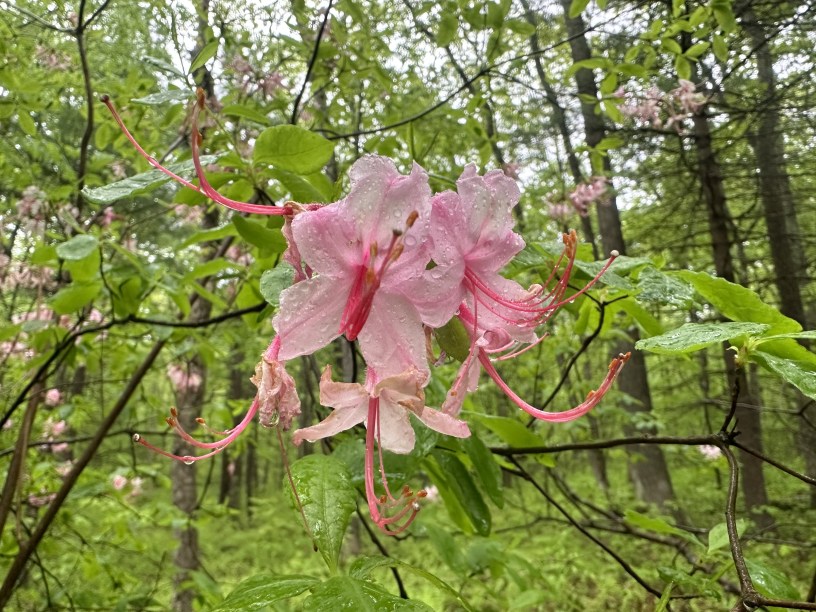
“I have heard our elders give advice like ‘You should go among the standing people’ or ‘Go spend some time with those Beaver people.’ They remind us of the capacity of others as our teachers, as holders of knowledge, as guides. Imagine walking through a richly inhabited world of Birch people, Bear people, Rock people, beings we think of and therefore speak of as persons worthy of our respect, of inclusion in a peopled world. We Americans are reluctant to learn a foreign language of our own species, let alone another species. But imagine the possibilities. Imagine the access we would have to different perspectives, the things we might see through other eyes, the wisdom that surrounds us. We don’t have to figure out everything by ourselves: there are intelligences other than our own, teachers all around us. Imagine how much less lonely the world would be.”
~Robin Wall Kimmerer, Braiding Sweetgrass: Indigenous Wisdom, Scientific Knowledge, and the Teachings of Plants
I recently finished reading Robin Wall Kimmerer’s book Braiding Sweetgrass and watched a presentation she gave on “The Honorable Harvest.” Dr. Kimmerer is a remarkable person. She is a Potawatomi botanist, author, and the director of the Center for Native Peoples and the Environment at the State University of New York College of Environmental Science and Forestry. She offers insights into the natural world through the lens of Western scientific knowledge and indigenous wisdom.
One of my biggest take-aways from Braiding Sweetgrass and the presentation on “The Honorable Harvest” was the importance of gratitude. Dr. Kimmerer shared that we are showered with the gifts of the Earth, and that can help us respond ethically by giving back to the land.
Can we think of ourselves as bearers of gifts as opposed to consumers?
Can we contemplate what the Earth asks of us?
Do we understand that gifts and responsibilities are two sides of the same coin?
If we contemplate what the Earth asks of us, we may come to understand that we are called to respond to the gifts of the Earth with gratitude. This can create an outcome of sustainability. We can embrace a culture of abundance vs. scarcity. (As an aside, conversations about abundance vs. scarcity are occurring constantly in the church world these days given current trends in membership, attendance, giving, church mergers and closures, etc.).
The thing is, gratitude can remind us that we already have what we need.
When we are given a gift, don’t we often want to give a gift in return?
Gratitude ends up being transformational because it challenges the fears inherent in scarcity mindsets and provides an invitation to act and return the gifts that are given.
There are teachers all around us if we would only have the eyes to see and the ears to hear and the hearts to be attuned. There are beings in the more-than-human world that have wisdom to share. In the words of Jesus, “Consider the lilies, how they grow: they neither toil nor spin, yet I tell you, even Solomon in all his glory was not clothed like one of these.” (Luke 12:27, NRSVUE)
Gratitude can ground us, and gratitude is a powerful spiritual gift.
Love,
Pastor Lauren
Photo by Rev. Lauren Ostrout.
Thursday Thoughts 5/23/24
 Lauren Ostrout ~ on being made well
Beautiful.
LikeLike