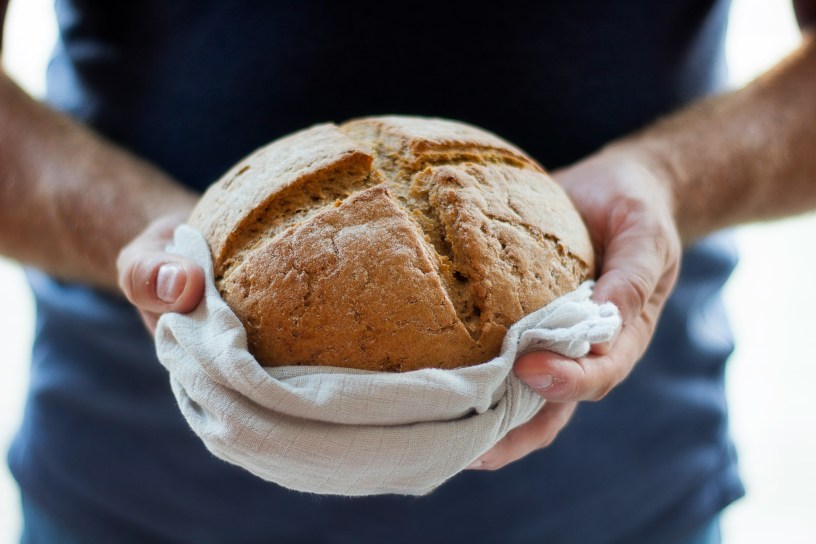
“Miraculous Bread” Colchester Federated Church, August 4, 2024, Eleventh Sunday after Pentecost (John 6:24-35)
Last Sunday we explored the stories of Jesus feeding the five thousand and walking on water in the Gospel according to John. We wondered about the nature of the miracle. Did Jesus miraculously take five loaves of bread and two fish, give thanks, distribute the blessed food among the crowd, and everyone had plenty to eat? Or did people observe Jesus giving thanks with the five loaves of bread and two fish given by a child, and the crowd felt moved by that sharing from scarcity—moved enough that folks scrounged around for whatever food they had brought to then share with one another?
As I said last Sunday—both interpretations are good and both understandings are about a miracle in a way. Of course Jesus miraculously multiplying these rather basic items enough to feed more than five thousand people (if we count everyone present) is a miracle. And it’s also a miracle that the child in our Gospel story was willing to share what they had in order for a miracle to be performed in the first place. Sharing from one’s scarcity so fellow hungry people can be fed and experience God’s abundant, compassionate love—well, if that’s not a miracle, then I don’t know what is!
Today the story continues with Jesus telling those same crowds, “I am the bread of life. Whoever comes to me will never go hungry, and whoever believes in me will never be thirsty.”[1] That “I am” statement becomes the culmination of a conversation that goes back and forth between Jesus and the crowds. Now “the crowds” Jesus is interacting with are the same crowds who witnessed the miracle of multiplication. These are the same people who just had plenty of bread and fish to eat on that mountainside. That’s important to keep in mind because today’s Gospel story is basically explaining and unpacking the miracle of multiplication. Jesus tells them, “I assure you that you are looking for me not because you saw miraculous signs but because you ate all the food you wanted. Don’t work for the food that doesn’t last but for the food that endures for eternal life, which the Human One will give you.”[2] It would seem that the sign these folks had just witnessed, the sign they had just experienced as they ate that bread and fish with thousands gathered before Jesus on that mountainside was still not enough to get them to understand Jesus’ identity.
In trying to process what they just witnessed, the crowds recall the faith story that is the most like what just happened—the story of the manna in the wilderness. We remember the Exodus story and all that Moses did to let God’s people go—to leave slavery in Egypt behind, wander in the wilderness, and eventually the people arrived (without Moses) in the Promised Land. God provided manna from heaven to feed those hungry people. The manna from heaven arrived daily and everyone collected as much as they could eat. Moses warned the people not to keep any of the bread until the morning, but some of the people didn’t listen. By the morning, the bread they were saving for later was infested with worms and smelled badly. Moses got really mad about that. But as the story is told in Exodus, “Every morning they gathered it [the bread], as much as each person could eat. But when the sun grew hot, it melted away . . . The Israelites ate manna for forty years, until they came to a livable land.”[3]
As we spoke about last Sunday, Old Testament scholar Walter Brueggemann explained the myth of scarcity in Exodus by sharing, “In answer to the people’s fears and complaints, something extraordinary happens. God’s love comes trickling down in the form of bread . . . the meaning of this strange narrative is that the gifts of life are indeed given by a generous God. It’s a wonder, it’s a miracle, it’s an embarrassment, it’s irrational, but God’s abundance transcends the market economy.”[4] In the world that the people left behind—the world of slavery and suffering—bread was never freely given. The manna in the wilderness story is an amazing moment of irrational abundance and God providing for God’s people wandering in the wilderness (for forty years)! So, doesn’t it make sense that the crowds make this comparison when reflecting upon what just happened with the feeding of the multitudes? You (Jesus) just fed us like our ancestors ate manna in the wilderness!
Though this understandable comparison gets immediately turned on its head by Jesus. Jesus says, “I assure you, it wasn’t Moses who gave the bread from heaven to you, but my Father gives you the true bread from heaven. The bread of God is the one who comes down from heaven and gives life to the world . . . I am the bread of life.”[5] Jesus is making a distinction between himself and Moses. Jesus wants the crowds to understand that it was not Moses who provided manna from heaven, it was God. Jesus is shifting the attention away from what he can do to who he is— “I am the bread of life. Whoever comes to me will never go hungry, and whoever believes in me will never be thirsty.”[6]
Preaching professor Karoline Lewis helpfully explains the situation by writing, “That which God afforded God’s people, bread and water, Jesus now offers to the crowd. Jesus is able to give what God is able to give. Bread and water are quite literally bread and water, but they also represent life, especially life in the midst of dire circumstances.”[7] When Jesus tells the crowds that he is the bread of life he is talking about so much more than the literal bread they just ate on that mountainside. Because this isn’t just about the sign, the miracle—this is about life and life in abundance. This is about the gift of life being given by a generous, loving God.
In the end, this is also a story about the importance of what we do and who we are. It’s a both/and moment in the Gospel that has something to say to us. I hope you’ve been watching some of the Paris Olympics. What makes the Olympics so compelling is not just the athletic performances, but the human-interest stories that tell us more about who these athletes are as human beings. These stories humanize the people we see performing on the world stage and perhaps can expand our horizons as we realize that the world is a whole lot bigger than Colchester, Connecticut. Yet, people are people everywhere. People everywhere experience adversity and defeat and victory. Each of us, all of us, are so much more than what we do and what people may see on the outside. That is only part of the story that makes each of us who we are as humans. At the end of the day, we are—each of us—loved by our generous, compassionate God. Thanks be to God. Amen.
[1] John 6:35, CEB.
[2] John 6:27.
[3] Exodus 16:21, 16:35.
[4] Walter Brueggemann, “The Liturgy of Abundance, The Myth of Scarcity,” https://www.religion-online.org/article/the-liturgy-of-abundance-the-myth-of-scarcity/
[5] John 6:32-33, 35.
[6] John 6:35.
[7] Karoline M. Lewis, John: Fortress Biblical Preaching Commentaries, pg. 89-90.
Photo by Kate Remmer on Unsplash
 Lauren Ostrout ~ on being made well