“Goodness and Mercy” Colchester Federated Church, April 26, 2026, Fourth Sunday of Easter (Psalm 23 & John 10:1-10)
In today’s Gospel story from the Gospel according to John, we read that Jesus is talking about sheep and their shepherd. Jesus refers to himself as the gate of the sheep and eventually refers to himself as the good shepherd. Jesus said that thieves and outlaws climb over the wall to enter the sheep pen. Yet the shepherd enters through the gate. Jesus says, “The guard at the gate opens the gate for him, and the sheep listen to his voice. He calls his own sheep by name and leads them out. Whenever he has gathered all of his sheep, he goes before them and they follow him, because they know his voice.”[1] The sheep listen to the shepherd’s voice and follow the shepherd where he leads.
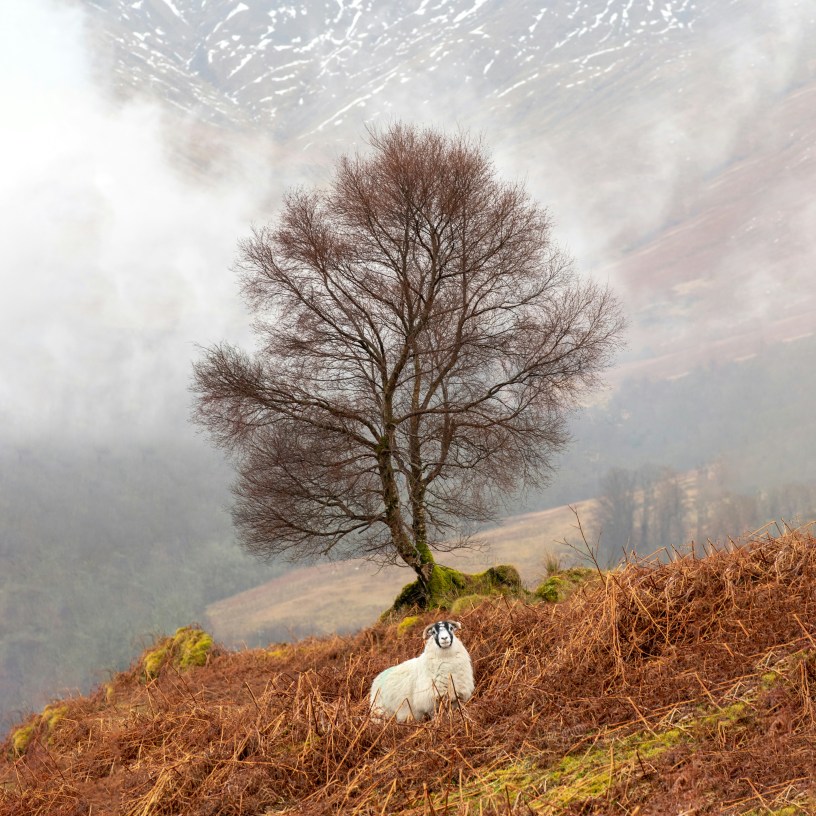
Though this is an ancient story and metaphor, sheep and shepherds can still be found the world over. In fact, Rev. Vince Amlin (a UCC minister in the Chicago area) wrote a wonderful Daily Devotional just last week about sheep and pondered the present-day meaning of Psalm 23.[2] So Vince and his friend Kyle were on a pilgrimage traveling St. Cuthbert’s Way. Walking the pilgrimage route takes pilgrims along the borders of Scotland and England. Talk about a part of the world where there are still lots of sheep about! Now St. Cuthbert’s Way is 62.5 miles, allowing the pilgrim to journey from Melrose in the Scottish borders (where St. Cuthbert began his religious life in 650 CE) to Holy Island off the Northumberland Coast (the eventual resting place of St. Cuthbert).[3] This is a spiritual journey—walking a physical path and a path of faith.
Vince and Kyle are walking through yet another pasture on St. Cuthbert’s Way and reflecting that they will never think of Psalm 23 the same way again. As Vince writes, “We learned quickly that sheep are a mess. The animals had moved on from this particular hillside, but the evidence of their presence was everywhere. Like, nowhere to step, everywhere. Like, more of a brown pasture than green, everywhere. Like, not somewhere you’d want to lie down or drink the water no matter how still it was, everywhere. And the wool! The Scottish hills were covered in thorny gorse bushes, and every bush looked like it was wearing a sweater. Big tufts of sheep just ripped off, the evidence of thoughtless or clumsy beings who clearly needed to be led in right paths.”
Vince realizes as he’s taking in the pastoral scene before him that he could sympathize with these messy sheep. Because in truth he had been a real jerk to Kyle the day before. And he felt really bad about it. Vince thought about the mess that he sometimes leaves in his wake, the evidence that he (and others) could see of his missteps. Though he was also thinking as he was walking this spiritual path about how he was forgiven. Vince was contemplating that moment when Kyle gave him a hug and they began their pilgrim walk again, walking on fresh ground besides those still waters—and how forgiveness really did restore his soul.
The scenes of Psalm 23 and that image of Jesus as the good shepherd from the Gospel according to John are perhaps some of the most moving and enduring images we have in our Christian faith. There is a famous painting that can often be seen in Christian churches where Jesus has a lamb around his shoulders and sheep grazing in a grassy meadow before him. Now Jesus looks way too fair skinned and blonde in that painting for what he would have looked like historically as a Middle Eastern man with brown skin and darker hair. Yet I recall that the painting of Jesus as the good shepherd at the UCC church of my childhood anyway had sheep of all different shapes and sizes and colors. In our young minds that picture seemed to emphasize that the good shepherd was present for everyone. No sheep was left out and left behind! No matter who you are, and no matter where you are on your faith journey—we are welcome in that grassy meadow with the good shepherd. The good shepherd was there to lead everyone beside those still waters, to restore our souls.
It might be helpful to think of this psalm in terms of spiritual journeys or a pilgrimage. After all this is about being led to restful waters and being guided in proper paths. We consider walking through the darkest valley and God’s faithful love pursuing us all the days of our lives. There’s a lot of movement in this psalm. We don’t know how the journey ends for the sheep in the sheep pen or the grassy meadows beside the restful waters. In some ways it feels like we are beginning in the middle of the story.
Jan Richardson once reflected on this in her poem “For Those Who Have Far to Travel.” And she rightly states, “If you could see the journey whole, you might never undertake it, might never dare the first step that propels you from the place you have known toward the place you know not. Call it one of the mercies of the road: that we see it only by stages as it opens before us, as it comes into our keeping, step by single step.”[4]
In our Christian tradition we often deeply feel the words of this psalm often uttered at funerals or in the dark nights of our own souls. “Even though I walk through the darkest valley, I fear no danger because you are with me. Your rod and your staff—they protect me.”[5] In those moments when it feels like we are trudging through the valleys, in those moments when it feels like we are in danger, we can rely on the presence of God. Because we need the guidance and the gentle leading of our good shepherd. This does not mean that God can prevent every bad thing from happening to us in our lives. This does not mean that we see the journey whole. It means that God is with us through it all. Through the highest of highs and the lowest of lows. God is with us on the road as we step forward in faith.
Sometimes it is helpful to consider multiple translations of the beautiful words of the psalmist lest they become so rote that we miss the depth of their meanings. Today we heard the 23rd Psalm from the Common English Bible.
“The Lord is my shepherd. I lack nothing.
He lets me rest in grassy meadows; he leads me to restful waters; he keeps me alive.
He guides me in proper paths for the sake of his good name.”[6]
This emphasizes the relationship between the sheep and shepherd giving insight into the very nature of God. For a sheep to lie down in green pastures, be led to still waters, and be led on right paths is all about the shepherd taking good care of their sheep. The shepherd takes care of the sheep no matter how thoughtless or clumsy or careless they happen to be. “He keeps me alive.”[7] On a surface level this is about having food and water, avoiding danger, and then attaining good shelter. The best translation of these verses may be that God keeps us alive—God wills life.
On a literal level for those sheep the care they receive from the shepherd can be the difference between life and death. To be led to grassy meadows and restful waters and proper paths ensures that their well-being is maintained. Because the sheep listen for the voice of their good shepherd. The sheep do not lack anything because the shepherd is providing the basic necessities for life. “He calls his own sheep by name and leads them out.”[8] We can contemplate how our lives depend on God.
In the end, we often hear the 23rd Psalm at funerals. And that is a perfectly good time to hear these comforting words, particularly “Surelygoodness and mercy shall follow me all the days of my life, and I shall dwell in the house of the Lord my whole life long.”[9] Though these words are not just about walking through the valley of the shadow of death. This Psalm is also about living because it puts daily activities that we all experience into the very arms of God.
It ends up that God cares about the seemingly mundane aspects of our very existence. God is with us and beside us and before us on our pilgrim journeys. All of life is a gift from God. God lets us rest in grassy meadows and leads us to restful waters. God pursues us all the days of our lives. Let us take comfort. Let us be at peace. Thanks be to God. Amen.
[1] John 10:3-4, CEB.
[2] Vince Amlin, “Messy Sheep,” UCC Daily Devotional, April 12, 2026, https://www.ucc.org/daily-devotional/messy-sheep/
[3] St. Cuthbert’s Way, https://www.stcuthbertsway.info/
[4] Jan Richardson, “For Those Who Have Far to Travel: An Epiphany Blessing,” https://paintedprayerbook.com/2011/12/31/epiphany-blessing-for-those-who-have-far-to-travel/
[5] Psalm 23:4, CEB.
[6] Psalm 23:1-3, CEB.
[7] Psalm 23:3, CEB.
[8] John 10:3, CEB.
[9] Psalm 23:6, NRSVUE.
Photo by Robert Greinacher on Unsplash

