“The kingdom of heaven is like . . .” Orange Congregational Church UCC, July 26, 2026 (Matthew 13:31-33, 44-52) Ninth Sunday after Pentecost
Over the last several weeks we have been hearing some of Jesus’ famous parables as found in the Gospel according to Matthew. We heard the Parable of the Sower and the Parable of the Weeds among the Wheat. We remember that parables make comparisons between everyday objects and ordinary experiences and eternal, transcendent realities.[1] In today’s text Jesus makes several comparisons to the kingdom of heaven. This kingdom he was working for in his ministry—where the last would be first and the first would be last, where we love our neighbors as we love ourselves. This kingdom where humans become passionate about what God’s passionate about. This kingdom where we are bringing forth God’s reign of mercy, peace, and justice.
There are many wonderful images Jesus uses to describe this eternal, transcendent reality. Jesus taught that the kingdom of heaven is like yeast that a woman took and mixed in with flour so that it becomes leavened. Jesus gave an encouraging word. Those committed to following Jesus may sometimes wonder if our efforts of witness are impactful out in the world. Yet we can rest assured that this work is of ultimate importance, even if it feels like our actions are small or sometimes seemingly inconsequential. Because God has a significant outcome in store for creation even though right now we see in a mirror dimly. Something good is happening when we live into Jesus’ teachings of compassion. Because yeast is a fermenting agent and a small amount can leaven a large amount of flour.
Jesus teaches that the joy we feel when we discover the kingdom is like the joy of finding treasure hidden in a field. We cannot help but respond. For finding this treasure is due to the grace of God. We may experience God showing up unexpectedly, and our lives are transformed. Though the kingdom is something we may well stumble upon by accident as opposed to seeking high and low for it. We show up, we pay attention, and we see where God can lead us.
Jesus says that the kingdom of heaven is like a merchant in search of fine pearls. When the merchant discovers one pearl of great value, he goes and sells everything he has to buy that one pearl. There are some people who seem to stumble upon the kingdom of heaven like the one who discovered treasure hidden in the field. Others are earnestly committed to finding ultimate meaning. Those folks may spend years of study, go on pilgrimages, learn from great teachers and scholars to find ultimate meaning, to find God. Here Jesus says in this parable that this earnest path of seeking is good too. When we discover what we’ve been looking for, we’re willing to make some drastic changes in our lives in order to accept the gift. The journey of life and faith is not the same for every person, and that is a good thing in the end.
Or maybe the kingdom of heaven is like a net that is thrown into the sea and catches fish of every kind so that the net overflows. The work of spreading the good news about the kingdom of God is like casting that net into the sea and bringing in fish of every kind to hear about God’s love. It’s like sowing seeds with something like abandon not knowing where they might land, and somehow finding freedom in that not-knowing.
Finally (and perhaps most famously), Jesus teaches that the kingdom of heaven is like a mustard seed—one of the smallest seeds. Yet plant that tiny seed in the Earth and it can become the greatest of all shrubs and eventually a tree so that even the birds of the air can nest in its shade. Some species of trees are known for being hubs within ecosystems, supporting remarkable biodiversity in the land. Oak trees in particular are sometimes called “cathedrals of the natural world” because oaks support a remarkable amount of biodiversity, from larger wildlife who graze on acorns down to the fungal species that work symbiotically with the tree to nurture life.[2]
This image from the natural world that Jesus uses is special. The mustard seed is one of my favorite images of the kingdom of God. Because it’s a remarkable image—this tiny mustard seed becomes a great shrub and eventually large enough to be viewed as a tree. And then this tree supports other beings like birds that find safety and shelter in the branches. We all can make a difference even if our beginnings are humble. Because seeds can sprout and grow with God’s help. We may be starting off small, even insignificant. Though we can blossom and provide shelter for those who need compassion.
These are words of hope and words of comfort Jesus shared in the face of uncertainty. A reminder that if we’re working to help God create a more merciful world, we will bear fruit in time. We just need to have a little bit of faith.
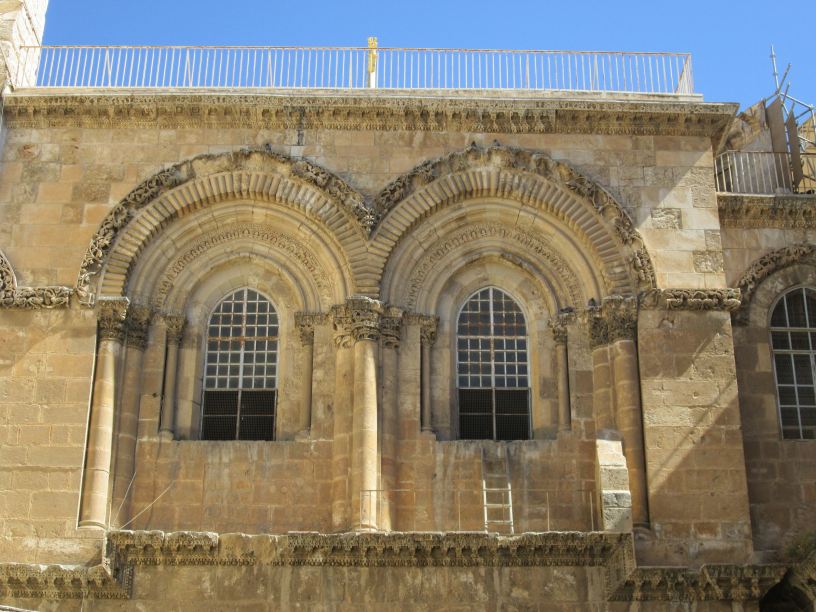
There was a moment on my own faith journey where this mustard seed faith, this deep yearning for a little bit of faith arrived in an unexpected way. During a Sabbatical ten years ago by now I spent a month in the Holy Land as part of a continuing education program—learning from Jewish, Muslim, and Christian scholars and traveling to some of the holiest sites of our Abrahamic faiths. Of course, our group visited the Church of the Holy Sepulchre in Jerusalem, arguably the holiest site in Christianity where we commemorate both the crucifixion and resurrection of Jesus. One can easily sense people yearning for that little bit of faith inside the walls of the church.[3]
Now under a mandate from 1852 the care of the church is shared by no less than six Christian denominations—the Greek Orthodox, Armenian Apostolic, Roman Catholic, Coptic, Ethiopian, and Syriac Orthodox churches. These denominations do not come together often. The church itself is divided into sections with a set of complicated rules that mandate how the denominations travel through each section on given days. Fistfights have even been known to break out inside the church if one crosses into another’s territory. Famously there are two Muslim families in Jerusalem (the Joudeh family and the Nusseibeh family) who hold the keys to the church, and members of these families open the church every morning and lock the church every night.
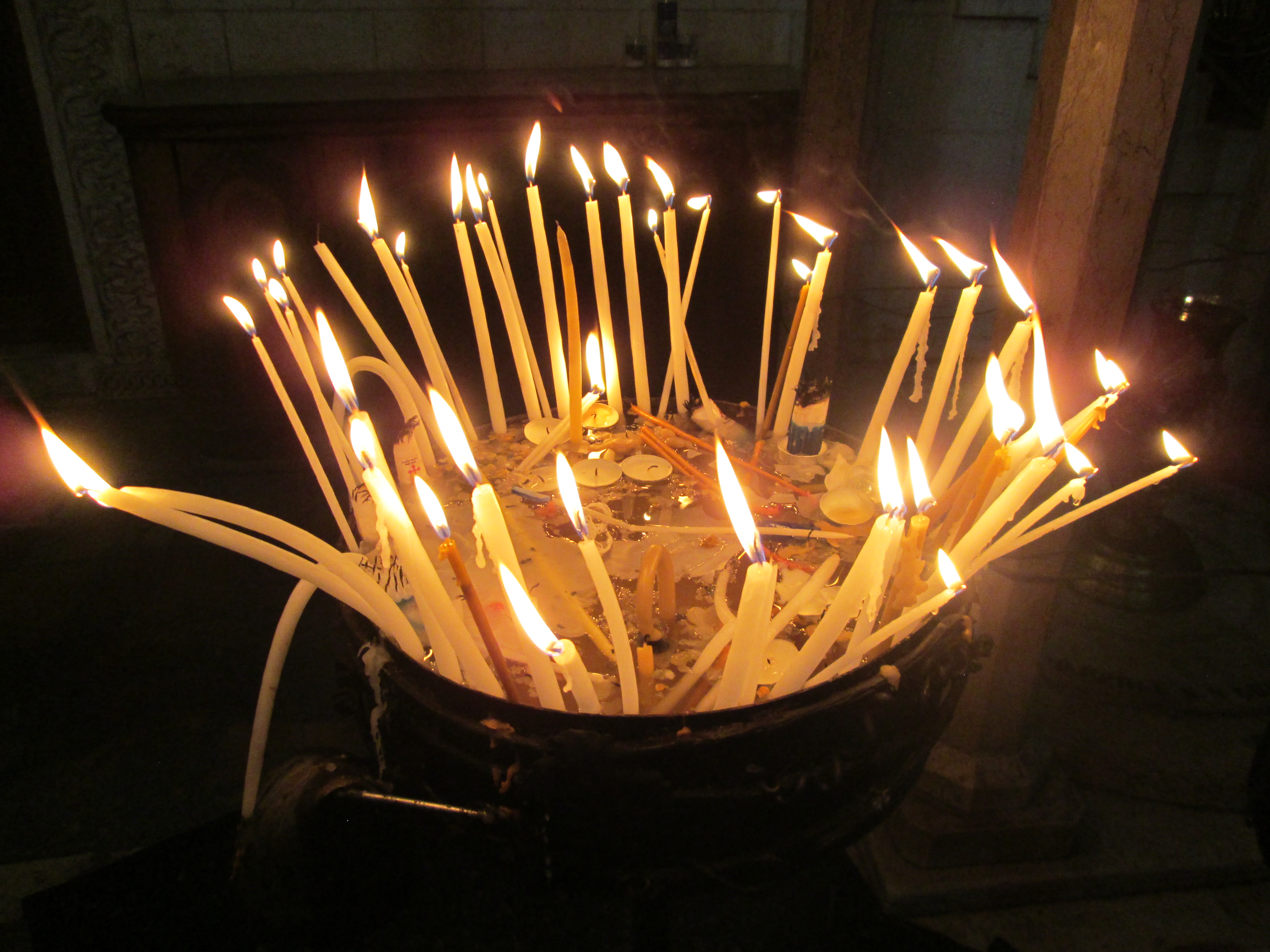
So imagine this huge church with all sorts of side chapels where liturgy is being read in various languages, prayers are being prayed, songs are being sung, processions are being walked simultaneously as crowds of Christian pilgrims navigate the holy chaos. I had never seen or experienced anything quite like the Holy Sepulchre. Oh, and if you are deemed to take too long to venerate at the rock of Golgotha or inside the room of the Tomb itself, priests will yell at pilgrims to move along in multiple languages. Even loudly banging on altars to get the point across yelling in Arabic for instance, “Yalla! Yalla!” roughly translated as come on, hurry up! The Holy Sepulchre is magnificent and complicated. Priest and Professor Jerome Murphy-O’Connor famously reflected:
“One expects the central shrine of Christendom to stand out in majestic isolation, but anonymous buildings cling to it like barnacles. One looks for numinous light, but it is dark and cramped. One hopes for peace, but the ear is assailed by a cacophony of warring chants. One desires holiness, only to encounter a jealous possessiveness.”[4]
Now our group was given some time inside the church to explore on our own. I made my way back to this stone slab at the entrance where it was a little cooler and lighter as the doors were propped open to the alleys beyond the church. This stone (the Stone of Unction or Stone of Anointing) supposedly marks the spot where Jesus’ body was prepared for burial after he was crucified and before he was placed in the tomb. Our guide shared that Christians often venerate the stone in unusual ways. If someone had just bought a souvenir in the marketplace outside, they would lay that souvenir on the stone to get charged up with holiness. Parents will plop their children down for a blessing. People will be sprawled out on the stone or kiss the stone—you get the idea.
I quietly observed the people and how folks used the stone to observe their faith. Local Christians come to the stone too; it wasn’t just pilgrims from afar. Perhaps because the entrance of the church is cool and gets you out of the stifling sun for a minute. Perhaps because you can be inside the Holy Sepulchre without plunging into the darkness and chaos and jealous turf wars. Perhaps because you can feel charged up with holiness and then move on with the rest of your day—tending your shop, playing with your children, preparing a meal for your family.
It would be easy to observe these practices and judge a little. It would be easy to think it’s misguided or just a waste of time to charge oneself up with holiness from a stone slab. But the look on peoples’ faces during and after venerating that stone where Jesus’ body might have been laid—the looks were so often peaceful and joyful. People would leave after touching that stone or placing an object atop that stone with their faces almost glowing. Maybe this is because this spiritual practice helped them have that little bit of faith, that faith as small as a mustard seed that can defy the odds or even change lives.
What helps us keep a little bit of faith? If we’ve lost it, how do we find it again? If we pay attention, how might God show up this week? Thanks be to God. Amen.
[1] Exposition of Parables from Arland Hultgren, The Parables of Jesus: A Commentary.
[2] James Godfrey-Faussett, “Oak trees & biodiversity: Why oaks are ecosystem powerhouses,” oneearth.org, November 4, 2025, https://www.oneearth.org/oak-trees-kings-of-biodiversity
[3] Jerome Murphy-O’Connor, The Holy Land: An Oxford Archaeological Guide, pgs. 49-67.
[4] Jerome Murphy-O’Connor, The Holy Land: An Oxford Archaeological Guide, pg. 49.
Photos by Rev. Lauren Ostrout.

