“The Heavenly Throne Room” Orange Congregational Church UCC, November 1, 2026 (Revelation 7:9-17) All Saints Sunday
Today is All Saints Day. To put this holy day into liturgical context, All Saints Day developed because there were so many saints and martyrs that were remembered in the Roman Catholic Church that the Church literally ran out of days in the calendar. The solution was to designate November 1 as the day to commemorate all the saints who could not have their own specific date and whose names may have even been forgotten in some quarters of the church over time. In the Catholic Church, all canonized saints are commemorated on November 1 and all the faithful who have died are commemorated on November 2, All Souls Day.[1]
Of course, Mainline Protestants put our own spin on things. With our belief in the priesthood of all believers, we have historically combined these holy days. On All Saints Sunday we tend to focus on loved ones we have revered. We praise the saints of God, faithful and brave and true. As we sing in I Sing a Song of the Saints of God, “And one was a doctor, and one was a queen, and one was a shepherd in pastures green.”[2] We combined All Saints Day and All Souls Day, with an emphasis on All Souls, and typically moved the commemoration to the first Sunday in November—today.
Thus All Saints Sunday revolves around giving thanks for any person who has been influential in our spiritual formation and growth. We remember the influence every single life can have.[3] For Mainline Protestants, All Saints Sunday connects us as believers as we stand together, thankful for God’s grace and hopeful for resurrection and eternal life beyond death. We rejoice for the great cloud of witnesses who have gone home to God before us.
One of the traditional readings for All Saints is the depiction of the heavenly throne room in the book of Revelation. John of Patmos describes this vision of a great multitude from every nation, from all tribes, from all peoples and languages. This great multitude is standing before the throne of God and before the Lamb (Christ). Everyone in the multitude is robed in white with palm branches as they sing, “Blessing and glory and wisdom and thanksgiving and honor and power and might be to our God forever and ever! Amen.”[4] There are angels around the throne and elders. There are four living creatures who look like a lion, an ox, one has a face like a human, and then a flying eagle (these are cherubim—angelic beings who guard God’s throne). The scene concludes with one of the elders addressing John of Patmos (again this is all within a vision) and explaining that the multitude are people who have come through “the great ordeal” (most likely a time of persecution). And now they are home with God, in the safety of the heavenly throne room with the one seated on the throne who “will shelter them.” For “They will hunger no more and thirst no more; the sun will not strike them, nor any scorching heat, for the Lamb at the center of the throne will be their shepherd, and he will guide them to springs of the water of life, and God will wipe away every tear from their eyes.”[5]
This is a vision of victory and peace, a vision of God fulfilling God’s promises. We need not take this all literally. After all, John of Patmos wrote the Book of Revelation to seven faith communities of Asia Minor as he was in exile. This is apocalyptic literature where visions and otherworldly journeys are shared using metaphorical and symbolic language. It was possibly written at a time when Christians were persecuted by leaders of the Roman Empire and was meant to shore up the faithful as they weathered these storms. Hence the reassurance that with God people would hunger and thirst no more, and the Lamb would be their shepherd. God will wipe away every tear from the eyes of the faithful. Because there was a great deal to mourn at this time, and many tears must have been shed.
As the final book of the Christian canon, Revelation offers a hopeful vision of the new heaven and the new earth. This is a vision (shared again in Chapter 21) where “the home of God is among mortals. God will dwell with them; they will be God’s peoples, and God will be with them and be their God. God will wipe every tear from their eyes. Death will be no more; mourning and crying and pain will be no more, for the first things have passed away.”[6] As New Testament scholar Lynn Huber explains in The Society of Biblical Literature Study Bible, “Revelation offers a vision of the future cityhome for those faithful to God and the Lamb at the end of time. This parallels Genesis’s description of the rural garden-home created by God for humanity at the beginning of time.”[7] In the end, somehow, all will be well.
All of this to say, these visions can seem strange and strangely powerful. In a culture where we seem to increasingly deny death and push aging and death as far away from us as possible, the Christian Church can stand as a witness to the inevitably of death. We believe that death is not the final word in our stories, and death is not the final word in God’s story. We believe that there is something more, something beyond life on earth as we know it. In Christianity, we believe that we do not live in an endless cycle of Good Fridays and pain and sorrow, not when there is Easter and resurrection and new life waiting to dawn. As we can remember on a Sunday like this, our tradition has these strangely hopeful otherworldly visions of being home with God where God will wipe away every tear from our eyes, for the first things have passed away.
We can also acknowledge on a day like All Saints that loss and grief and mourning are part of a life well lived. Because to love another is to open oneself to grieve one day. Grief is a sign of love. Grief is all around us. When we encounter people out in the world, we may not even know that we are encountering a person grieving some loss they have experienced or are experiencing in that moment. Grief is natural and a profound expression of love, love that does not end at death. In some ways, our ministry as a faith community to those who are grieving the death of a loved one is even more important today in an era where people are increasingly “spiritual but not religious.”
Unitarian Universalist minister Sharon Wylie wrote a poem called “Nobody Needs a Church Or, Lament of the Ministers” that has come to mean a lot to me over the years. Wylie laments, “And nobody wants a church until a loved one is dying or dead and suddenly it would be nice to have someone to give the eulogy, and people to bring the casseroles, and friends to sit and cry with . . . ‘Where can I find people to connect with?’ they ask, and ‘Who can I talk to about my grief?’ ‘Who will visit my dying father?’ and ‘Who will pray for me?’ I know the answers to these questions.”[8]
We are especially equipped in the church to help people in times of loss because we have a built-in sense of community. The love of Christ Jesus binds us together to help bind the wounds of the brokenhearted. Because we are part of that great cloud of witnesses. All Saints Sunday helps us to reclaim this reality. “Ringed by this cloud of witnesses divine, we feebly struggle, they in glory shine.”[9] We are part of a tradition that does not deny the inevitably of loss and death and grief. And our God is a God who dwells with us. Thanks be to God. Amen.
[1] Laurence Hull Stookey, Calendar: Christ’s Time for the Church, 147-148.
[2] I Sing a Song of the Saints of God, verse 1, The New Century Hymnal #295.
[3] Stookey, Calendar: Christ’s Time for the Church, 147-148.
[4] Revelation 7:12, NRSVUE.
[5] Revelation 7:16-17, NRSVUE.
[6] Revelation 21:3-4, NRSVUE.
[7] Lynn R. Huber, Introduction to The Revelation to John in The SBL Study Bible, New Revised Standard Version Updated Edition, pg. 2165.
[8] Sharon Wylie, “Nobody Needs a Church Or, Lament of the Ministers,” October 29, 2014, http://sharonwylie.com/2014/10/nobody-needs-a-church-or-lament-of-the-ministers/
[9] For All the Saints, verse 4, The New Century Hymnal #299.
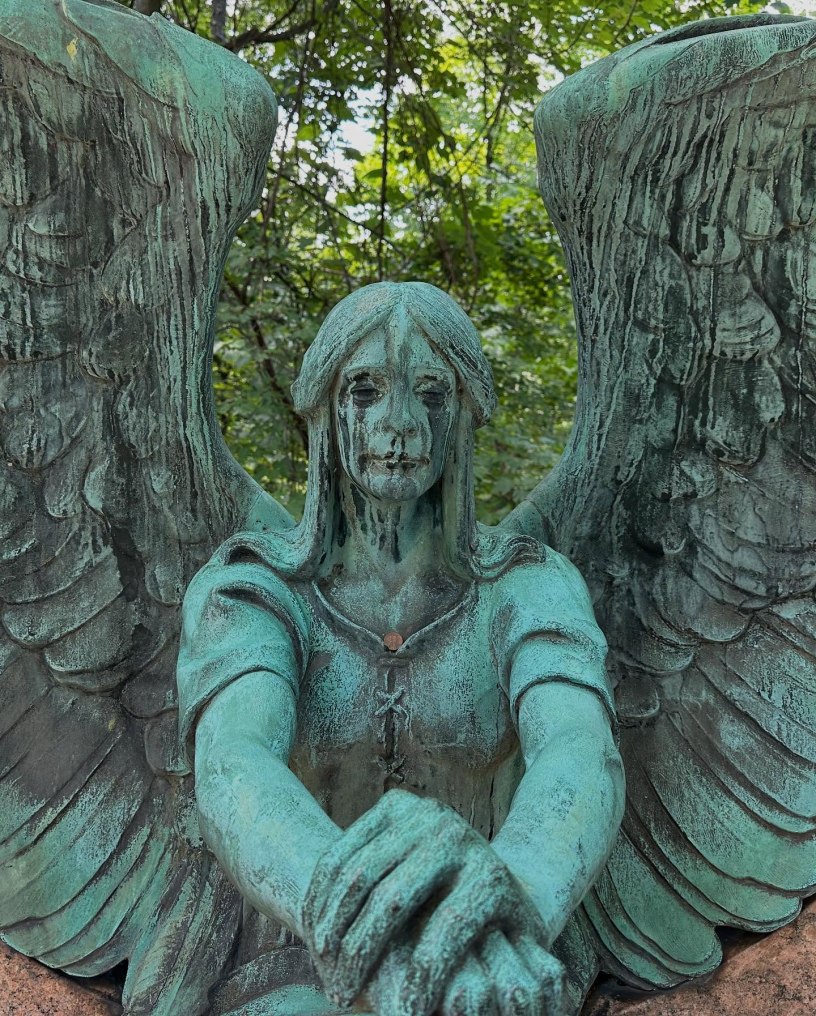
Photo by Rev. Lauren Ostrout of The Haserot Angel in Lakeview Cemetery, Cleveland, Ohio.

