“Troubled Hearts” Orange Congregational Church UCC, November 8, 2026, (John 14:1-14) Joining/Consecration Sunday
Jesus once said, “Do not let your hearts be troubled.”[1] And I don’t know about you, but when someone tells me to not be troubled, it is not as if my troubles just magically disappear. Even when the person saying “do not let your hearts be troubled” is Jesus, sometimes the troubles just seem to persist. Then again if genetics can be blamed, my grandmother made worrying an Olympic sport (with my mother not far behind)!
Jesus’ opening words brought to mind Mary Oliver’s poem “I Worried”—
I worried a lot.
Will the garden grow, will the rivers
flow in the right direction, will the earth turn
as it was taught, and if not, how shall
I correct it?Was I right, was I wrong, will I be forgiven,
can I do better?Will I ever be able to sing, even the sparrows
can do it and I am, well,
hopeless.Is my eyesight fading or am I just imagining it,
am I going to get rheumatism,
lockjaw, dementia?Finally I saw that worrying had come to nothing.
And I gave it up. And took my old body
and went out into the morning,
and sang.[2]
Sometimes we worry a lot. We worry about being right and about being wrong. We worry about being forgiven and about wanting to do better. We worry about our children and our spouses and our friends and our church and our country and the future in general. We worry about things that we cannot control and tie ourselves up in knots with worry. Sometimes our hearts are just troubled.
It is telling (and hopeful) that Jesus instructs his disciples about troubles and trust during his farewell discourse in the Gospel according to John. In effect, Jesus says goodbye to his disciples and provides comfort and final teachings in chapters 13 through 17. These words were meant to strengthen and encourage the community. Because Jesus is going to return to God. The hour will soon be upon him. Jesus assures his beloved disciples that he is going to prepare a place for them, a place in God’s house. And God’s house has room to spare. If that were not the case, Jesus would not have told them that he is going to prepare a place for them.
When we hear Jesus’ words, we may think that Jesus is talking about a building. In the Christian tradition, we have sometimes referred to church buildings as God’s house or the house of the Lord. Of course it is natural to think about dwellings as we may seek something to visualize. We may start imagining that God lives in a mansion in heaven surrounded by angels with harps who seem to always be reclining on clouds. After all we just heard about the heavenly throne room in the book of Revelation last Sunday—that vision that John of Patmos shared about God dwelling with God’s people for all time where God would wipe away every tear from our eyes for the first things have passed away.
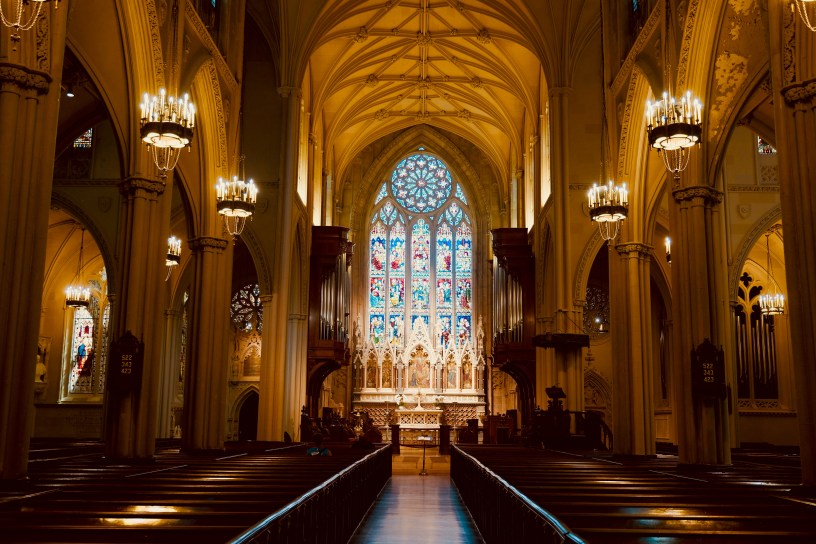
Of course, it’s not bad if those are the images that come to our minds when we hear Jesus speaking to his disciples about God’s house with room to spare. Moreover, today is Consecration Sunday where we will bless our pledges offered for the good of our faith community. Let’s face it, sometimes church budgets and buildings and staff and programs are on our minds on a Sunday like this. We think in concrete terms. Though church is not simply a building, historic and beautiful as it may be. And giving to our church is not just about buildings and budgets, as necessary as they might be to operate. Church is not just a place where we go, church is also the people of God. We give as a spiritual practice, as a sign of thanksgiving for God’s good gifts in our lives. We are the church.
The truth is that the image Jesus is using here is a bit different than God living in a heavenly mansion with some extra rooms. The New Oxford Annotated Bible notes that house as Jesus is using the term is not a building at all, but household relationships. In God’s household, there is room to spare.
Doesn’t that bring up a whole new set of images? Maybe a long kitchen table where it’s no bother at all to set another place. Or an extra bed with warm blankets to lay down to rest. These are still “house as a building” images, but the point is the hospitality extended because of the relationship that exists among God and God’s people.
In God’s household, there is room to spare because we are all children of God. Thus preparing a place means that Jesus is mediating a relationship between God and the disciples. Jesus is shown in this passage to be God’s unique and authentic mediator. Jesus tells his followers, “I am the way and the truth and the life.”[3] If the disciples truly know Jesus, then they know God. This text is all about relationships. We can understand Jesus’ words to not be spatial but relational.[4] It comes down to an invitation to have a real relationship with God, with Jesus, and with one another. Jesus concludes this passage with a promise, “Very truly, I tell you, the one who believes in me will also do the works that I do and, in fact, will do greater works than these, because I am going to [God].”[5]
Rev. Jennifer Ruth Lynn Garrison reflects on this promise Jesus makes by sharing that the someone walking around doing great works is you. In the end, Garrison writes, “You might not feel like you’re participating in great works in your church community. Is it a great work to lay out the communion table just so, to feed a family or two, to spend a Saturday evening prepping to teach Sunday school, to invite your church friends to write another letter to their senator? Does it really seem like a great work to wear a mask because it will create more safety for your pew partner? How about shoveling the church walk this Sunday? Or driving a neighbor to Bible study? Is your weekly tithe, small or large though it may be, a great work? Really? Jesus assures us that yes, it is. You are doing great work, because you are doing it in Christ’s name. Jesus the Christ, who came to empower you to the great works that only you, working in your community, can do.”[6]
That is the good news today for all of us to hear. It is good news to hear whether you are a visitor or friend of the church, whether you have been a member of Orange Congregational Church for decades, or whether you just joined this particular Body of Christ as a member today. What we each do in this beloved community matters. We can be empowered to do good here for God, for our community, and for one another. That doesn’t mean that our troubles automatically go away as soon as we walk through the church doors. Yet we have a community to help shore up our sometimes-troubled hearts. And it takes all of us to be about this good work together. Thanks be to God. Amen.
[1] John 14:1, NRSVUE.
[2] Mary Oliver, “I Worried,” in Swan: Poems and Prose Poems.
[3] John 14:6, NRSVUE.
[4] Footnotes on John 14.1-14: The household of God in The New Oxford Annotated Bible: New Revised Standard Version with The Apocrypha, Fully Revised Fourth Edition, pg. 1906 New Testament.
[5] John 14:12, NRSVUE.
[6] Rev. Jennifer Ruth Lynn Garrison, Reflection on John 14:1-14 “Do Not Let Your Hearts Be Troubled” from There Our Hearts Will Be UCC Stewardship Theme Materials for 2026.

