“The Spirit Moves” Colchester Federated Church, May 24, 2026, Pentecost Sunday (Acts 2:1-21)
“When Pentecost Day arrived, they were all together in one place. Suddenly a sound from heaven like the howling of a fierce wind filled the entire house where they were sitting. They saw what seemed to be individual flames of fire alighting on each one of them. They were all filled with the Holy Spirit and began to speak in other languages as the Spirit enabled them to speak.”[1]
The Holy Spirit arrives in style—with wind, tongues of fire, and gifts of speaking in diverse languages. Pentecost marks the birth of the Christian Church. It’s full of energy, passion, and mystery. Just look at the gifts of the Spirit! Look at Peter facing the crowd and declaring the Good News for all to hear! Look at this new revelation of God’s presence among us that ushers in the Church!
It’s a story full of symbolic meaning. As historian Diana Butler Bass shares, “It is a tale of new creation, about God remaking the world in which we live. Pentecost celebrates all things being made as God intends, and the world set aright . . . Pentecost uses four symbols, the four elements that ancient people believed made up the universe, to unfold a mystical story of God’s re-creation: wind, water, fire, and earth.”[2] Wind is how we can feel the Spirit sweeping over the earth—seeing or hearing the wind blow can still help us consider the divine. Water is the main element of baptism, and after the fiery events of Pentecost thousands of people are baptized according to Acts. Fire accompanies the divine presence. To this day, we light candles in our churches to symbolize the start of our worship in praise of God. And of course speaking in diverse languages shows that we are called to witness to God’s love to the ends of the earth and teach the Christian faith in a way that everyone can connect with and understand. We are called to meet people where they are—in the highways and byways of life. Pentecost is a bold story of this small band of Jesus’ followers having a message so important to share that they would put their lives on the line to do it. They would face personal hardships and some would face persecution to spread Jesus’ message of radical love and inclusion.
In our Tuesday morning Bible Study class here at Colchester Federated Church, we have actually been reading and studying Acts together since January. We will read and discuss the final chapter (Acts 28) in just a few days. Pentecost landing today in light of our timeline feels fortuitous somehow.
Some of our class discussions have revolved around the historical circumstances of the book’s writing. After all Acts is the companion volume to the Gospel according to Luke, a continuation of the story of Jesus’ followers. The story shares all that was happening to grow the church after Jesus’ death, resurrection, and ascension. For instance, Barnabus and Saul (who became Paul) were in Antioch and Luke shares, “They were there for a whole year, meeting with the church and teaching large numbers of people. It was in Antioch where the disciples were first labeled ‘Christians.’”[3] The Jesus movement is growing and evolving throughout this ancient text.
Some New Testament scholars refer to these books as Luke-Acts because they were written by the same author. Though the Acts of the Apostles is unique as the story shares a whole cast of characters and is written to a wide audience of Greek-speaking Jews and God-worshiping Gentiles who desired to know more about Jesus’ teachings. Who were these followers of the Way anyway? In a way, the Holy Spirit is centerstage in Acts. There are several epic speeches made throughout the book by Peter, Stephen, James, and Paul. It is sometimes related that the Spirit was helping give them courage to speak. In Stephen’s case, his face was radiant just like an angel’s before he faced those who accused him of speaking against God in testifying to the power of Jesus the Christ. As we are fond of saying in Bible Study, this is powerful stuff.[4]
If there is one person who can blow us away every Pentecost, it may just be Peter. Peter goes from denying that he even knew Jesus to standing with the other disciples, raising his voice, and declaring that the Holy Spirit has been poured out for all. One can imagine that Peter takes a giant leap of faith. Trusting God to be with him. It’s like William Sloane Coffin once said, “I love the recklessness of faith. First you leap, and then you grow wings.”[5] On Pentecost we can see Peter taking that reckless leap of faith. And if we continue reading the story we can see that Peter’s wings grew in time.
The turning point on Pentecost is when Peter stands up to address the crowd. He speaks his mind with conviction. The lectionary cuts off the rest of Peter’s speech. Yet he tells those crowds, “Change your hearts and lives. Each of you must be baptized in the name of Jesus Christ for the forgiveness of your sins. Then you will receive the gift of the Holy Spirit.”[6] That day three thousand people are baptized according to the Book of Acts—they commit themselves to the teachings of Jesus, and a new life of prayer and commitment to this new community of Christ followers. That’s how the story goes. The decisive moment is Peter taking a personal religious experience and witnessing to others—going forth and telling what happened and how he encountered God in the person of Jesus. It was Peter’s testimony that made the difference, his leap of faith to share what was on his heart.
Sometimes we make plans and God laughs. The Spirit moves where the Spirit wills. Sometimes life does not unfold as we expected it to unfold. We encounter speedbumps and road blocks and detours. Sometimes we have to go on the road less traveled. Sometimes we have to take those leaps of faith and trust that our wings will grow. This is all really hard if we tend to be planners and want everything just so in our lives. Living with uncertainty is not easy for most of us. Yet how can we attempt to contain the movements of God’s Spirit in our lives or in the church? The Spirit moves—blowing through the wilderness, stirring us from placidness.
If we keep reading the Acts of the Apostles we will see all the traveling that Paul in particular does and all of the people he meets along the way. Paul’s journey ends in Rome where our Christian tradition relates that he was executed by beheading around 67 C.E. during the reign of the Roman Emperor Nero. These were dangerous times in which the earliest followers of Jesus were living. That is part of what makes the story so powerful. We see how the disciples act and how they respond in the face of so much uncertainty.
Jesus’ disciples were small in number in the beginning, and not powerful as a movement within society. Far from it! They likely had no idea of all that would come after that momentous religious experience on the Day of Pentecost. Peter preaches like he had never preached before to that crowd in Jerusalem. He speaks about young people seeing visions and old people dreaming dreams. That people shall prophecy and everyone who calls on God’s name will be saved. People think they are so crazy that they accuse the disciples of being drunk. Peter responds that it is only 9 AM, we are not drunk! We’re on fire with the love of God and we want to tell you what Jesus taught us: to love God and to love our neighbors as ourselves. We can usher in God’s realm through our just actions. God’s grace extends to all even when we don’t live up to God’s intentions for our lives.
In the end, Peter took that leap of faith and spoke in a way that people new to Jesus’ teachings could truly hear. This ushers in a whole new way of spreading Christ’s message. It’s freely given. It’s rather dramatically proclaimed. It’s not reserved for the elite and powerful, but spread to the ends of the earth—to anyone who has ears to hear and eyes to see and a heart to accept Christ’s love for us all.
The Spirit moves in our world. The Spirit moves in our lives. The Spirit moves in our churches. So do not be afraid if a leap of faith comes your way. The Spirit will be there to help us grow our wings. Thanks be to God. Amen.
[1] Acts 2:1-4, CEB.
[2] Diana Butler Bass, A Beautiful Year: 52 Meditations on Faith, Wisdom, and Perseverance, pg. 212.
[3] Acts 11:26, CEB.
[4] F. Scott Spencer, “Acts Introduction,” in The CEB Study Bible with Apocrypha, pgs. 215-217 NT.
[5] William Sloane Coffin, Credo, pg. 7.
[6] Acts 2:38, CEB.
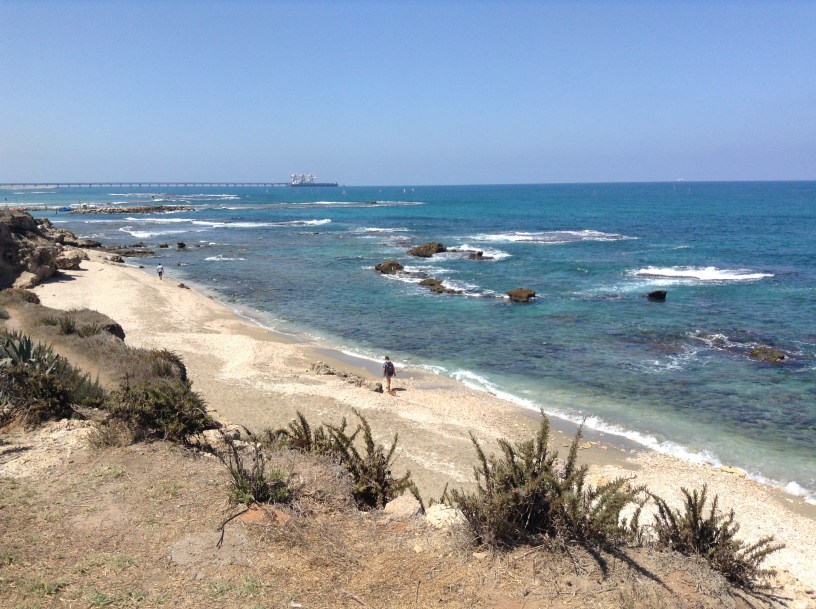
Photo by Rev. Lauren Ostrout of Caesarea.

