“Heaven and Earth” Colchester Federated Church, May 17, 2026, Seventh Sunday of Easter (John 17:1-11)
As we continue exploring the Gospel according to John, we hear about Jesus praying for the disciples. This is the last text we will explore in Eastertide as next Sunday—May 24th—is Pentecost. Be sure to wear your red! For we will celebrate the birth of the Christian Church on Pentecost Sunday and usher in a whole new season of the church year as we move into Ordinary Time.
Though today we are still thinking about all that happened after Jesus’ resurrection (even if the lectionary texts are ordered in various ways in Eastertide and not exactly chronological). In this morning’s text, Jesus is looking up to heaven and praying to Abba God. Jesus says, “I’m praying for them. I’m not praying for the world but for those you gave me, because they are yours. Everything that is mine is yours and everything that is yours is mine; I have been glorified in them. I’m no longer in the world, but they are in the world, even as I’m coming to you. Holy Father, watch over them in your name, the name you gave me, that they will be one just as we are one.”[1]
John 17:11 (that they may all be one) is the historic motto of the United Church of Christ, one of the denominations our church belongs to here at Colchester Federated Church. This is the motto because it reflects Jesus’ prayer for unity and that the UCC is historically a united and uniting church—an expression of Christianity that brought four denominations together when it formed in 1957. That they may all be one gets to this idea that we can have unity in the essentials of our faith. As the motto of Eden Theological Seminary states: “In essentials unity, in non-essentials liberty, in all things charity.” We do not all have to believe exactly the same, because we are all on our individual journeys of faith. People are on these unique spiritual journeys and sometimes at different stages. That’s wonderful, and not something to be feared! We can be charitable to one another in this community of faith.
It is significant when Jesus says that he is praying for his followers. Prayer is not just something that Jesus taught his followers to do. Every Sunday we say the prayer that Christians have come to know as the Lord’s Prayer because this is the prayer that Jesus taught his followers (then and now) to say. We can debate the translation used, whether we use debts/debtors or trespasses/those who trespass against us. Some folks use more inclusive versions of the Lord’s Prayer (as we spoke about last Sunday, there are many names to address the divine). Though it’s not up for debate that Jesus taught his followers to pray that specific prayer. Because we can read about Jesus teaching the disciples the Lord’s Prayer in Matthew 6 and Luke 11. The Lord’s Prayer (even said in different versions) is dearly held by many Christians because this is the prayer that Jesus taught us to say.
We can see throughout the Gospels that prayer is a spiritual practice that Jesus taught. Though prayer is also a spiritual practice that Jesus himself did, and that is important to note as we seek to follow in the footsteps of Jesus in our own lives. Jesus practiced what he preached. There’s this beautiful transitional passage in Luke’s fifth chapter that relates, “News of him spread even more and huge crowds gathered to listen and to be healed from their illnesses. But Jesus would withdraw to deserted places for prayer.”[2] It’s just a short transition in Luke’s Gospel. Though it says a whole lot about Jesus. Praying, it would seem, helped Jesus to be about God’s work in the world. Because here we also see Jesus praying to God for his disciples in John’s Gospel. He’s not teaching the disciples to pray in this passage; Jesus is praying for them.
Our Gospel story is reminiscent of a poem by Tim Nolan called “Prayer Chain.” In the poem, Tim Nolan relates that his mother called him to tell him about an old classmate who was dying and his name appeared on the parish prayer chain. His mother gives him news of people who are very sick or destitute. Or it had not worked out—the marriage. Or the kids were on drugs. He reflected upon all the old mothers praying intensely for the pain of their children on the parish prayer chain. Nolan writes:
and for life—they were praying for life—
in their quiet rooms—sipping decaf coffee—I bet they’ve been praying for me at times—
so I’ll find my way—so I won’t rob a bank—I’ll take them—the mystical prayers of old mothers—
it matters—all this patient and purposeful love.[3]
The first time I ever read this poem it stopped me in my tracks because poetry is not just about the words on the page but the structure of the poem. The punctuation and the form say something about what the poet is trying to convey without using words at all. In “Prayer Chain” the lines are often broken up by dashes both within each line and then leading onto the next. The poem reads as almost incomplete thoughts or thoughts that are running into one another. We can imagine these dear folks praying for those who are dying, very sick, destitute, marriages in shambles, kids on drugs. There is so much to pray for! The steady presence of all those old mothers praying intensely for all the pain of their children can be felt. On the one hand, “Prayer Chain” could be read as depressing thinking about what people go through in their lives. Thinking about all the heartbreak communities witness and families endure. On the other hand, the poem ends on this lovely, hopeful note. Giving gratitude for the mystical prayers of old mothers. Because their mystical prayers show patient and purposeful love, and that love matters. It’s not as if their prayers automatically fix the problems on the parish prayer chain. But the mystical prayers of old mothers matter to those held in prayer and to God.
In our Gospel story Jesus is praying to Abba God in that same spirit of these old mothers praying for life as they sip their decaf coffee in quiet rooms. Jesus knows that he cannot protect the disciples from all the hardships that will come after he is gone. The persecution of the earliest Christians was real and is still real in some places. But Jesus can entrust his followers to God. Jesus prays, “I am in the world no more, but while I am coming to you, they are still in the world. Abba, holy God, protect those whom you have given me with your Name—the Name that you gave me—that they may be one, even as we are one.”[4] Asking for God to protect or watch over those we love is something that you or I may pray today or tomorrow. And isn’t it amazing to see Jesus praying for God’s protection for those he loved?
Some year ago in our CFC Bible Study, we read Rev. Molly Phinney Baskette’s book How to Begin When Your World is Ending. Molly was diagnosed with an aggressive cancer when she was only 39 years old and the mother of two small children. That cancer diagnosis and the intense treatment that followed inevitably shaped her theology and her relationship with God. When Molly reflects on prayer she writes, “Prayer is a way of finding out what we really want, opening our hearts to whatever will come, our worst fears and best hopes, our projections and reality-checks, and getting gradually free of fear. . . Prayer is a way of feeling everything. . . Prayer is a natural energy exchange between us and God, and God, like an empty nester, loves it when we call.”[5]
In the end, sometimes we may worry that there is a right way or a wrong way to pray. We may worry that it’s been a while since we called on God. We worry that we started to pray and then fell asleep right in the middle. Or it’s difficult to face our fears—and sometimes that’s exactly what prayer does. Prayer can provide a way of feeling everything and facing our worst fears and our best hopes, our projections and our reality-checks. Let us remember and take heart that Jesus taught us to pray and Jesus prayed. We can pray for life, for those we love to find their way. Sometimes we can embody and other times we can receive all that patient and purposeful love. What a blessing. Thanks be to God. Amen.
[1] John 17:9-11, CEB.
[2] Luke 5:15-16, CEB.
[3] Tim Nolan, “Prayer Chain,” https://writersalmanac.publicradio.org/index.php%3Fdate=2008%252F04%252F26.html
[4] John 17:11, The Inclusive Bible.
[5] Molly Phinney Baskette, How to Begin When Your World is Ending: A Spiritual Field Guide to Joy Despite Everything, pgs. 82 and 87.
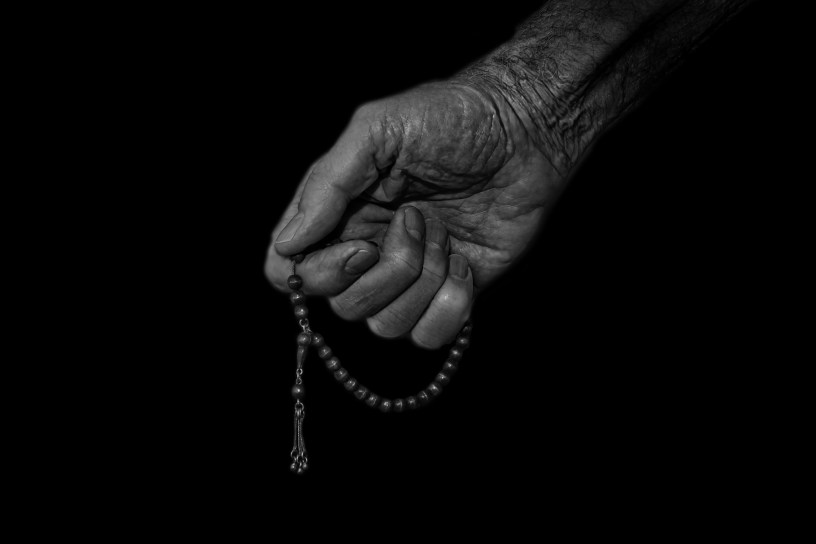
Photo by Torben Gettermann on Unsplash

