“Under the Oaks” Colchester Federated Church, June 14, 2026, (Genesis 18:1-15, 21:1-7) Third Sunday after Pentecost
As we continue on with the story of Abraham, Sarah, and their family, we find ourselves in the family tent in the heat of the day. There’s a famous phrase from the book of Hebrews: “Do not neglect to show hospitality to strangers, for by doing that some have entertained angels without knowing it.”[1] That teaching calls to mind this sacred story from the book of Genesis.
Because Abraham has an experience with the divine as three visitors show up at his tent. Are they three men or angels? Is one of them somehow God? The lines are blurry here between human and divine when it comes to these strangers. In the story we see that Abraham greets them, bowing deeply. He implores these visitors not to pass him by, but to allow him to bring these visitors water to drink and to wash their feet as they rest from their long journeys. Abraham offers them bread so they can eat and feel stronger. Let it be known that Abraham offering hospitality means that he returns to the family tent and also implores Sarah to help him help their guests. The whole family gets to work to extend generosity to these strangers.
We are to understand this story as Abraham modeling true hospitality, and hospitality was a big deal in their culture. Abraham hurries to prepare the meal. He ordered a young calf to be slaughtered to serve his guests—meat was not an everyday item on the menu. Meat was a real luxury. Abraham is serving his guests the best food he can offer. Abraham asks Sarah to knead bread using the finest flour and to serve the baked goods with the middle eastern form of butter. This all might seem oddly detailed. Does it really matter what meal Abraham and Sarah were serving these mysterious visitors in the shade of these oak trees on a hot day? Though ancient audiences would have understood that Abraham was truly rolling out the red carpet for his guests.
What comes of this hospitality is that Sarah eventually gives birth to Isaac—the child that Sarah and Abraham had longed for. Sarah couldn’t help but respond to the outlandish idea of her bearing a child in her old age with laughter at first. Though one of their divine visitors challenged that response, “Is anything too difficult for the Lord? When I return to you about this time next year, Sarah will have a son.”[2] And as we hear a little later in Genesis, God was attentive to Sarah just as God had promised.
Now we can be conscious with our more modern sensibilities that this is not the easiest story to hear if anyone struggles with infertility. Perhaps a more helpful way to consider this story is to focus on hospitality and the true spirit of welcome that Abraham, Sarah, and their whole household showed to these guests. Because this story can serve as a reminder that kindness pays off in the end. For love and kindness are never wasted—acts of compassion benefit those who receive them and those who are compassionate. Of course being kind in order to be rewarded is not the point of being kind. Yet helping people in need, providing for guests who were in need of everyday essentials like food, water, shelter, and rest (who showed up in the heat of the day no less) did end up having lasting positive consequences for this particular family. This can remind us of the ripple effect of kindness where a single act of mercy and goodwill causes a chain reaction of goodness. The original action has a way of multiplying outward to impact more and more people, all for the good.
It is fitting to hear this story of Isaac’s birth announced and Isaac’s birth (which is the Lectionary text for this Third Sunday after Pentecost) on a day where we also celebrate a baptism here at Colchester Federated Church. In our church’s understanding of baptism this event is about dear Kayden and his parents and godparents and the family present here, and baptisms are about welcoming a person into the care of Christ’s church. This is why we have the congregational assent and welcome where we all say—welcome Kayden into the faith and family of Jesus Christ. We enfold you in our arms of love, for you are our brother in Christ. God’s people will be here to help you grow strong and secure in the fellowship of God’s faithful disciples—you are not alone. In some ways baptism is an act of Christian hospitality because this is an act of extravagant welcome.
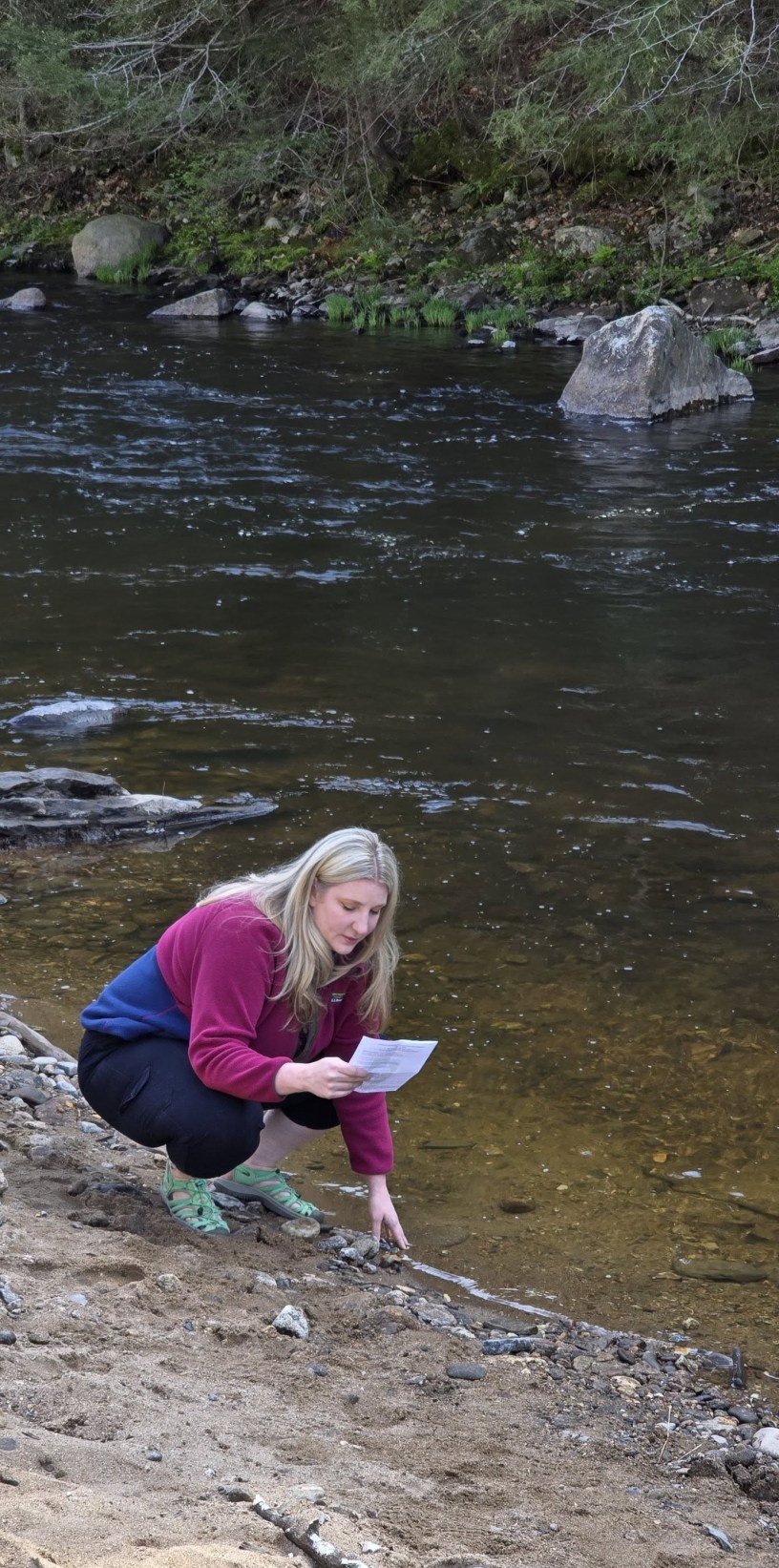
In nine years of ministry here at CFC there have been many memorable baptismal moments, many of them occurring at the Salmon River for youth and adult baptisms. It has been wonderful to be part of a federated church (ABC and UCC) where we offer baptisms for infants and children as well as Believer’s Baptism by full immersion for youth and adults. Though if you have never waded into the water at the baptismal site it is hard to explain how treacherous it feels to walk in with the uneven rocks and the river current when the water levels are high and the Salmon River is really moving. There was the year that one of our Discipleship mentors slipped and fell into the river almost taking out one of our Discipleship kids. There were several times when it was so cold that we could all see our breath in the air—nevertheless we braved those icy waters in early May to baptize another beloved child of God. And then there was that moment when we all gathered down at the river to pray and a bald eagle flew right behind me. It is an especially beautiful place of God’s creation. For baptisms of infants that have taken place here in our sanctuary, of course there have been fussy babies and happy babies and shocked and amazed babies as they looked out at the congregation or felt the water sprinkled onto their sweet heads.
Whenever we experience a baptism it can be an invitation to consider our own baptisms (whether we can remember them fully or not). We are invited to contemplate that moment in our lives or to anticipate our baptisms one day to come. We can take time to consider the baptisms of loved ones that have inspired us and helped us understand our own worthiness, that we are also beloved children of God. Because there is that moment in any infant baptism when the minister asks, “By what name will your child be called?” Or in the case of an adult baptism, the minister asks the baptismal candidate what name to use before we pour water into the font or enter the waters of baptism together. In either scenario, there is a space within the liturgy of being named and claimed by God just as Jesus experienced in the Jordan River with John the Baptist. Jesus heard the voice of God: “You are my Son, the Beloved; with you I am well pleased.”[3] Baptism is an important event on everyone’s journey of faith.
Writer Anne Lamott once reflected about the importance of baptism in the Christian faith by writing, “Christianity is about water: ‘Everyone that thirsteth, come ye to the waters.’ It’s about baptism, for God’s sake. It’s about full immersion, about falling into something elemental and wet. Most of what we do in worldly life is geared toward our staying dry, looking good, not going under. But in baptism, in lakes and rain and tanks and fonts, you agree to do something that’s a little sloppy because at the same time it’s also holy, and absurd. It’s about surrender, giving in to all those things we can’t control; it’s a willingness to let go of balance and decorum and get drenched.”[4]
So on this day when Kayden was baptized and we heard the story of Isaac’s birth announced let us remember that we are part of the faith and family of Jesus Christ. We are invited to claim our worthiness and to surrender to divine mystery—to allow ourselves to be moved by the power of God far beyond ourselves. We are invited to remember how Abraham and Sarah showed hospitality to the strangers among them and how that kindness rippled out, sparking a chain reaction of goodness and mercy.
And may we go forth into the world in peace and be of good courage. Let us hold fast to all that is good and render to no one evil for evil. Let us strengthen the fainthearted and support the weak, help the afflicted and honor everyone we meet on our life’s journeys. May we love and serve God, forever rejoicing in the power of the Holy Spirit.[5] Thanks be to God. Amen.
[1] Hebrews 13:2, NRSVUE.
[2] Genesis 18:14, CEB.
[3] Luke 3:22, NRSVUE.
[4] Anne Lamott as quoted in Words That Listen: A Literary Companion to the Lectionary Volume 1: Advent to Ascension, by J. Barney Hawkins IV and Ian S. Markham, 69.
[5] “Living in the World” Blessing adapted from The Church of England, https://www.churchofengland.org/prayer-and-worship/worship-texts-and-resources/common-worship/common-material/new-patterns-34

