“Take Heart” Orange Congregational Church UCC, August 9, 2026, (Matthew 14:22-33) Eleventh Sunday after Pentecost
We are moving from focusing on a unique Old Testament story of Jacob wrestling with God and reconciling with his brother Esau last Sunday to a very familiar story of Jesus walking on water this Sunday. Our story from the Gospel according to Matthew begins simply enough. After the feeding of the five thousand men (plus the women and children present) with those five loaves of bread and two fish, Jesus has the disciples get into a boat and go ahead to the other side of the Sea of Galilee while he dismissed the crowds. After the crowds depart, Jesus goes up alone on the mountain to pray. This was not unusual for Jesus who did need time alone with God, often in deserted places in nature. Evening comes and Jesus remains atop the mountain alone. Though by this time the boat is battered by the waves and far from the land. The wind is against the disciples.
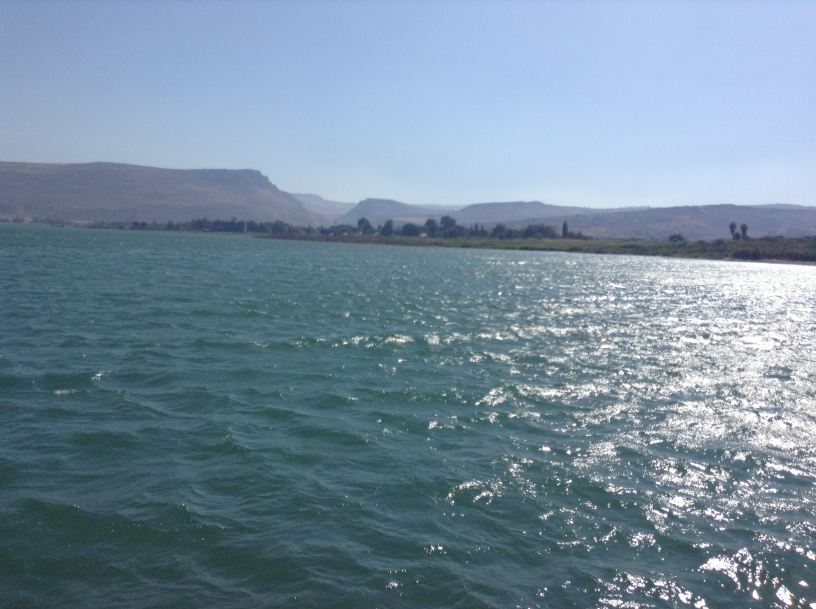
The Sea of Galilee is the largest body of fresh water in Israel and notorious for sudden changes in weather. There is a reason why these stormy sea stories arise. In the book Jesus and His World: An Archeological and Cultural Dictionary John Rousseau and Rami Arav relate that there are two valleys open on the west side of the Sea of Galilee. In their words, this body of water is “directly affected by the strong afternoon westerly breezes, especially in the summer. These breezes can come up quickly, and in a few minutes the lake can sometimes turn from a peaceful lagoon into a high sea with waves soaring up over 7 feet, making afternoon sailing extremely hazardous.”[1] These are likely some of the conditions that the disciples were facing as Matthew tells us that the boat was battered by waves, far from land, and the wind is against them. We can imagine that while this was not out of the ordinary for the Sea of Galilee’s weather patterns (and some of the disciples were fishermen used to sailing these waters), it would still have been frightening. This storm may have come up suddenly turning a peaceful evening sail into chaos.
Matthew tells us that early in the morning Jesus came walking toward the disciples on the sea. The disciples are understandably terrified and mistake Jesus for a ghost. They cry out in fear. Though Jesus meets their fear with words of comfort and words of challenge, “Take heart, it is I; do not be afraid.”[2]
This is a story about fear and faith, about Jesus’ identity and authority. It could be a reminder that Christianity is not just about what we believe in our heads, but what we do with our hearts and our hands. Christian discipleship is active after all. Discipleship is something that we do. Just like Church is not just a building that we go to and a worship service that we attend. Church (the Body of Christ) is something that we belong to, and we can be the Church out in the world that God so loves. We can remember from the Letter of James, “So faith by itself, if it has no works, is dead.”[3] Because ultimately to believe is to care, and to care is to do.
This week’s Gospel text can remind us of the work of Bible scholar and theologian Marcus Borg who was known for reaching out to people who might have been wounded by the Church, urging folks to meet Jesus again, as if for the first time. Borg became known for embracing mystery, especially in his later writings as he was getting older and perhaps thinking about matters of faith differently. Marcus Borg once reflected, “So, is there an afterlife, and if so, what will it be like? I don’t have a clue. But I am confident that the one who has buoyed us up in life will also buoy us up through death. We die into God. What more that means, I do not know. But that is all I need to know.”[4] This scholar’s willingness to say “I don’t have a clue” about some weighty religious matters continues to help people on our paths of discipleship. It is okay to admit that we do not have all the answers. Yet we can have confidence in the One who has buoyed us up all the days of our lives.
Marcus Borg also emphasized the importance of beloving Jesus, that we do not need to solely focus on affirming certain theological claims made about Jesus. But rather on “giving one’s heart, loyalty, fidelity, and commitment to Jesus. This is the way into new life.”[5] After all if we think about the English word “faith” we can recall that it derives from the Latin word fidelitas meaning “fidelity” or “faithfulness.” In effect faith is about trust—deeply trusting God. This story of Jesus walking on water is ultimately about trusting in the buoyancy of God.
A powerful image of faith as trusting in God was once shared by philosopher Soren Kierkegaard. Kierkegaard related that “faith is like floating in seventy thousand fathoms of water.”[6] Now this is obviously a metaphor because no body of water is that deep. The Challenger Deep located in the southern end of the Mariana Trench (near Guam) was recorded as 35,876 feet deep.[7] That’s about seven miles deep, and that is the deepest recorded part of the ocean (that we know about anyway). Thus another way to say this in modernity is that faith is like floating above the Challenger Deep (knowing that the ocean floor is seven miles beneath us).
That feels intimidating to think about the ocean floor seven miles below us as we simply float on the water’s surface. Though if we become afraid of the mysterious depths below and we flail and struggle, we might sink. If we trust that the water will keep us afloat no matter the depths below us, we will keep on floating. Think about swimming lessons you might have completed as a child or swimming lessons your children or grandchildren might have had. We learn the importance of breathing and floating and treading water in addition to swimming strokes. My aunt and uncle have a home on Ocracoke Island in the Outer Banks of North Carolina, and we spent many summers in the Outer Banks as a family. We learned about riptides and how to safely swim in those strong ocean waters. Those lessons about riptides were reinforced over and again—remain calm, swim parallel to the shore to escape the strong current, and then make your way to land.
“Faith is like floating in seventy thousand fathoms of water.” This is a remarkable image rooted in faith as trust and an acknowledgment of the mysterious aspects of the divine that we will never fully comprehend. We can listen to those words from Jesus and take heart. We can find comfort in all these Gospel stories of Jesus walking on water, Jesus stilling storms at sea, and Jesus inviting Peter to walk across the water to him.

Because the story continues with Peter calling out to Jesus to command him to walk on the water. And there goes Peter getting out of the boat and starting to walk out to meet Jesus only to notice the strong wind and become afraid and start to sink. “Lord, save me!” Peter exclaims only to have Jesus compassionately reach out his hand to catch him before Peter sank down into the depths below.[8] Of course this whole story is foreshadowing Peter’s denial of Jesus outside the courtyard of the high priest before Jesus is crucified. Though even here it is ironic that Peter (as an experienced fishermen) does become so afraid. It shows his humanity.
And even though Jesus challenges Peter with, “You of little faith, why did you doubt?” we do not need to see this story as an admonition that doubts cannot happen.[9] Peter’s faith development from fear and doubt to denial to leadership in the early Church just goes to show that authentic faith can arise from those moments of struggle, even failure. In Peter’s part of this story, we can see the hope here for all of us.
In the end, we have times of wrestling with God and coming to deeper understandings on our faith journeys. And sometimes it is the doubts and the second guesses and making the faith our own that deepens our trust in the One who buoys us up. So, take heart. Thanks be to God. Amen.
[1] John J. Rosseau and Rami Arav, Jesus and His World: An Archaeological and Cultural Dictionary, pg. 246.
[2] Matthew 14:27, NRSVUE.
[3] James 2:17.
[4] Fred Plumer, “Memorial to a Beloved Advisor, And Friend—Marcus Borg,” January 23, 2015, Progressive Christianity, https://progressivechristianity.org/resource/memorial-to-a-beloved-advisor-and-friend-marcus-borg/
[5] Marcus Borg, Speaking Christian: Why Christian Words Have Lost their Meaning and Power—And How They Can Be Restored, 163.
[6] Soren Kierkegaard, as quoted by Marcus Borg in Speaking Christian: Why Christian Words Have Lost Their Meaning and Power—And How They Can Be Restored, pg. 122.
[7] “How deep is the ocean?” National Oceanic and Atmospheric Administration, https://oceanservice.noaa.gov/facts/oceandepth.html
[8] Matthew 14:30.
[9] Matthew 14:31.
Photos of the Sea of Galilee by Rev. Lauren Ostrout.

