“Love does no wrong” Orange Congregational Church UCC, September 6, 2026, (Matthew 18:15-20) Fifteenth Sunday after Pentecost
Years ago I completed a training to learn conflict mediation skills with the Lombard Mennonite Peace Center.[1] Let’s just say that sometimes when we begin working in our professions it soon becomes clear that our formal educations cannot prepare us for everything we encounter on the job. Maybe you have had a similar experience. There’s even a Facebook group for clergy called Things they didn’t teach us in Seminary!
Anyway, one of the most important Bible passages we used at this training for church leaders to talk about this topic was today’s lectionary Gospel text Matthew 18:15-20 (Reconciliation in the community of faith). That training and the resources we were given have informed how I think about this Gospel passage ever since. Jesus’ instructions can have a lasting impact on Christian congregations if we have the ears to hear and the eyes to see and the hearts willing to follow where he might lead.
The truth is that if we took a highlighter and highlighted Gospel passages where Jesus was in conflict with others, our Bibles would be full of bright colors. Jesus did not shy away from conflict, sometimes with his own disciples and with various religious leaders he encountered along the way. As just one example, think of the famous scene of Jesus anointed by Mary of Bethany. We remember that moment when “Mary took a pound of costly perfume made of pure nard, anointed Jesus’ feet, and wiped them with her hair.”[2] Judas objected to this loving action because it seemed too opulent—the perfume would have cost a small fortune. Jesus responds to Judas with, “Leave her alone. She bought it so that she might keep it for the day of burial. You always have the poor with you, but you do not always have me.”[3] We could analyze this story from the perspective of conflict. Judas calls out Mary. Then Jesus defends Mary as Judas attempted to shame her for what she had done in lovingly anointing Jesus. The story makes us consider how we can be of service to one another. The conflict we see can become transformational as we still find inspiration in this beautiful moment. Yet there is a real disagreement here.
Thus one of the first lessons we learned in conflict mediation training is that the Bible is full of conflict. Conflict is normal. In fact, the United Church of Christ Church Profile lists the following prompt: “Every church has conflict, some minor, some larger. ‘Where two or three are gathered, there will be disagreement . . .’ These are our congregation’s values and practices when it comes to conflict.” And let me tell you that when churches respond, “We love each other so much, and there is no conflict here!” that is often a big red flag for clergy. We can’t help but wonder what’s the real story . . .
Because conflict is normal, especially where two or three are gathered. There will invariably be differences of opinion. It is not as if the Church is immune because we are still a community full of people. Yes, we are gathered to worship God and to love our neighbors as we love ourselves. Though that does not mean that the differences we may have individually simply disappear as soon as we enter any church building. Perhaps conflict can be an opportunity to learn something new about God. Conflict can lead to transformation within us and in our communities of faith. We do not have to give into despair and hopelessness. Of course on the surface conflicts can feel overwhelming. They can feel downright unmanageable not just to the people involved in the situation but to anyone on the outside who might want to help.
Conflicts can involve people and process and problems. This is one way to consider the common elements of conflict. There are psychological aspects of conflicts, relational elements when someone’s feelings get hurt or emotions run high. People are involved here. Conflicts can also arise because of a process—how decisions are made and how people feel about how decisions are made. Decision-making is a key aspect of conflicts because sometimes we don’t feel like we are being treated fairly or we have a sense of powerlessness. Sometimes we can feel excluded and then that causes us to act out by not cooperating. And then there’s problems. We sometimes have issues and differences of opinion. We might have different beliefs and values, needs and interests. If we are honest, we might wholeheartedly “lock into” our position that we feel is the only way and that creates an impasse. Where do we go from here?
When it comes to conflict in churches, that’s where Matthew 18 comes in handy. Because Jesus lays out a process, “If your brother and sister sins against you, go and point out the fault when the two of you are alone. If you are listened to, you have regained that one. But if you are not listened to, take one or two others along with you, so that every word may be confirmed by the evidence of two or three witnesses. If that person refuses to listen to them, tell it to the church, and if the offender refuses to listen even to the church, let such a one be to you as a gentile and a tax collector.”[4] Well that should solve all our problems in Christian community, right? And we have never had any conflict in the church after this, and we all lived happily ever after?
Here’s some of what we can glean from this text. God intends for us to live in peace with one another. As the Apostle Paul will later relate, “Love does no wrong to a neighbor; therefore, love is the fulfilling of the law.”[5] Peacemaking begins with our sisters and brothers, our kin in Christ. We also can take a step back and consider that Jesus shared a process for conflict mediation within the community of believers to begin with. This underscores that conflict is normal. Remember all the times that Jesus himself was dealing with conflict? It seems Jesus understood that conflict was inevitable, and therefore it’s best to lay out a path forward to address it. The question becomes not if we have conflict, but how we can best respond to that conflict.
So what do we see? It’s best to speak to one another on a personal level than to get into triangulation. Triangulation is what we might feel inclined to do when we feel uncomfortable. We involve a third-party to avoid having a direct conversation with the person we are having a hard time with. We can notice that Jesus tells us to speak to our sibling in Christ alone after we have been wronged. “If your brother and sister sins against you, go and point out the fault when the two of you are alone.”[6] That can be uncomfortable, but sometimes we may not even realize that we hurt someone.
Though sometimes we may not be listened to—the other person may not be able to hear what we are saying. When that happens Jesus instructs the community to move onto involving other people. “But if you are not listened to, take one or two others along with you, so that every word may be confirmed by the evidence of two or three witnesses.”[7] It’s good to draw on the gifts of others. Bring in wise ones to help come back together. And if even that does not work “tell it to the church.” Because conflicts between individuals can often spill out into the whole congregation anyway.
A helpful view of this passage from Rev. Jin S. Kim is that, “When we enter into membership in Christian community, we bind ourselves to one another with Christ as our head. Furthermore, the fact that we risk relationships with people outside of our own gender, nationality, language, ethnicity, or socioeconomic status is precisely what makes us Christians. The overcoming of such differences is what distinguishes us from the world, which organizes around sameness. We are not free from each other; we are free in each other. In other words, we are most free when we bring in the collective wisdom and discernment of the whole diverse body of Christ together.”[8]
In the end, it is good to remember that Jesus taught, “For where two or three are gathered in my name, I am there among them.”[9] We have collective wisdom in this diverse body of Christ. And Christ remains with us. Thanks be to God. Amen.
[1] Much of the information on conflict mediation in this sermon can be found in the Mediation Skills Training Institute for Church Leaders workbook from the Lombard Mennonite Peace Center.
[2] John 12:3, NRSVUE.
[3] John 12:7.
[4] Matthew 18:15-17.
[5] Romans 13:10.
[6] Matthew 18:15.
[7] Matthew 18:16.
[8] Jin S. Kim, Pastoral Perspective of Matthew 18:15-20 in Feasting on the Word: Preaching the Revised Common Lectionary, Year A, Volume 4, Eds. David L. Bartlett and Barbara Brown Taylor, pg. 48.
[9] Matthew 18:20.
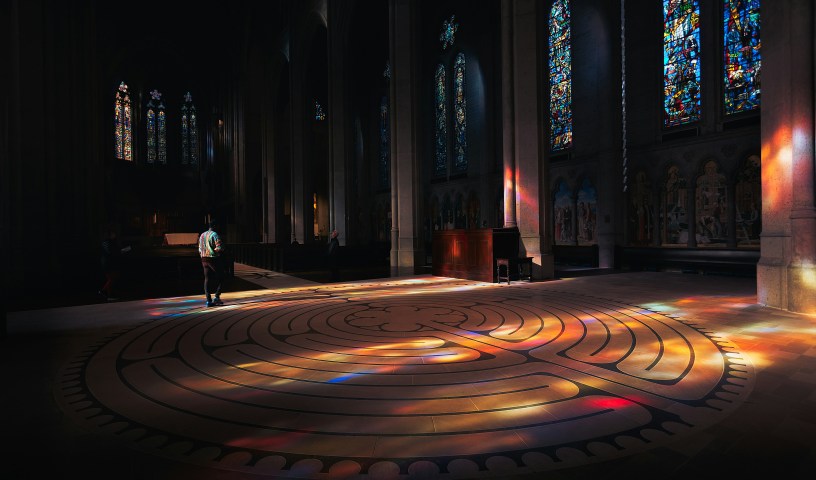
Photo by Erez Attias on Unsplash

